If the length of a clock pendulum increases by $0.2 \%$ due to atmospheric temperature rise, then the loss in time of clock per day is ........... $s$
Medium
Download our app for free and get started
(a)
Time period $=2 \pi \sqrt{\frac{1}{g}}$
$T \propto \sqrt{I}$
$\frac{T^{\prime}}{T} \propto \sqrt{\frac{I^{\prime}}{I}}$
$T=T \sqrt{\frac{1+l \propto \Delta \theta}{I}}$
$T=T\left(1+\frac{1}{2} \propto \Delta \theta\right)[\alpha \Delta \theta=0.002]$
$\Delta T=T-T=\frac{1}{2} T \propto \Delta \theta=T \times 0.001$
Time lost in time $t$ is
$\Delta T=\frac{1}{2} \quad t=1 \text { day }=24 \times 3600 \,s =86400 \,s$
$\Delta T=\left(\frac{\Delta T}{T}\right) \times t$
$\Delta T=0.001 \times 86400$
$\Delta T=86.4 \,s$

Download our appand get started for free
Experience the future of education. Simply download our apps or reach out to us for more information. Let's shape the future of learning together!No signup needed.*
Similar Questions
- 1If $x = a\sin \left( {\omega t + \frac{\pi }{6}} \right)$ and $x' = a\cos \omega t$, then what is the phase difference between the two wavesView Solution
- 2The composition of two simple harmonic motions of equal periods at right angle to each other and with a phase difference of $\pi $ results in the displacement of the particle alongView Solution
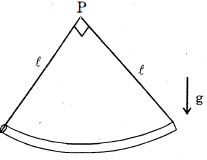
- 3A circular arc of mass $m$ is connected with the help of two massless strings as shown in the figuw in vertical plane. About point $P$, small oscillations are given in the plane of the arc. Time period of the oscillations of $SHM$ will beView Solution
- 4View SolutionWhich of the following statements is not true ? In the case of a simple pendulum for small amplitudes the period of oscillation is
- 5Four simple harmonic vibrations:View Solution
${y_1} = 8\,\cos\, \omega t;\,{y_2} = 4\,\cos \,\left( {\omega t + \frac{\pi }{2}} \right)$ ;
${y_3} = 2\cos \,\left( {\omega t + \pi } \right);\,{y_4} = \,\cos \,\left( {\omega t + \frac{{3\pi }}{2}} \right)$ ,
are superposed on each other. The resulting amplitude and phase are respectively;
- 6A particle executes $SHM$ of amplitude $25\, cm$ and time period $3\, s$. What is the minimum time required for the particle to move between two points $12.5\, cm$ on either side of the mean position ..... $\sec$View Solution
- 7View SolutionFor a particle executing simple harmonic motion, which of the following statements is not correct
- 8One-forth length of a spring of force constant $K$ is cut away. The force constant of the remaining spring will beView Solution
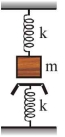
- 9A mass $m$ is suspended from a spring of force constant $k$ and just touches another identical spring fixed to the floor as shown in the figure. The time period of small oscillations isView Solution
- 10Which one of the following equations of motion represents simple harmonic motion ?View Solution
Where $k,k_0,k_1$ and $a$ are all positive