Question
(i) (a) What is a machine?
(b) In reference to machine define effort and actual mechanical advantage.
(ii) Prove that efficiency of a machine is the ratio between mechanical advantage and the velocity ratio,
(iii) A machine displaces a load of 125 kgf through a distance 0.30 m, when an effort of 12.5 kgf acts through a distance of 4.0 m.
Calculate the (a) velocity ratio (b) mechanical advantage (c) % age efficiency of the machine
Answer

(i) (a) Machine is a device by which we can overcome large resistance or gain speed or change the direction of effort applied, by applying comparatively a small force at a convenient point, and in a desired direction.
(b) Effort: Effort is the external force applied on a machine to overcome the load or resistance.
Actual mechanical advantage: Actual mechanical advantage is the ratio between the useful load moved to the effort applied.
(ii) Consider a machine which displaces a useful load ' $l$ ' through a distance ' $d$ ', when an effort ' B ' causes a displacement through distance D.
$\begin{aligned} \therefore \text { Output } & =\text { Work done in displacing the load }=l \times d \\ \text { Input } & =\text { Work done by the effort in causing the displacement }= E \times D \end{aligned}$
$\therefore$ Efficiency $=\eta=\frac{\text { Output }}{\text { Input }}=\frac{l \times d}{ E \times D }=\frac{l}{ E }\div \frac{D}{d}= MA \div VR$
$\therefore \eta=\frac{M A}{V R}$
$\therefore$ Efficiency of a machine is the ratio of mechanical advantage to the velocity ratio.
(iii) (a) Velocity ratio $=\frac{\text { Distance through which effort moves }}{\text { Distance through which the load moves }}=\frac{4.0 m}{0.3 m}=\frac{40}{3}=13.33$
(b) Mechanical advantage $=\frac{\text { Load }}{\text { Effort }}=\frac{125 kgf }{12.5 kgf }=10$
(c) $\%$ efficiency $=\frac{ MA }{ VR } \times 100=\frac{10}{\frac{40}{3}} \times 100=\frac{10 \times 100 \times 3}{40}=75 \%$

Need a full question paper?

Generate a complete, print-ready paper with questions like this in minutes — across 16+ boards, with answer keys.

Start Generating Free

Similar questions

An electric bulb is rated 250 W, 230 V.

(i) the energy consumed in one hour, and

(ii) the time in which the bulb will consume 1.0 kWh energy when connected to 230 V mains.

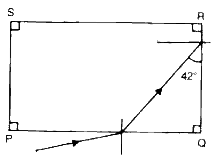
(a) A ray of monochromatic light enters glass $PQRS$ as shown in the fig. Complete the path of ray till it emerges from the glass. (Critical angle of glass is $42^0).$

(b) Draw diagram of a prism periscope.
(c) What are the advantages of total internal reflecting prism over plane mirror?
You have three resistors of values 2Ω, 3Ω and 5Ω. How will you join them so that the total resistance is less than 1Ω? Draw diagram and find the total resistance.
A body ' $A$ ' of mass $m_1$ of a substance of a specific heat capacity $c_1$ at a temperature $\theta_1$ is mixed with a body ' $B$ ' of mass $m_2$ of other substance of specific heat capacity $c_2$ at a lower temperature $\theta_2$. Deduce the expression for the temperature of the mixture. State the assumption made, if any.
Define the e.m.f. (E) of a cell and the potential difference (V) of a resistor R in terms of the work done in moving a unit charge. State the relation between these two works and the work done in moving a unit charge through a cell connected across the resistor. Take the internal resistance of the cell as ‘r’. Hence obtain an expression for the current i in the circuit.
A uniform metre scale is balanced at a 40 cm mark when weights of 20 gf and 5 gf are suspended at 5 cm mark and 75 cm mark respectively. Calculate the weight of metre scale.
A radar sends a signal to an aircraft at a distance of $30 \ km$ away and receives it back after $2 x 10^{-4}$​​​​​​​ seconds. What is the speed of the signal?
How many alpha and beta particles are emitted when Uranium nucleus $9 U ^{238}$ decays to Lead If ${ }_{82} Pb^{206}$ ?
Describe one experiment to demonstrate the phenomenon of electromagnetic induction.

In the figure:

What do you mean by the term local earthing? Explain how it is done.