Question
What do you mean by the term local earthing? Explain how it is done.

Answer

Local earthing is made near kWh meter. In this process a 2 - 3 metre deep hole is dug in the ground. A copper rod placed inside a hollow insulating pipe, is put in the hole. A thick copper plate of dimensions 50 cm × 50 cm is welded to the lower end of the copper rod and it is buried in the ground. The plate is surrounded by a mixture of charcoal and salt to make a good earth connection.
To keep the ground damp, water is poured through the pipe from time to time. This forms a conducting layer between the plate and the ground. The upper end of the copper rod is joined to the earth connection at the kWh meter.

Need a full question paper?

Generate a complete, print-ready paper with questions like this in minutes — across 16+ boards, with answer keys.
Start Generating Free

Similar questions

 (i) A $200 g$ ball is thrown vertically upward with an initial velocity of $30 ms^{-1}$. Draw a velocity-time graph for the motion of ball.
(ii) How long will the ball take to reach the highest point?
(iii) What will be the kinetic energy of ball, when it returns to the starting point, neglecting the air resistance?
(iv) What will be the potential energy of ball at highest point?
A certain nucleus X has a mass number 15 and atomic number 7. Find the number of neutrons. The nucleus X losses one α-particle and Express the change and write the symbol of the new nucleus.
Radioactive substances were found to give off three types of rays. Name them. How do they
(a) React to the magnetic field?
(b) React to the electric field?
(c) Act when different thickness of lead sheets is placed in their path?
(i) (a) Define volt.
(b) A wire of uniform thickness with a resistance of $27 \Omega$ is cut into three equal pieces and they are joined in parallel. Find the resistance of the parallel combination.
(ii) (a) What do you understand by the term internal resistance of cell?
(b) Which of the two cables, one of 10 A and other of 20 A will be thicker? Give one reason for your answer.
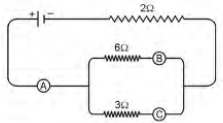
(iii) In the given figure, $A , B$ and C are three ammeters. The ammeter B reads 0.5 A (All the ammeters have negligible resistance.)
ImageCalculate:
(a) the readings in the ammeters A and C .
(b) the total resistance of the circuit.
A body ' $A$ ' of mass $m_1$ of a substance of a specific heat capacity $c_1$ at a temperature $\theta_1$ is mixed with a body ' $B$ ' of mass $m_2$ of other substance of specific heat capacity $c_2$ at a lower temperature $\theta_2$. Deduce the expression for the temperature of the mixture. State the assumption made, if any.
(i) (a) What is a machine?
(b) In reference to machine define effort and actual mechanical advantage.
(ii) Prove that efficiency of a machine is the ratio between mechanical advantage and the velocity ratio,
(iii) A machine displaces a load of 125 kgf through a distance 0.30 m, when an effort of 12.5 kgf acts through a distance of 4.0 m.
Calculate the (a) velocity ratio (b) mechanical advantage (c) % age efficiency of the machine
(i) An electric bulb is rated $240 V-60 W$ and is working at $100 \%$ efficiency.
(a) Calculate the resistance of the bulb.
(b) If an identical bulb is connected in series with this bulb, then :
(i) Draw the circuit diagram.
(ii) What is the rate of conversion of energy in each bulb?
(iii) Total power used by the bulbs.
(ii) A family uses 2 light bulbs of 60 W , a fan of 120 W and a heater of 750 W an average of 8 hours a day. If the cost of electricity is ₹ 3.50 per unit, what is the daily expenditure of the family in a day?
(iii) A bulb is marked $150 W-220 V$ and an electric heater is marked $1500 W-220 V$.
(a) What is the ratio of resistance of these two devices?
(b) How does power rating of a device help you to select the type of connecting wire to be used?
(c) Which of the above devices needs thicker connecting wire?
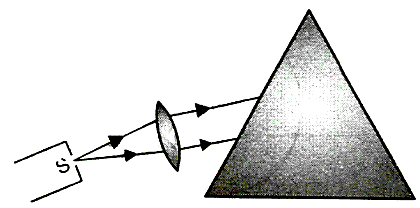
Fig shows part of the arrangement for obtaining pure spectrum.
(a) Complete thediagram and show how to obtain a pure spectrum.
(b) What are the conditions necessary for obtaining a pure spectrum?
When a sound is made from a distance of $18 m$, in front of a tall building, it is found to get repeated again. Which phenomenon is associated with this observation? Give a brief explanation of this phenomenon?
State the changes in the position, size and nature of the image of an object when brought from infinity up to a convex lens. Illustrate your answer by drawing ray diagrams.