Question
$i. A$ Why does the electric field inside a dielectric slab decrease when kept in an external electric field?
$B$. Derive an expression for the capacitance of a parallel plate capacitor filled with a medium of dielectric constant K.
$ii$. A charge $q =2 \mu C$ is placed at the centre of a sphere of radius $20 \ cm$ . What is the amount of work done in moving $4 \mu C$ from one point to another point on its surface?
$iii.$ Write a relation for polarisation $\overrightarrow{ P }$ of a dielectric material in the presence of an external electric field.
Answer

$i. A. A$ dielectric material gets polarized when it is placed in an external electric field.
The field produced due to the polarization of material reduces the effect of external electric field.
Hence, the electric field inside a dielectric decreases.
$B$. Electric field in vacuum between the plates $= E 0=\frac{\sigma}{\varepsilon_0}$
Electric field in dielectric between the plates, $E =\frac{E_0}{K}$
Potential difference between the capacitor plates
$V=E t+E_0(d-t)$
where $'t\ '$ is the thickness of dielectric slab.
$ V =\frac{E_0}{K} t + E _0(d- t )$
$V =\frac{\sigma}{\varepsilon_o}\left[\frac{t}{K}+( d - t )\right]$
$V =\frac{\sigma}{\varepsilon_o}\left[\frac{t+K(d-t)}{K}\right]$
$\text { As } C =\frac{Q}{V}$
$\Rightarrow C =\frac{\varepsilon_0 A K}{t+K(d-t)}$
$ii.$ The surface of the sphere is equipotential.
So, the work done in moving the charge from one point to the other is zero.
$ W = q \Delta V (\because \Delta V =0)$
$=0$
$iii. P =\chi E$

Need a full question paper?

Generate a complete, print-ready paper with questions like this in minutes — across 16+ boards, with answer keys.

Start Generating Free

Similar questions

Explain the shortcomings of Rutherford's Atomic Model.###Write two shortcomings of Rutherford's Atomic Model.
With the help of a circuit, show how a moving coil galvanometer can be converted into an ammeter of a given range. Write the necessary mathematical formula.
Answer the following questions:
(a) Are the equations of nuclear reactions (such as those given in Section 13.7) 'balanced' in the sense a chemical equation (e.g., $2 H _2+ O _2 \rightarrow 2 H _2 O$ ) is? If not, in what sense are they balanced on both sides?
(b) If both the number of protons and the number of neutrons are conserved in each nuclear reaction, in what way is mass converted into energy (or vice-versa) in a nuclear reaction?
(c) A general impression exists that mass-energy interconversion takes place only in nuclear reaction and never in chemical reaction. This is strictly speaking, incorrect. Explain.
A car travelling at $60\ km/h$ overtakes another car travelling at $42\ km/h$. Assuming each car to be $5.0m$ long, find the time taken during the overtake and the total road distance used for the overtake.
An object is placed at a distance of 30cm from a converging lens of focal length 15cm. A normal eye (near point 25cm, far point infinity) is placed close to the lens on the other side.
  1.  Can the eye see the object clearly?
  2.  What should be the minimum separation between the lens and the eye so that the eye can clearly see the object?
  3.  Can a diverging lens, placed in contact with the converging lens, help in seeing the object clearly when the eye is close to the lens?
Consider a straight piece of length x of a wire carrying a current i. Let P be a point on the perpendicular bisector of the piece, situated at a distance d from its middle point. Show that for d >> x, the magnetic field at P varies as $\frac{1}{\text{d}^2}$ whereas ford d << x, it varies as $\frac{1}{\text{d}}.$
  1. Obtain lens makers formula using the expression
  1. $\frac{\text{n}_{2}}{\text{v}} - \frac{\text{n}_{1}}{\text{u}} = \frac{(\text{n}_{2} - \text{n}_{1})}{\text{R}}$
    Here the ray of light propagating from a rare medium of refractive index $(n_1)$ to a denser medium of refractive index $(n_2)$ is incident on the convex side of spherical refracting surface of radius of curvature $R.$
  2. Draw a ray diagram to show the image formation by a concave mirror when the object is kept between its focus and the pole. Using this diagram, derive the magnification formula for the image formed.
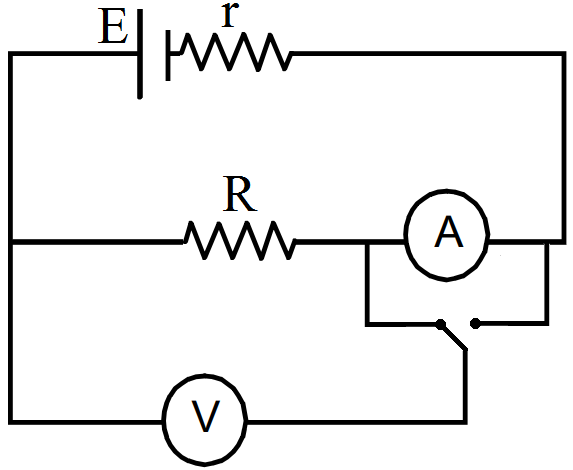
The emf $\epsilon$ and the internal resistance r of the battery, shown in the figure. are 4.3V and $1.0\Omega$ respectively. The external resistance R is $50\Omega.$ The resistances of the ammeter and voltmeter are $2.0\Omega$ and $200\Omega$ respectively. (a) Find the readings of the two $200\Omega$ respectively. (a) Find the readings of the two meters. (b) The switch is thrown to the other side. What will be the readings of the two meters now?
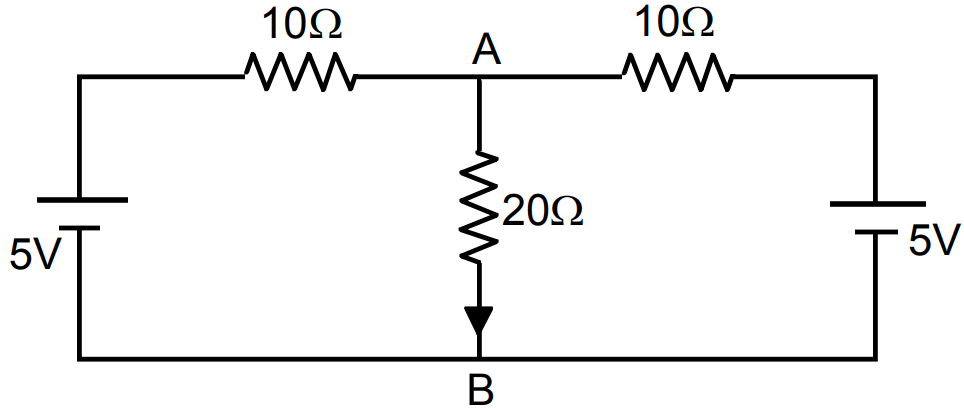
(a) Find the current in the $20\Omega$ resistor shown in the figure. (b) If a capacitor of capacitance $4\mu\text{F}$ is joined between the points A and B, what would be the electrostatic energy stored in it in steady state?
A capacitor of capacitance C is given a charge Q. At t = 0, it is connected to an uncharged capacitor of equal capacitance through a resistance R. Find the charge on the second capacitor as a function of time.