Question
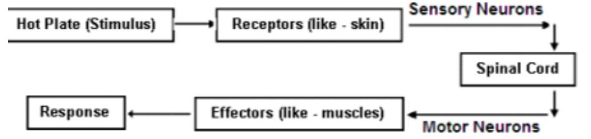
i. Define a reflex arc. Why have reflex arcs evolved in animals? Trace the sequence of events which occur, when you suddenly touch a hot object.
ii. Name the part of nervous system which helps in communication between the central nervous system and other parts of the body. What are the two components of this system?
Answer

i. The pathway in which impulses travel during the reflex action is called a reflex arc. Because the thinking part of the brain is not fast enough/for quick response to avoid injury. Reflex arc:
Image
ii. Peripheral Nervous System
Components: Cranial Nerves; Spinal Nerves

Need a full question paper?

Generate a complete, print-ready paper with questions like this in minutes — across 16+ boards, with answer keys.

Start Generating Free

Similar questions

In a house two 60W electric bulbs are lighted for 4 hours, and three 100W bulbs for 5 hours everyday. Calculate the electric energy consumed in 30 days.
  1. Name an instrument that measures electric current in a circuit. Define the unit of electric current.
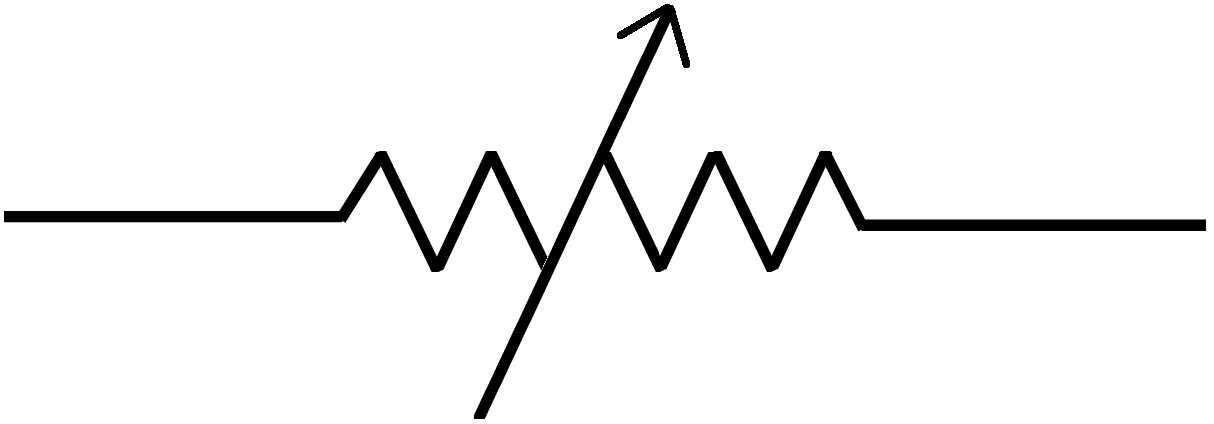
  2. What do the following symbols mean in circuit diagrams?
  1.  
  1.  
  1. An electric circuit consisting of a 0.5 m long nichrome wire XY, an ammeter, a voltmeter, four cells of 1.5 V each and a plug key was set up.
  1. Draw a diagram of this electric circuit to study the relation between the potential difference maintained between the points ‘X’ and ‘Y’ and the electric current flowing through XY.
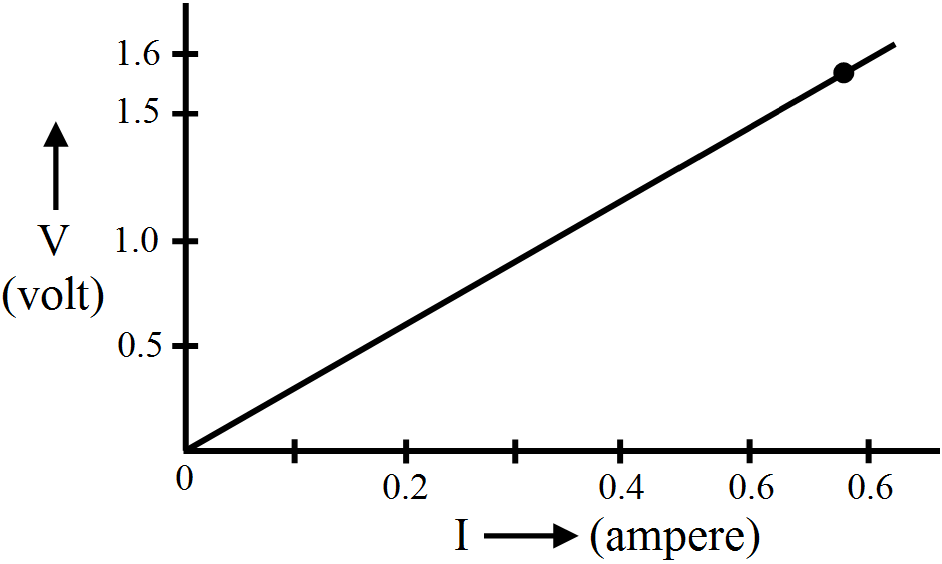
  2. Following graph was plotted between V and I values:

What would be the values $\frac{\text{V}}{\text{I}}$of ratios when the potential difference is 0.8 V, 1.2 V and 1.6 V respectively? What conclusion do you draw from these values?
Water and dissolved minerals get into the root hair of a plant by a process called A and enter the conducting tissue B. The process C helps the water and dissolved minerals to move up through the tissue B in roots and stem, and reach the leaves of a plant. In the leaves food is made by a process D. This food is then transported to all the parts of a plant through tissue E. The process of distributing food made in the leaves to all the parts of the plants is called F.
  1. What are (i) A, (ii) B, (iii) C, (iv) D, (v) E, and (vi) F?
  2. Which tissue is made up of living cells: B or E?
  3. Which tissue, B or E, contains sieve tubes?
  4. Which tissue, B or E, contains tracheids?
With the help of a labelled diagram, describe the working of a nuclear power plant.
  1. A student is unable to see clearly the words written on the black board placed at a distance of approximately 3m from him. Name the defect of vision the boy is suffering from. State the possible causes of this defect and explain the method of correcting it.
  2. Why do stars twinkle? Explain.
What are the merits of the modern periodic table of elements?
An electric heater which is connected to a 220V supply line has two resistance coils A and B of $24 Ω$ resistance each. These coils can be used separately (one at a time), in series or in parallel. Calculate the current drawn when:
  1. Only one coil A is used.
  2. Coils A and B are used in series.
  3. Coils A and B are used in parallel.
  1. Why does carbon form compounds mainly by covalent bonding?
  2. List any two reasons for carbon forming a very large number of compounds.
  3. An organic acid ‘X’ is a liquid which often freezes during winter time in cold countries, has the molecular formula, $C _2 H _4 O _2$ On warming it with ethanol in the presence of a few drops of concentrated sulphuric acid, a compound ‘Y’ with a sweet smell is formed.
  1. Identify ‘X’ and ‘Y’.
  2. Write a chemical equation for the reaction involved.
Define the term dispersion of white light. Name the colour of light which bends (i) the most, (ii) the least, while passing through a glass prism Draw a ray diagram to Justify your answer.
The following diagram shows a part of the periodic table in which the elements are arranged according to their atomic numbers.
(The letters given here are not the chemical symbols of the elements):
a
3
b
4
 
c
5
d
6
e
7
f
8
g
9
h
10
i
11
j
12
 
k
13
l
14
m
15
n
16
o
17
p
18
  1. Which element has a bigger atom, a or f?
  2. Which element has a higher valency, k or o?
  3. Which element is more metallic, i or k?
  4. Which element is more non-metallic, d or g?
  5. Select a letter which represents a metal of valency 2.
  6. Select a letter which represents a non-metal of valency 2.