Question
i. Explain by giving one example each:
a. Unisexual flowers
b. Bisexual flowers
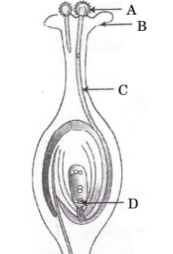
ii. Name the labelled parts A, B, C and D in the diagram given below.
Image
iii. Pollination may occur without fertilisation but fertilisation will not take place without pollination. Give reason to justify this statement.
Answer

i. Unisexual flowers have either stamens or carpels but not both.
Fg - Papaya and watermelon
Bisexual flowers have both stamens and carpels. Here are some examples of each: eg - Hibiscus and mustard
ii. A - Pollen grain
B - Stigma
C - Pollen tube
D - Female germ cell
iii. Pollination may occur without fertilization but fertilization will not take place without pollination because pollination does not depend on fertilization but fertilization cannot take place without pollination because for fertilization to occur, it requires both male and female gametes.

Need a full question paper?

Generate a complete, print-ready paper with questions like this in minutes — across 16+ boards, with answer keys.

Start Generating Free

Similar questions

Name the reaction which is commonly used in the conversion of vegetable oils to fats. Explain the reaction involved in detail.
Give one example each of a chemical reaction characterised by:
  1. Evolution of a gas.
  2. Change in colour.
  3. Formation of a precipitate.
  4. Change in temperature.
  5. Change in state.
Why is variation during reproduction beneficial to the species but not necessarily for the individual?
When we touch a hot plate unknowingly, then this heat is sensed by a receptor P present in our fingers. The receptor triggers and impulse in neuron Q which transmits the message to an organ R which is a part of the central nervous system. Here the impulse is passed on to a neuron S which in turn passes it to a yet another neuron T. The neuron T passes the impulse to a tissue U in our arm. The tissue U then contracts and pulls our hand away from the hot plate.
  1. What is the name of (i) receptor P (ii) neuron Q, and (iii) organ R?
  2. What is (i) neuron S, and (ii) neuron T?
  3. Name the tissue U.
  4. What name is given to the phenomenon in which hand is pulled away quickly from the hot plate?
  5. Name the effector in this whole process.
What is long-sightedness? State the two causes of long-sightedness (or hypermetropia). With the help of ray diagrams, show:
  1. The eye-defect long-sightedness.
  2. Correction of long-sightedness by using a lens.
Image
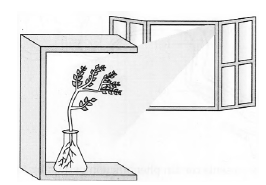
Observe the above figure carefully and answer the following:
i. Which phenomenon does the figure represent?
ii. Which plant hormone is involved?
iii. How this plant hormone brings this movement?
In what ways damages are caused to the environment?
Give a detailed explanation on the following.Properties of acetic acid.
If the teeth are not cleaned regularly, they become covered with a sticky yellowish layer W of food particles and bacteria. Since layer W covers the teeth, the alkaline liquid X secreted by glands Y inside the mouth cannot reach the teeth surface to neutralise the acid formed by the action of organisms Z on sugary food, and hence tooth decay sets in.
  1. What is W known as?
  2. What is (i) X, and (ii) Y?
  3. What are organisms Z?
  4. State one way of removing layer W from the teeth.
  1. A $6 \Omega$ resistance wire is doubled on itself. Calculate the new resistance of the wire.
  2. Three $2 \Omega$ resistors A, B and C are connected in such a way that the total resistance of the combination is $3\Omega.$ Show the arrangement of the three resistors and justify your answer.