Question types

MODEL PAPER - 5 [2026] question types

46 questions across 17 question groups — pick any mix to generate a Science paper with step-by-step answer keys.

46
Questions
17
Question groups
5
Question types
Sample Questions

MODEL PAPER - 5 [2026] questions

One sample from each question group in this chapter. Select any group above to see the full set with answer keys.

Q 1M.C.Q1 Mark
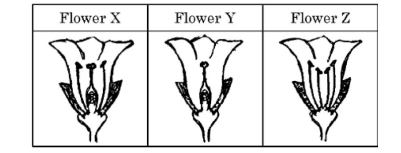
Consider the following three flowers namely $\mathrm{X}, \mathrm{Y}$ and Z . Which flower(s) would develop into a fruit?
Image
  • X and Y only
  • B
    X only
  • C
    $Y$ and $Z$
  • D
    Z only

Answer: A.

View full solution
Q 2M.C.Q1 Mark
In an ecosystem, the $10 \%$ of energy available for transfer from one trophic level to the next trophic level is in the form of:
  • Chemical energy
  • B
    Heat energy
  • C
    Mechanical energy
  • D
    Light energy

Answer: A.

View full solution
Q 3M.C.Q1 Mark
In the excretory system of human beings, some substances in the initial filtrate such as glucose, amino acids, salts and water are selectively reabsorbed in
  • Nephron
  • B
    Ureter
  • C
    Urethra
  • D
    Urinary bladder

Answer: A.

View full solution
Q 4M.C.Q1 Mark
How much of the net primary productivity of a terrestrial ecosystem is eaten and digested by herbivores?
  • A
    $0.1 \%$
  • B
    $100 \%$
  • $10 \%$
  • D
    $1 \%$

Answer: C.

View full solution
Q 5M.C.Q1 Mark
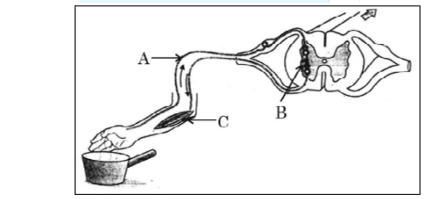
In a nerve cell, the site where the electrical impulse is converted into a chemical signal is known as:
  • Neuromuscular junction
  • B
    Dendrites
  • C
    Axon
  • D
    Cell body

Answer: A.

View full solution
Which of the given statement is correct or wrong:
Statement A: Ethane decolorizes bromine water whereas ethyne does not.
Statement B: Mixture of water and alcohol is used in radiators of vehicles in cold countries.
  • A
    Both - Statement A and Statement B - are
  • B
    Statement A is true; Statement B is false. false.
  • Statement B is true; Statement A is false.
  • D
    Both - Statement A and Statement B - are true.

Answer: C.

View full solution
Which one of the following elements symbolized as A and B is a metal: ${ }_{11}^{23} A,{ }_{20}^{40} B$ ?
  • A
    B is metal
  • B
    Neither A nor B is a metal
  • C
    A is metal
  • Both A and B are metals

Answer: D.

View full solution
Juice of tamarind turns blue litmus to red. It is because of the presence of an acid called:
  • A
    methanoic acid
  • B
    oxalic acid
  • tartaric acid
  • D
    acetic acid

Answer: C.

View full solution
Carbon compounds:
i. are good conductors of electricity.
ii. are bad conductors of electricity.
iii. have strong forces of attraction between their molecules.
iv. have weak forces of attraction between their molecules.
The correct statements are:
  • A
    (i) and (ii)
  • B
    (ii) and (iii)
  • (ii) and (iv)
  • D
    (i) and (iii)

Answer: C.

View full solution
Q 10M.C.Q-[Che-1M]1 Mark
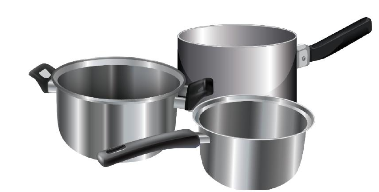
Aluminum is used for making cooking utensils. Which of the following properties of aluminum are responsible for the same?
Image
i. Good thermal conductivity
ii. Good electrical conductivity
iii. Ductility
iv. High melting point
  • A
    (i) and (ii)
  • B
    (ii) and (iii)
  • C
    (i) and (iii)
  • (i) and (iv)

Answer: D.

View full solution
Kulhads (disposable cups made of clay) and disposable paper cups both are used as an alternative for disposable plastic cups. Which one of these two can be considered as a better alternative to plastic cups and why?
View full solution
a. What is meant by garbage? List two classes into which garbage is classified.
b. What do we actually mean when we say that the enzymes are specific in their action?
View full solution
a. What happens when in a human female the egg released by the ovary is not fertilized?
b. Name one bacterial and one viral infection caused due to unsafe sex.
View full solution
When a piece of limestone reacts with dilute HCl , a gas X is produced. When gas X is passed through lime water then a white precipitate Y is formed. On passing excess of gas X , the white precipitate dissolves forming a soluble compound Z.
a. What are $\mathrm{X}, \mathrm{Y}$ and Z ?
b. Write equations for the reactions which take place :
i. When limestone reacts with dilute HCl .
ii. When gas X reacts with lime water to form white precipitate Y.
View full solution
The process of spore formation takes place in many simple multicellular organisms. Name the
i. organism using this process to reproduce, and
ii. reproductive and non-reproductive parts of such organisms. List two benefits to an organism that reproduces through spores.
View full solution
Mendel, in one of his experiments with pea plants, crossed a variety of pea plant having round seeds with one having wrinkled seeds. State Mendel's observations giving reasons of $F_{1}$ and $F_{2}$ progeny of this cross. Also, list any two contrasting characters, other than round seeds of pea plants that Mendel used in his experiments.
View full solution
i. Which types of metals can be obtained in their pure form by just heating their oxides in air? Give one example.
ii. Consider the reaction given below used to obtain Manganese metal in pure form:
$3 \mathrm{MnO}_{2}(\mathrm{~s})+4 \mathrm{Al}(\mathrm{s}) \longrightarrow 3 \mathrm{Mn}(\mathrm{l})+2 \mathrm{Al}_{2} \mathrm{O}_{3}(\mathrm{~s})+$ Heat
a. What type of reaction is it?
b. What is the role of aluminium in this reaction?
View full solution
Identify the type of reaction in the following
a. $\mathrm{ZnCO}_{3}+2 \mathrm{HCl}(\mathrm{aq}) \longrightarrow \mathrm{ZnCl}_{2}(\mathrm{aq})+\mathrm{H}_{2} \mathrm{CO}_{3}(\mathrm{aq})$
b. $2 \mathrm{NaBr}(\mathrm{aq})+\mathrm{Cl}_{2}(\mathrm{~g}) \longrightarrow 2 \mathrm{NaCl}(\mathrm{aq})+\mathrm{Br}_{2}(\mathrm{aq})$
c. $2 \mathrm{CuO}(\mathrm{s}) \xrightarrow{\text { heat }} 2 \mathrm{Cu}(\mathrm{s})+\mathrm{O}_{2}(\mathrm{~g})$
View full solution
What is a displacement reaction? Write balanced chemical equation for a displacement reaction in which iron is a reactant. Name one more element whose behaviour is similar to that of iron in such reactions. Why will this kind of behaviour not be shown by gold?
View full solution
i. Distinguish between hormonal co-ordination in plants and animals.
ii. Which part of the brain is responsible for -
1. intelligence
2. riding a bicycle
3. vomiting
4. controlling hunger
iii. How is brain and spinal-cord protected against mechanical injuries?
View full solution
i. Explain by giving one example each:
a. Unisexual flowers
b. Bisexual flowers
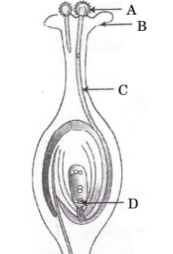
ii. Name the labelled parts A, B, C and D in the diagram given below.
Image
iii. Pollination may occur without fertilisation but fertilisation will not take place without pollination. Give reason to justify this statement.
View full solution
A series of organic compounds having the same functional group, with similar or almost identical chemical characteristics in which all the members can be represented by the same general formula and the two consecutive members of the series differ by $-\mathrm{CH}_{2}$, group or 14 mass unit in their molecular formulae is called a homologous series. For example, all the members of the alcohol family can be represented by the general formula, $\mathrm{C}_{n} \mathrm{H}_{2 n+1} \mathrm{OH}$ where, $n$ may have the values $1,2,3, \ldots$ etc. The various members of a particular homologous series are called homologues. The physical properties such as density, melting point, boiling point, solubility, etc. of the members of a homologous series show almost regular variation in ascending or descending the series.
i. Write two characteristics of homologous series.
ii. What are the fourth and fifth members of the alcohol homologous series? Write their name with the formula.
iii. Draw structure of Butanol.
OR
What is heteroatom?
View full solution
Image
i. Which of the compounds $\mathrm{P}, \mathrm{Q}, \mathrm{R}, \mathrm{S}, \mathrm{T}, \mathrm{U}$ belong to same homologous series?
ii. Write the name of compound R. Also write the functional group present in it.
iii. What is the IUPAC name of compound T and U
OR
What are unsaturated hydrocarbons? Which of the compounds $\mathrm{P}, \mathrm{Q}, \mathrm{R}, \mathrm{S}, \mathrm{T}, \mathrm{U}$ are example of unsaturated hydrocarbons?
View full solution
In each of the following situations what happens to the rate of photosynthesis?
i. Cloudy days
ii. No rainfall in the area
iii. Good manuring in the area
iv. Stomata get blocked due to dust
View full solution
i. Five solutions $\mathrm{A}, \mathrm{B}, \mathrm{C}, \mathrm{D}$ and E when tested with pH paper showed pH as $4,1,13,7$ and 10 respectively. Which solution is:
(1) Strongly acidic
(2) Strongly alkaline
(3) Weakly acidic
(4) Neutral and
(5) Weakly alkaline? Arrange the solutions in increasing order of $\mathrm{H}^{+}$ion concentration.
ii. Write the name and formula of (1) an acidic salt and (2) a basic salt giving the name of the parent acid and parent base used to form the salt in each case.
View full solution
Q 29M.C.Q-[Phy-1M]1 Mark
Which of the following statement is incorrect?
A. A ray of light passing from an optically rarer medium to an optically denser medium bends away from the normal.
B. A ray of light passing from an optically denser medium to an optically rarer medium bends away from the normal.
C. A ray of light passing from an optically rarer medium to an optically denser medium bends toward the normal.
D. A ray light passing from an optically denser medium to an optically rarer medium bends towards the normal.
  • A
    A, B and D
  • B
    B and C
  • C
    A and C
  • D
    A and D
View full solution
Q 30M.C.Q-[Phy-1M]1 Mark
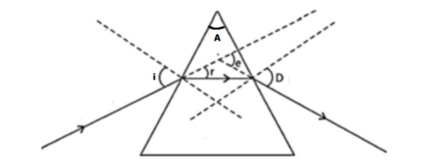
Study the following figure in which a student has marked the angle of incidence ( $\angle \mathrm{i}$ ), angle of refraction ( $\angle \mathrm{r}$ ), angle of emergence ( $\angle \mathrm{e}$ ), angle of prism ( $\angle \mathrm{A}$ ) and the angle of deviation ( $\angle \mathrm{D}$ ). The correctly marked angles are :
Image
  • A
    $\angle \mathrm{A}, \angle \mathrm{i}$ and $\angle \mathrm{D}$
  • B
    $\angle \mathrm{A}, \angle \mathrm{i}$ and $\angle \mathrm{r}$
  • C
    $\angle \mathrm{A}, \angle \mathrm{i}, \angle \mathrm{r}$ and $\angle \mathrm{D}$
  • $\angle \mathrm{A}$ and $\angle \mathrm{i}$

Answer: D.

View full solution
Assertion (A): Force experienced by moving charge will be maximum if direction of velocity of charge is perpendicular to applied magnetic field.
Reason (R): Force on moving charge is independent of direction of the applied magnetic field.
View full solution
a. Draw the pattern of magnetic field lines produced by a current carrying circular loop showing the direction of current in the loop and the direction of the magnetic field lines.
b. State the rule which can be applied to know the direction of magnetic field lines in the above case.
View full solution
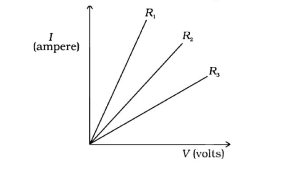
In 1827, a German physicist Georg Simon Ohm (1787-1854) found out the relationship between the current I, flowing in metallic wire and the potential difference across its terminals. He stated that the electric current flowing through a metallic wire is directly proportional to the potential difference V, across its ends provided its temperature remains the same.
The resistance of a circuit is defined as the ratio between the voltage applied to the current flowing through it. Rearranging the above relation,
$R=\frac{V}{I}$
Electric charge flows easily through some materials than others. The electrical resistance measures how much the flow of this electric charge is restricted within the circuit.
Image
i. What is the unit of electrical resistance?
ii. Define Ohm's law.
iii. From graph which resistance have high resistance?
OR
What does the slope of V-I graph at any point represent?
View full solution
i. A person suffering from myopia (near-sightedness) was advised to wear the corrective lens of power -2.5 D . A spherical lens of the same focal length was taken in the laboratory. At what distance should a student place an object from this lens so that it forms an image at a distance of 10 cm from the lens?
ii. Draw a ray diagram to show the position and nature of the image formed in the above case.
View full solution
An object 6 cm in size is placed at 50 cm in front of a convex lens of focal length 30 cm . At what distance from the lens should a screen be placed in order to obtain a sharp image of the object? Find the nature and size of the image. Also draw labelled ray diagram to show the image formation in this case.
View full solution

Generate a MODEL PAPER - 5 [2026] paper free

Pick question groups from the list above, set marks and difficulty, and export a branded PDF with step-by-step answer keys. First 3 chapters free — no signup.

Download App