Question
i. One dozen means how many items? ii. One gross means how many items?

Answer

i. One dozen means 12 items. ii. One gross means 144 items.

Need a full question paper?

Generate a complete, print-ready paper with questions like this in minutes — across 16+ boards, with answer keys.
Start Generating Free

Similar questions

A sample of old wood shows $7.0 dps / g$. If the fresh sample of tree shows $16.0 dps / g$, How old is the given sample of wood? Half life of ${ }^{14} C 5730 y$.
Chalcopyrite $(CuFeS_2)$ is a common ore of copper. Since it has low concentration of copper, the ore is first concentrated through froth floatation process. The concentrated ore is then heated strongly with silicon dioxide $($silica$)$ and oxygen in a furnace. The product obtained, copper$(I)$ sulphide, is further converted to copper $(99.5\%$ pure$)$ with a final blast of air $(O_2)$ during which sulphur dioxide is released as a by$-$product.
$i.$ Write a balanced reaction for the extraction of copper from copper$(I)$ sulphide.
$ii.$ Which species undergoes an increase in the oxidation state?
$iii.$ Which species accepts electrons?
An 8.0 L of sample at 0 °C and 5.6 atm of pressure contains 2.0 moles of a gas. If more 1.0 mole of gas at the same temperature and pressure is added, calculate the final volume.
Write a note on occurrence of hydrogen.
Ammonia is a good complexing agent. Explain.
Explain with examples: Disinfectant
Find the temperature in $^\circ C$ at which volume and pressure of $1 mol$ of nitrogen gas becomes $10 \ dm \ 3$ and $2.46$ atmosphere respectively.
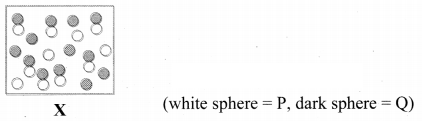
Consider the reaction $P_{(g)} + Q_{(g)} ⇌ PQ_{(g)}.$ Diagram $‘X \ ’$ represents the reaction at equilibrium.Image
$i.$ If each molecule $($sphere$)$ represents a partial pressure of $1 \ atm,$ calculate the value of $K_P.$
$ii.$ Predict the change in equilibrium, when the volume is increased by $50$ percentage.
Parameters of blue and red light are 400 nm and 750 nm respectively. Which of the two is of higher energy?
Naina was preparing a compound in the laboratory. She added compound $‘A \ ’$ to $(CaOH)_2$ solution. As a result of this, a compound $‘B \ ’$ was obtained which had a pungent smell. On adding Nessler’s reagent to the compound $‘B \ ’,$ a brown precipitate of compound $‘C \ ’$ was obtained.
Write the chemical reactions involved and identify $‘A \ ’, ‘B \ ’$ and $‘C \ ’.$