Questions

Answer the following in brief.

Take a timed test

17 questions · self-marked practice — reveal the answer and mark yourself.

Question 13 Marks
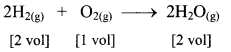
If 10 volumes of dihydrogen gas react with 5 volumes of dioxygen gas, how many volumes of water vapour would be produced?
Answer
Image

If 10 volumes of dihydrogen gas react with 5 volumes of dioxygen gas, then 10 volumes of water vapour would be produced.

View full question & answer
Question 23 Marks
Classify the following as element and compound.
i. Mercuric oxide
ii. Helium gas
iii. Water
iv. Table salt
v. Iodine
vi. Mercury
vii. Oxygen
viii. Nitrogen
Answer
No.MaterialElement or compound
i.Mercuric oxideCompound
ii.Helium gasElement
iii.WaterCompound
iv.Table saltCompound
V.lodineElement
vi.MercuryElement
vii.OxygenElement
viii.NitrogenElement
View full question & answer
Question 33 Marks
Which are mixtures and pure substances from the following?
i. Sea water
ii. Gasoline
iii. Skin
iv. A rusty nail
v. A page of textbook
vi. Diamond
Answer
No.MaterialPure substance or mixture
i.SeawaterMixture
ii.GasolineMixture
iii.SkinMixture
iv.A rusty nailMixture
V.A page of textbookMixture
vi.DiamondPure substance
View full question & answer
Question 43 Marks
i. One dozen means how many items? ii. One gross means how many items?
Answer
i. One dozen means 12 items. ii. One gross means 144 items.
View full question & answer
Question 53 Marks
State the law of multiple proportions.
Answer
The law states that, “When two elements A and B form more than one compounds, the masses of element B that combine with a given mass of A are always in the ratio of small whole numbers”.
View full question & answer
Question 63 Marks
What is meant by molar volume of a gas ?
Answer
The volume occupied by one mole of a gas at standard temperature $\left(0^{\circ} C \right)$ and pressure $(1 atm)( STP )$ is called as molar volume of a gas. The molar volume of a gas at STP is $22.4 dm ^3$.
View full question & answer
Question 73 Marks
What is the SI unit of amount of a substance ?
Answer
The SI unit for the amount of a substance is mole (mol).
View full question & answer
Question 83 Marks
How many particles are present in $1$ mole of a substance ?
Answer
The number of particles in one mole is $6.0221367 \times 10^{23}$.
View full question & answer
Question 93 Marks
How many grams does an atom of hydrogen weigh ?
Answer
The mass of a hydrogen atom is $1.6736 \times 10^{-24} g.$
View full question & answer
Question 103 Marks
Point out the difference between 12 g of carbon and 12 u of carbon.
Answer
12 g of carbon is the molar mass of carbon while 12 u of carbon is the mass of one carbon atom.
View full question & answer
Question 113 Marks
Find the formula mass of
i. KCl
ii. AgCl
Atomic mass of K = 39 u, Ag =108 u and Cl = 35.5 u.
Answer
i. Formula mass of KCl
= Average atomic mass of K + Average atomic mass of Cl
= 39 u + 35.5 u = 74.5 u

ii. Formula mass of AgCl
= Average atomic mass of Ag + Average atomic mass of Cl
= 108 + 35.5 = 143.5 u
Ans:
i. Formula mass of KCl = 74.5 u
ii. Formula mass of AgCl = 143.5 u
View full question & answer
Question 123 Marks
Give reason: Dalton’s atomic theory explains the law of multiple proportion.
Answer
  • The law of multiple proportion states that, “When two elements A and B form more than one compounds, the masses of element B that combine with a given mass of A are always in the ratio of small whole numbers
  • According to Dalton’s atomic theory, compounds are formed when atoms of different elements combine in fixed ratio.
Hence, Dalton’s atomic theory explains the law of multiple proportion.
View full question & answer
Question 133 Marks
Give reason: Dalton’s atomic theory explains the law of conservation of mass.
Answer
  • The law of conservation of mass states that, “Mass can neither be created nor destroyed” during chemical combination of matter.
  • According to Dalton’s atomic theory, chemical reactions involve only the reorganization of atoms. Therefore, the total number of atoms in the reactants and products should be same and mass is conserved during a reaction.
Hence, Dalton’s atomic theory explains the law of conservation of mass.
View full question & answer
Question 143 Marks
Why are fractional units of the $SI$ units of length often used? Give two examples of the fractional units of length. How are they related to the $SI$ unit of length?
Answer
$i.$ Some properties such as the atomic radius, bond length, wavelength of electromagnetic radiation, etc. are very small and therefore, fractional units of the $SI$ unit of length are often used to express these properties.
$ii.$ Fractional units of length: Nanometre $(nm),$ picometre $(pm),$ etc.
$iii.$ Nanometre $(nm)$ and picometre $(pm)$ are related to the $SI$ unit of length $(m)$ as follows:
$1 nm = 10^{-9} m, 1 pm = 10^{-12}m$
View full question & answer
Question 153 Marks
Give reason: The mass of a body is more fundamental property than its weight.
Answer
  • Mass is an inherent property of matter and is the measure of the quantity of matter of a body.
  • The mass of a body does not vary with respect to its position.
  • On the other hand, the weight of a body is a result of the mass and gravitational attraction
  • Weight varies because the gravitational attraction of the earth for a body varies with the distance from the centre of the earth.
Hence, the mass of a body is more fundamental property than its weight.
View full question & answer
Question 163 Marks
Explain the following terms:
i. Organic chemistry
ii. Inorganic chemistry
iii. Physical chemistry
Answer
i. Organic chemistry: It deals with properties and reactions of compounds of carbon.
ii. Inorganic chemistry: It deals with the study of all the compounds which are not organic.
iii. Physical chemistry: It deals with the study of properties of matter, the energy changes and the theories, laws and principles that explain the transformation of matter from one form to another. It also provides basic framework for all the other branches of chemistry.
View full question & answer
Question 173 Marks
Which are mixtures and pure substances from the following?
iv. A rusty nail
v. A page of textbook
vi. Diamond
Answer
No.MaterialPure substance or mixture
iv.A rusty nailMixture
V.A page of textbookMixture
vi.DiamondPure substance
View full question & answer