Question
i. Pick out only the vector quantities from the following: Temperature, pressure, impulse, time, power, charge.
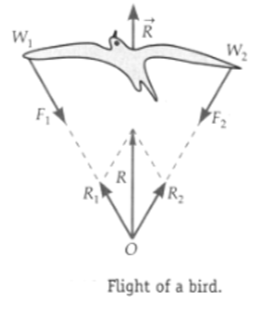
ii. Show by drawing a neat diagram that the flight of a bird is an example of composition of vectors.
iii. A man is travelling at $10.8 km h ^{-1}$ in a topless car on a rainy day. He holds his umbrella at an angle $37^{\circ}$ to the vertical to protect himself from the rain which is falling vertically downwards. What is the velocity of the rain? $\left[\right.$ Given $\cos 37^{\circ}=\frac{4}{5}$ ]
Answer

i. Impulse
ii. Flight of a bird. When a bird flies, it pushes the air with forces $F_1$ and $F_2$ in the downward direction with its wings $W_1$ and $W _2$. The lines of action of these two forces meet at point O . In accordance with Newton's third law of motion, the air exerts equal and opposite reactions $R_1$ and $R_2$. According to the parallelogram law, the resultant $R$ of the reactions $R_1$ and $R_2$ acts on the bird in the upward direction and helps the bird to fly upward.
Image
iii. $v _{ R }=10.8 km h ^{-1}=3 ms^{-1}$
Given: $\cos 37^{\circ}=\frac{4}{5} \therefore \tan 37^{\circ}=\frac{3}{4}$
But $\tan 37^{\circ}=\frac{v_R}{v_M}$ or $\frac{3}{4}=\frac{v_R}{3 m s^{-1}}$
or $v_R=\frac{9}{4}=2.25 ms^{-1}$

Need a full question paper?

Generate a complete, print-ready paper with questions like this in minutes — across 16+ boards, with answer keys.

Start Generating Free

Similar questions

A child running a temperature of 101°F is given an antipyrin (i.e. a medicine that lowers fever) which causes an increase in the rate of evaporation of sweat from his body. If the fever is brought down to 98°F in 20 minutes, what is the average rate of extra evaporation caused, by the drug. Assume the evaporation mechanism to be the only way by which heat is lost. The mass of the child is 30kg. The specific heat of human body is approximately the same as that of water, and latent heat of evaporation of water at that temperature is about 580cal g–1.
A boy's catapult is made of a rubber cord 42cm long and 6mm in diameter. The boy stretches the cord by 20cm. Find the Young's modulus of the rubber if a stone weighing 0.02kg when catapulted flies with a velocity of 20ms-1. Disregard the change in the cross-section of the cord in stretching.
Write Kelvin-Planck and Clausius statements for second law of thermodynamics. Define coefficient of efficiency and coefficient of performance. Show the heat flow in case of an engine and refrigerator using schematic diagrams.
Find the components along the $x , y , z$ axes of the angular momentum l of a particle, whose position vector is r with components $x , y , z$ and momentum is p with components $p _{ x }, p _{ y }$ and $p _{ z }$. Show that if the particle moves only in the x y plane the angular momentum has only a z-component.
Two discs of moments of inertia I1 and I2 about their respective axes (normal to the disc and passing through the centre), and rotating with angular speed $\omega_1$ and $\omega_2$ are brought into contact face to face with their axes of rotation coincident.
  1. Does the law of conservation of angular momentum apply to the situation? why?
  2. Find the angular speed of the two-disc system.
  3. Calculate the loss in kinetic energy of the system in the process.
  4. Account for this loss.
The current in an ideal, long solenoid is varied at a uniform rate of 0.01A/s. The solenoid has 2000 turns/m and its radius is 6.0cm.
  1. Consider a circle of radius 1.0cm inside the solenoid with its axis coinciding with the axis of the solenoid. Write the change in the magnetic flux through this circle in 2.0 seconds.
  2. Find the electric field induced at a point on the circumference of the circle.
  3. Find the electric field induced at a point outside the solenoid at a distance 8.0cm from its axis.
Draw velocity-time graph of uniformly accelerated motion in one dimension. From the velocity time graph of uniform accelerated motion, deduce the equations of motion in distance and time.
  1. Define mean free path.
  2. Derive an expression for mean free path of a gas molecule.
Briefly describe the Cavendish torsion balance. How is it used to measure G?
Two particles A and B, having opposite charges 2.0 × 10-6C and 2.0 × 10-6C, are placed at a separation of 1.0cm.
  1. Write down the electric dipole moment of this pair.
  2. Calculate the electric field at a point on the axis of the dipole 1.0m awa.y from the centre.
  3. Calculate the electric field at a point on the perpendicular bisector of the dipole and 1.0m away from the centre.