Question
$i$. Using Huygens's construction of secondary wavelets explains how a diffraction pattern is obtained on a screen due to a narrow slit on which a monochromatic beam of light is incident normally.
$ii.$ Show that the angular width of first diffraction fringe is half that of the central fringe.
$iii.$ Explain why the maxima at $\theta=\left(n+\frac{1}{2}\right) \frac{\lambda}{a}$ a become weaker and weaker with increasing $n$.
Answer

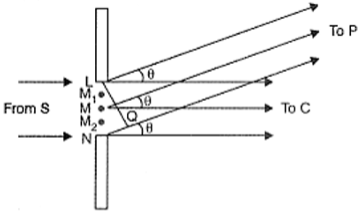
$i$. We can regard the total contributions of the wavefront $LN$ at some point $P$ on the screen, as the resultant effect of the superposition of its wavelets like $LM , MM _2, M _2 N$.
These have to be superposed taking into account their proper phase differences.
Image
We, therefore, get maxima and minima, i.e., a diffraction pattern, on the screen.
​​​​​​​Maxima and minima are produced when the path difference between waves is a whole number of wavelengths or an odd number of half wavelengths respectively.
Conditions for first minima on the screen
$\operatorname{a sin} \theta=\lambda$
$\Rightarrow \theta=\frac{\lambda}{a}$
$\operatorname{a sin} \theta=\lambda$
$\Rightarrow \theta=\frac{\lambda}{a}$
$\therefore$ Angular width of the central fringe on the screen $($from the figure$)$
$=2 \theta=\frac{2 \lambda}{a}$
Angular width of first diffraction fringe $($From fig$)$
$=\frac{\lambda}{a}$
For the first diffraction, the angular width of the fringe is half that of the central fringe.
$iii$. Maxima becomes weaker and weaker with increasing $n$.
This is because the effective part of the wavefront, contributing to the maxima becomes smaller and smaller, with increasing $n$.

Need a full question paper?

Generate a complete, print-ready paper with questions like this in minutes — across 16+ boards, with answer keys.

Start Generating Free

Similar questions

Suppose the gravitational potential due to a small system is $\frac{\text{k}}{\text{r}^2}$ at a distance r from it. What will be the gravitational field? Can you think of any such system? What happens if there were negative masses?
A uniform magnetic field B exist in a region. An electron projected perpendicular to the field goes in a circle. Assuming Bohr's quantization rule for angular momentum, calculate (a) the smallest possible radius of the electron (b) the radius of the nth orbit and (c) the minimum possible speed of the electron.
Find the charge required to flow through an electrolyte to liberate one atom of.
  1. A monovalent material.
  2. A divalent material.
Write Gauss' law in electrostatics. With the help of a suitable example and a diagram, show that the outward flux due to point charge ' $q$ ' in a closed surface in vaccum does not depend on the size and shape of the surface and its magnitude is $\frac{q}{\epsilon_0}$.
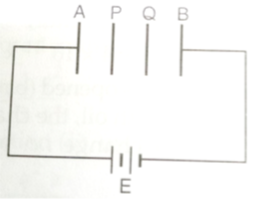
Two parallel metal plates P and Q are inserted at equal distances into a plane capacitor as shown in fig. Plates A and B of the capacitor are connected to a battery of e.m.f. V.
a. What are the potentials of the four plates?
Image
a. What are the potentials of the four plates?
b. How will the potentials of plates P and Q and the intensities of the fields in each of the three spaces change after plates P and Q have been connected by a wire?
c..What will happen to the charges on plates A and B, when plates P and Q are connected with a wire?
d. Will there be charges on the plates P and Q after connecting them with a wire?
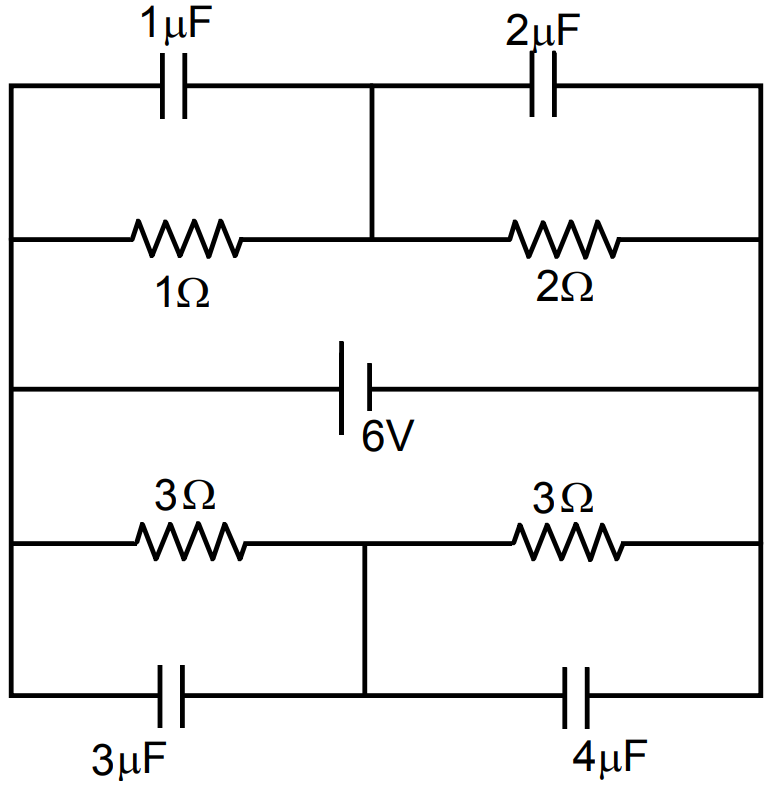
Find the charges on the four capacitors of capacitances $1\mu\text{F},2\mu\text{F},3\mu\text{F}$ and $4\mu\text{F}$ shown in the figure.
Find the change in the internal energy of 2 kg of water as it is heated from $0^{\circ} \mathrm{C}$ to $4^{\circ} \mathrm{C}$. The specific heat capacity of water is $4200 \mathrm{Jgg}^{-1} \mathrm{~K}^{-1}$ and its densities at $0^{\circ} \mathrm{C}$ and $4^{\circ} \mathrm{C}$ are $999.9 \mathrm{kgm}^{-3}$ and $1000 \mathrm{kgm}^{-3}$ respectively. Atmospheric pressure $=10^{-6} \mathrm{~Pa}$.
The current−voltage characteristic of an ideal p-n junction diode is given by $\text{i}=\text{i}_0\Big(\text{e}^{\frac{\text{eV}}{\text{kT}}}-1\Big)$ where, the drift current $i_0$ equals $10\mu\text{A}.$ Take the temperature T to be 300K.
  1. Find the voltage $V_0$ for which $\text{e}^{\frac{\text{eV}}{\text{KT}}}=100.$ One can neglect the term 1 for voltages greater than this value.
  2. Find an expression for the dynamic resistance of the diode as a function of V for $V > V_0.$
  3. Find the voltage for which the dynamic resistance is $0.2\Omega.$
A particle of mass m and charge q is thrown at a speed u against a uniform electric field E. How much distance will it travel before coming to momentary rest?
Three rods of lengths 20cm each and area of cross section $1cm^2$ are joined to form a triangle ABC. The conductivities of the rods are $\text{K}_\text{AB}=50\text{Js}^{-1}\text{m}^{-1}{^{\circ}}\text{C}^{-1},\ \text{K}_\text{BC}=200\text{Js}^{-1}\text{m}^{-1}{^{\circ}}\text{C}^{-1}$ and $\text{K}_\text{AC}=400\text{Js}^{-1}\text{m}^{-1}{^{\circ}\text{C}}^{-1}.$ The junctions A, B and C are maintained at $40^\circ C, 80^\circ C$ and $80^\circ C$ respectively. Find the rate of heat flowing through the rods AB, AC and BC.