Question
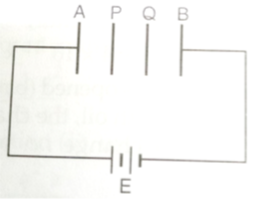
Two parallel metal plates P and Q are inserted at equal distances into a plane capacitor as shown in fig. Plates A and B of the capacitor are connected to a battery of e.m.f. V.
a. What are the potentials of the four plates?
Image
a. What are the potentials of the four plates?
b. How will the potentials of plates P and Q and the intensities of the fields in each of the three spaces change after plates P and Q have been connected by a wire?
c..What will happen to the charges on plates A and B, when plates P and Q are connected with a wire?
d. Will there be charges on the plates P and Q after connecting them with a wire?
Answer

a. The plates P and Q divide the space between the plates A and B in three equal parts. Since V = Ed, the potentials of the plates A, P, Q, and B will be respectively V, 2V/3, V/3 and 0.
b. When the plates P and Q are connected with a wire, the space between the plates A and B gets divided into two equal parts. Hence, the potentials of plates A, P, Q, and B will be respectively V, V/2, V/2 and 0.
Since the potential difference between the plates A and P; and between the plates, Q and B have increased from V/3 to V/2, the electric field between these plates will increase. As the potential difference the plates P and Q is zero, the electric field will also be zero.
c. Since the potential difference between the plates A and P and between the plates Q and B have increased, the charge on the plates A and B will increase.
d. Yes, the plate P will have a positive charge and the plate Q will have a negative charge.

Need a full question paper?

Generate a complete, print-ready paper with questions like this in minutes — across 16+ boards, with answer keys.

Start Generating Free

Similar questions

$i.$ There are two sets of apparatus of Young's double$-$slit experiment. Inset $A$, the phase difference between the two waves emanating from the slits does not change with time, whereas in set $B,$ the phase difference between the two waves from the slits changes rapidly with time. What difference will be observed in the pattern obtained on the screen in the two setups?
$ii.$ Deduce the expression for the resultant intensity in both the above$-$mentioned setups $( A$ and $B ),$ assuming that the waves emanating from the two slits have the same amplitude a and same wavelength $\lambda$.
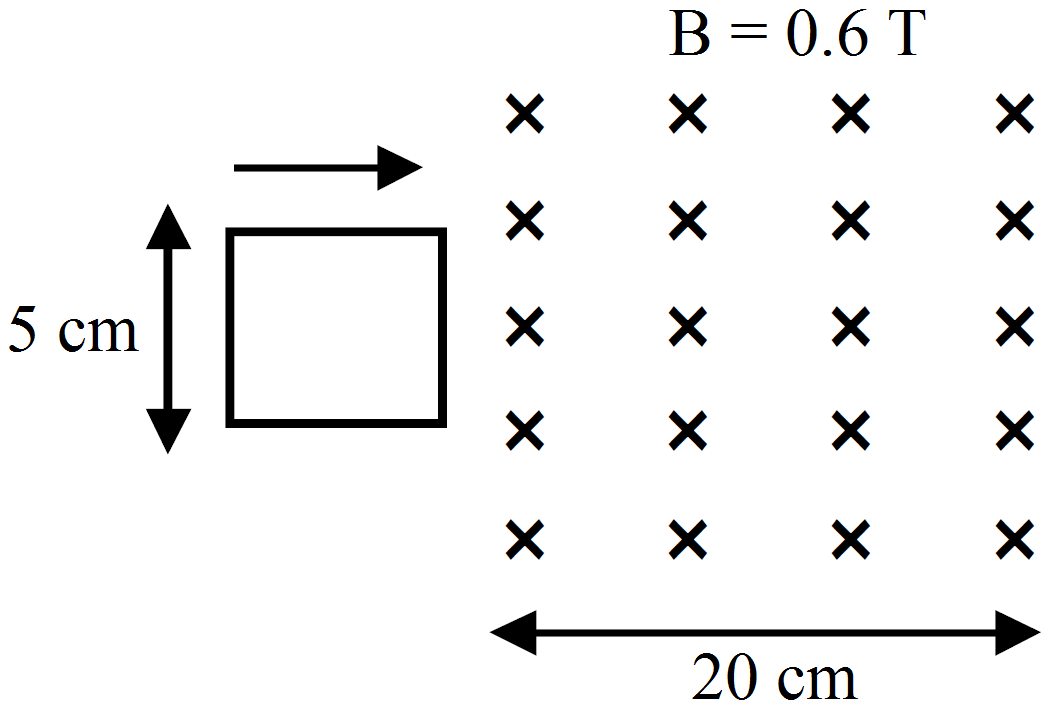
Figure shows a square loop of side 5cm being moved towards right at a constant speed of 1cm/s. The front edge enters the 20cm wide magnetic field at t = 0. Find the emf induced in the loop at:
  1. t = 2s
  2. t = 10s
  3. t = 22s
  4. t = 30s.
Monochromatic radiation of wavelength 640.2 nm $(1nm = 10^{–9} m)$ from a neon lamp irradiates photosensitive material made of caesium on tungsten. The stopping voltage is measured to be 0.54 V. The source is replaced by an iron source and its 427.2 nm line irradiates the same photo-cell. Predict the new stopping voltage.
A coil of 0.01 henry inductance and 1ohm resistance is connected to 200volt, 50Hz ac supply. Find the impedance of the circuit and time lag between max. alternating voltage and current.
  1. Derive the mathematical relation between refractive indices $n_1$ and $n_2 $ of two radii and radius of curvature R for refraction at a convex spherical surface. Consider the object to be a point since lying on the principle axis in rarer medium of refractive index $n_1$ and a real image formed in the denser medium of refractive index $n_{2}$.Hence, derive lens maker's formula.
  2. Light from a point source in air falls on a convex spherical glass surface of refractive index 1.5 and radius of curvature 20 cm. The distance of light source from the glass surface is 100 cm. At what position is the image formed?
In a semiconductor, electrons and holes move in opposite directions to each other. How? Explain with figure.
Answer the following the questions.
  1. A small compass needle of magnetic moment ‘m’ is free to turn about an axis perpendicular to the direction of uniform magnetic field ‘B’. The moment of inertia of the needle about the axis is ‘I’. The needle is slightly disturbed from its stable position and then released. Prove that it executes simple harmonic motion. Hence deduce the expression for its time period.
  2. A compass needle, free to turn in a vertical plane orients itself with its axis vertical at a certain place on the earth. Find out the values of (i) horizontal component of earth’s magnetic field and (ii) angle of dip at the place.
A gun of mass M fires a bullet of mass m with a horizontal speed V. The gun is fitted with a concave mirror of focal length f facing tpwards the receding bullet. Find the speed of separation of the bullet and the image just after the gun was fired.
A parallel-plate capacitor having plate area $400cm^2$ and separation between the plates 1.0mm is connected to a power supply of 100V. A dielectric slab of thickness 1.0mm and dielectric constant 5.0 is inserted into the gap:
  1. Find the increase in electrostatic energy.
  2. If the power supply is now disconnected and the dielectric slab is taken out, find the further increase in energy.
  3. Why does the energy increase in inserting the slab as well as in taking it out?
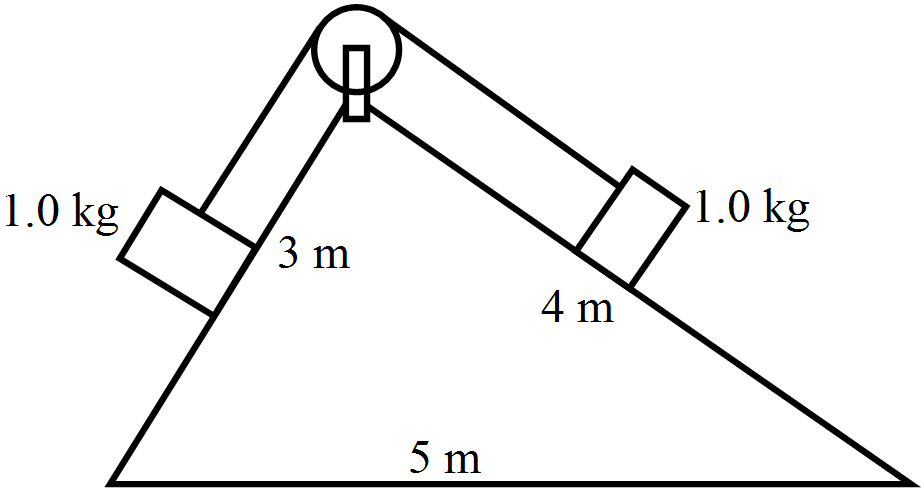
Consider the situation shown in figure. All the surfaces are frictionless and the string and the pulley are light. Find the magnitude of the acceleration of the two blocks.