Question
$i$. Using Huygens's construction of secondary wavelets explains how a diffraction pattern is obtained on a screen due to a narrow slit on which a monochromatic beam of light is incident normally.
$ii$. Show that the angular width of first diffraction fringe is half that of the central fringe.
$iii$. Explain why the maxima at $\theta=\left(n+\frac{1}{2}\right) \frac{\lambda}{a}$ a become weaker and weaker with increasing $n$.
Answer

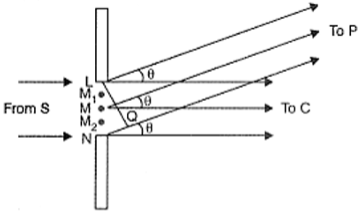
$i$. We can regard the total contributions of the wavefront $LN$ at some point $P$ on the screen, as the resultant effect of the superposition of its wavelets like $LM , MM _2, M _2 N$.
These have to be superposed taking into account their proper phase differences.
Image

We, therefore, get maxima and minima,
i.e., a diffraction pattern, on the screen.
Maxima and minima are produced when the path difference between waves is a whole number of wavelengths or an odd number of half wavelengths respectively.
Conditions for first minima on the screen
$\operatorname{a \sin} \theta=\lambda$
$\Rightarrow \theta=\frac{\lambda}{a}$
$\operatorname{a \sin} \theta=\lambda$
$\Rightarrow \theta=\frac{\lambda}{a}$
$\therefore$ Angular width of the central fringe on the screen $($from the figure$)$
$=2 \theta=\frac{2 \lambda}{a}$
Angular width of first diffraction fringe $($From fig$)$
$=\frac{\lambda}{a}$
For the first diffraction, the angular width of the fringe is half that of the central fringe.
$iii$. Maxima becomes weaker and weaker with increasing $n$.
This is because the effective part of the wavefront, contributing to the maxima becomes smaller and smaller, with increasing $n$.

Need a full question paper?

Generate a complete, print-ready paper with questions like this in minutes — across 16+ boards, with answer keys.

Start Generating Free

Similar questions

Three photo diodes $D1, D2$ and $D3$ are made of semiconductors having band gaps of $2.5eV, 2eV$ and $3eV,$ respectively. Which ones will be able to detect light of wavelength $6000\mathring{\text{A}}$?
A glass window is to be fit in an aluminium frame. The temperature on the working day is $40^\circ C$ and the glass window measures exactly $20\ cm \times 30\ cm$. What should be the size of the aluminium frame so that there is no stress on the glass in winter even if the temperature drops to $0^\circ C$ ? Coefficients of linear expansion for glass and aluminium are $9.0 \times 10^{-6 ^\circ} C^{-1}$ and $24 \times 10^{-6^\circ} C^{-1}$ respectively.
State the principle of working of p-n diode as a rectifier. Explain, with the help of a circuit diagram, the use of p-n diode as a full wave rectifier. Draw a sketch of the input and output waveforms.
The friction coefficient between a road and the tyre of a vehicle is $\frac{4}{3}.$ Find the maximum incline the road may have so that once hard brakes are applied and the wheel starts skidding, the vehicle going down at a speed of 36km/hr is stopped within 5m.
A thin paper of thickness $0.02\ mm$ having a refractive index $1.45$ is pasted across one of the slits in a Young's double slit experiment. The paper transmits $\frac{4}{9}$ of the light energy falling on it.
  1. Find the ratio of the maximum intensity to the minimum intensity in the fringe pattern.
  2. How many fringes will cross through the centre if an identical paper piece is pasted on the other slit also? The wavelength of the light used is 600nm.
The magnetic field B and the magnetic intensity H in material are found to be 1.6T and 1000A/m reepectively. Calculate the relative permeability $\mu_\text{r}$ and the susceptibility x of the material.
A long cylindrical volume contains a uniformly distributed charge of density $\rho.$ Find the electric field at a point P inside the cylindrical volume at a distance x from its axis (figure).
Positronium is just like a $H-$ atom with the proton replaced by the positively charged anti $-$ particle of the electron $($called the positron which is as massive as the electron$)$. What would be the ground state energy of positronium?
A metre stick weighing 240g is pivoted at its upper end in such a way that it can freely rotate in a vertical plane through this end (figure). A particle of mass 100g is attached to the upper end of the stick through a light string of length 1m. Initially, the rod is kept vertical and the string horizontal when the system is released from rest. The particle collides with the lower end of the stick and sticks there. Find the maximum angle through which the stick will rise.
Take the potential of the point B in figure to be zero:
  1. Find the potentials at the points C and D.
  2. If a capacitor is connected between C and D, what charge will appear on this capacitor?