Question 15 Marks
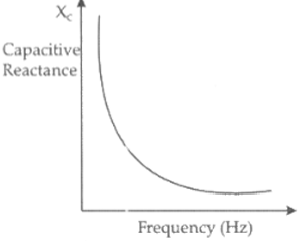
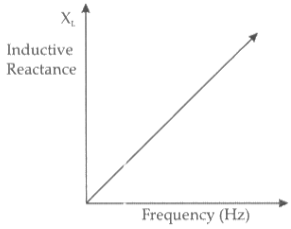
$a$. Draw graphs showing the variations of inductive reactance and capacitive reactance with the frequency of the applied ac source.
$b$. Draw the phasor diagram for a series $RC$ circuit connected to an ac source.
$c$. An alternating voltage of $220 V$ is applied across a device $X,$ a current of $0.25$ A flows, which lag behind the applied voltage in phase by $\frac{\pi}{2}$ radian. If the same voltage is applied across another device $Y,$ the same current flows but now it is in phase with the applied voltage.
$i$. Name the devices $X$ and $Y$.
$ii$. Calculate the current flowing in the circuit when the same voltage is applied across the series combination of $X$ and $Y$.
$b$. Draw the phasor diagram for a series $RC$ circuit connected to an ac source.
$c$. An alternating voltage of $220 V$ is applied across a device $X,$ a current of $0.25$ A flows, which lag behind the applied voltage in phase by $\frac{\pi}{2}$ radian. If the same voltage is applied across another device $Y,$ the same current flows but now it is in phase with the applied voltage.
$i$. Name the devices $X$ and $Y$.
$ii$. Calculate the current flowing in the circuit when the same voltage is applied across the series combination of $X$ and $Y$.
Answer
View full question & answer→$a$. Drawing the two graphs the graph shows the variation of capacitive resistance with frequency and inductive resistance with frequency.
The two graphs are as shown
$b$. Drawing the phaser diagram
$($the current leads the voltage by an angle $\theta$ where $0<\theta<\frac{\pi}{2} )$.
The required phaser diagram is as shown.
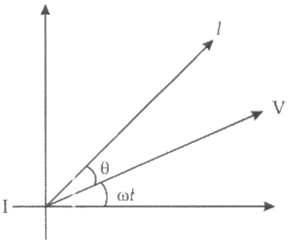
$[$Here, $\theta=\tan ^{-1}\left[\frac{1}{\omega C R}\right]$
$c.i$. In device $X$ :
Current lags behind the voltage by $\frac{\pi}{2}$
$\therefore X$ is an inductor.
In device $Y$ :
Current in phase with the applied voltage.
$\therefore Y$ is resistor.
$ii$. We are given that
$0.25=\frac{2 n 0}{X_L}$
or $ X _{ L }=\frac{2 n 0}{02} \Omega=880 \Omega$
Also $0.25=\frac{220}{X_R}$
$\therefore X_R=\frac{220}{0.25} \Omega=880 \Omega$
For the series combination of $X$ and $Y,$
Equivalent impedance $=\sqrt{X_L^2+X_R^2}=(880 \sqrt{2}) \Omega$
$\therefore $ Current flowing $ \frac{220}{880 \sqrt{2}} A=0.177 A$
The two graphs are as shown
$b$. Drawing the phaser diagram
$($the current leads the voltage by an angle $\theta$ where $0<\theta<\frac{\pi}{2} )$.
The required phaser diagram is as shown.
$[$Here, $\theta=\tan ^{-1}\left[\frac{1}{\omega C R}\right]$
$c.i$. In device $X$ :
Current lags behind the voltage by $\frac{\pi}{2}$
$\therefore X$ is an inductor.
In device $Y$ :
Current in phase with the applied voltage.
$\therefore Y$ is resistor.
$ii$. We are given that
$0.25=\frac{2 n 0}{X_L}$
or $ X _{ L }=\frac{2 n 0}{02} \Omega=880 \Omega$
Also $0.25=\frac{220}{X_R}$
$\therefore X_R=\frac{220}{0.25} \Omega=880 \Omega$
For the series combination of $X$ and $Y,$
Equivalent impedance $=\sqrt{X_L^2+X_R^2}=(880 \sqrt{2}) \Omega$
$\therefore $ Current flowing $ \frac{220}{880 \sqrt{2}} A=0.177 A$