Question
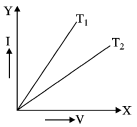
I-V graph at two different temperatures $T _1$ and $T _2$ for a metallic wire. Which temperature is greater and why? Image

Answer

Slope of graph at the temperature $T_2$ is less. Hence resistance will be more at this temperature. With increase in temperature, resistance also increases. Hence, $T_2$ is greater.

Need a full question paper?

Generate a complete, print-ready paper with questions like this in minutes — across 16+ boards, with answer keys.
Start Generating Free

Similar questions

Suppose $\vec{\text{a}}$ is a vector of magnitude 4.5 unit due north. What is the vector:
  1. $3\vec{\text{a}}$
  2. $-4 \ \vec{\text{a}}?$
If Bohr’s quantisation postulate (angular momentum $=\text{nh}/\pi$) is a basic law of nature, it should be equally valid for the case of planetary motion also. Why then do we never speak of quantisation of orbits of planets around the sun?
Given a uniform electric field$\overrightarrow{\text{E}}: 4 \times 10^3  \hat{i}$ N/C, find the flux of this field through a square of 5cm on a side whose plane is parallel to the y-z plane. What would be the flux through the same square if the plane makes a $30^{\circ}$ angle with the x-axis?
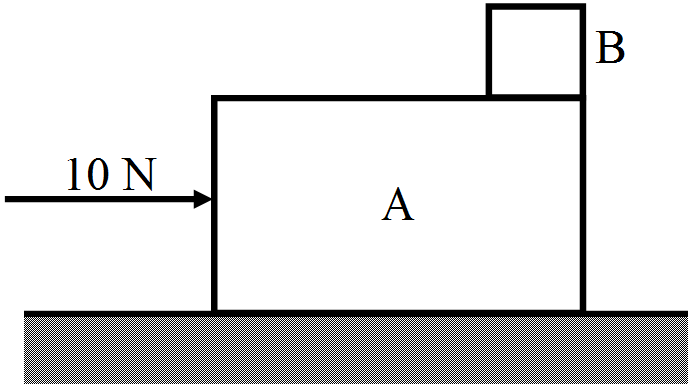
A small block B is placed on another block A of mass 5kg and length 20cm. Initially the block B is near the right end of block A. A constant horizontal force of 10N is applied to the block A. All the surfaces are assumed frictionless. Find the time elapsed before the block B separates from A.
In the absence of external electric field, derive the equation of potential energy of a system of three charges.
A Young's double slit apparatus has slits separated by 0.28mm and a screen 48cm away from the slits. The whole apparatus is immersed in water and the slits are illuminated by the red light ($\lambda=700\text{nm}$ in vacuum). Find the fringe-width of the pattern formed on the screen.
An electric field $\vec{\text{E}}=(\vec{\text{i}}20+\vec{\text{j}}30)\text{N}\text{C}^{-1}$ exists in the space. If the potential at the origin is taken to be zero, find the potential at (2m, 2m).
Suppose the energy liberated in the recombination of a hole-electron pair is converted into electromagnetic radiation. If the maximum wavelength emitted is 820nm, what is the band gap?
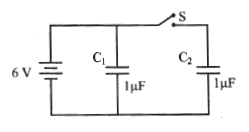
Figure shows two identical capacitors, $C_1$ and $C_2$, each of 1 μF capacitance connected to a battery of 6 V. Initially switch 'S' is closed. After sometime 'S' is left open and dielectric slabs of dielectric constant K = 3 are inserted to fill completely the space between the plates of the two capacitors. How will the (i) charge and (ii) potential difference between the plates of the capacitors be affected after the slabs are inserted?
Explain the difference between electric potential and electrical potential energy and explain the relationship between them.