Question
$i$. Write the electron $-$ dot structures for sodium, oxygen and magnesium.
$ii$. Show the formation of $\ce{Na _2 O}$ and $\ce{MgO}$ by the transfer of electrons.
$iii$. What are the ions present in these compounds?
Answer

$i$.
Metal Symbol Atomic number Electronic configuration $K, L, M, N$ No. of outermost electrons Electron dot structures
Sodium $Na$ $11$ $2, 8, 1$ $1$ $Na.$
Oxygen $O$ $8$ $2, 6$ $6$ $:O::$
Magnesium $Mg$ $12$ $2, 8, 6$ $2$ $Mg:$
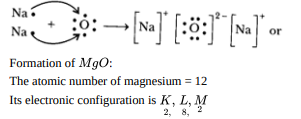
$ii.$ Formation of $\ce{Na _2 O}$
The atomic number of sodium is $11$ and it has only one valence electron.
Hence, electronic configuration of ${ }_{11} N a$ is $2, 8, 1.$
The atomic number of oxygen is $8$ and it has $6$ electrons in its valence shell.
Hence, electronic configuration of ${ }_8 O$ is $2, 6$.
Sodium has a tendency to lose the valence electron and oxygen has a tendency to gain the electron lost by sodium. Since,
sodium can lose only one electron of the valence shell, and oxygen atom needs two electrons to complete its octet in the
valence electron, two atoms of sodium combine with one atom of oxygen.
By losing valence electron, sodium is changed into
$N a^{+}$ and by gaining two electrons lost by two sodium atoms, oxygen atom is changed into an oxide anion, $O _2$. In this process, both the atoms, sodium and oxygen, obtain the stable electronic configuration of the noble gas neon.
$\underset{2,8,1}{ Na } \rightarrow \underset{2,8}{ Na ^{+}}+e^{-} O ^{2-}$
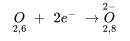
$O _{2,6}+2 e^{-} \rightarrow O _{2,8}^{2-}$
$2 Na ^{+}+ O ^2 \xrightarrow{\rightarrow} 2 Na ^{+} O ^{2-} \text { or } \ce{Na a_2 O} $
The oppositely charged sodium ion $Na ^{+} O ^{2-}$ , and oxide ion $O^{2-}$ , are now held together by electrostatic force of attraction or by ionic or electrovalent bond. $\ce{Na _2 O}$ is, therefore, an ionic or electrovalent compound.

Image
It has two electronic in its outermost shell.
So, the magnesium atom donates its $2$ valence electrons and forms a stable
magnesium ion $Mg ^{2+}$ , to attain the electronic arrangement of neon atom.
$\underset{2,8,2}{\operatorname{Mg}} \rightarrow \underset{2,8}{\stackrel{2+}{M g}}+2^{e-}$
The atomic number of oxygen $= 8$
Electronic configuration $ = \underset{2}{K}, \underset{6}{L}$
It has $6$ electrons in its valence shell.
Therefore, it requires $2$ more electrons to attain the stable electronic arrangement of neon gas.
Thus, oxygen accepts $2$ electrons donated by magnesium atom and forms a stable oxide ion $O^{2-}$.
Image

The oppositely charged magnesium ions $Mg ^{2+}$ , and oxide ions, are held together by a strong force of electrostatic attraction to form magnesium oxide compound.
$\ce{MgO}$ is ionic compound.
$iii$. The ions present in $\ce{Na _2 O}$ are sodium ions $\left(\ce{2 N a}^{+}\right)$ and oxide ion $O ^{2-}$.
The ions present in $\ce{M g O} $ are magnesium ion $\ce{(Mg2+)}$ and oxide ion $O ^{2-}$.

Need a full question paper?

Generate a complete, print-ready paper with questions like this in minutes — across 16+ boards, with answer keys.

Start Generating Free

Similar questions

Two resistances when connected in parallel give resultant value of 2 ohm; when connected in series the value becomes 9 ohm. Calculate the value of each resistance.
You are given three resistors each of $3\Omega$ and you are asked to get all possible values of resistance when you connect them in different combinations. How many values of resistance can you get?
Give one example each of a salt which gives an aqueous solution having:
  1. pH less than 7
  2. pH equal to 7
  3. pH more than 7
  1. Give the names and formulae of one metal chloride and one non-metal chloride.
  2. State an important property in which these metal chloride and non-metal chloride differ.
  3. Why do they differ in this property?
Name the type of mirror used in the following situations.
  1. Headlights of a car.
  2. Side/rear-view mirror of a vehicle.
  3. Solar furnace.
Support your answer with reason.
Define the following in terms of gain or loss of hydrogen with one example:
  1. Oxidation.
  2. Reduction.
Why does carbon form largest number of compounds? Give two reasons.
What is a period in a periodic table? How do atomic structures (electron arrangements) change in a period with increase in atomic numbers from left to right?
A green stemmed tomato plant denoted by (GG) is crossed with a tomato plant with purple stem denoted by (gg).
a. What colour of the stem would you expect in their $F_{1}$ progeny?
b. In what ratio would you find the green and purple coloured stem in plants of $\mathrm{F}_{2}$ progeny?
c. What conclusion can be drawn for the above observations?
Describe how, the water of river Ganga has been highly polluted.