Name the type of mirror used in the following situations.
- Headlights of a car.
- Side/rear-view mirror of a vehicle.
- Solar furnace.
Download our app for free and get started
- Concave mirror, to get powerful and parallel beams of light.
- Convex mirror because it always gives an erect image and enables the driver to view much larger area.
- Concave or parabolic mirror because it can concentrate sunlight at the focus to produce heat in the solar furnace.

Download our appand get started for free
Experience the future of education. Simply download our apps or reach out to us for more information. Let's shape the future of learning together!No signup needed.*
Similar Questions
- 1The refractive index of glass with respect to air is $\frac{3}{2}$ and refractive index of water with respect to air is $\frac{4}{3}$ . What will be the refractive index of water with respect to glass?View Solution
- 2View SolutionAn object of height 4.25mm is placed at a distance of 10cm from a convex lens of power +5D. Find:
- Focal length of the lens, and
- Size of the image.
- 3View Solution
- Draw a ray diagram to show the refraction of light through a glass slab and mark angle of refraction and the lateral shift suffered by the ray of light while passing through the slab.
- If the refractive index of glass for light going from air to glass is 3/2, find the refractive index of air for light going from glass to air.
- 4View SolutionThe image of a candle flame placed at a distance of 45 cm from aspherical lens is formed on screen placed at a distance of 90 cm from the lens. Identify the type of lens and calculate its focal length If the height of the flames 2cm, find the height of its image.
- 5a. What is the focal length of the lens used in sunglasses?View Solution
b. The following figures show the path of light rays through three lenses marked $L_1, L_2$, and $L_3$ and their focal points $F_1, F_2$, and $F_3$, respectively. Identify the nature of lenses.
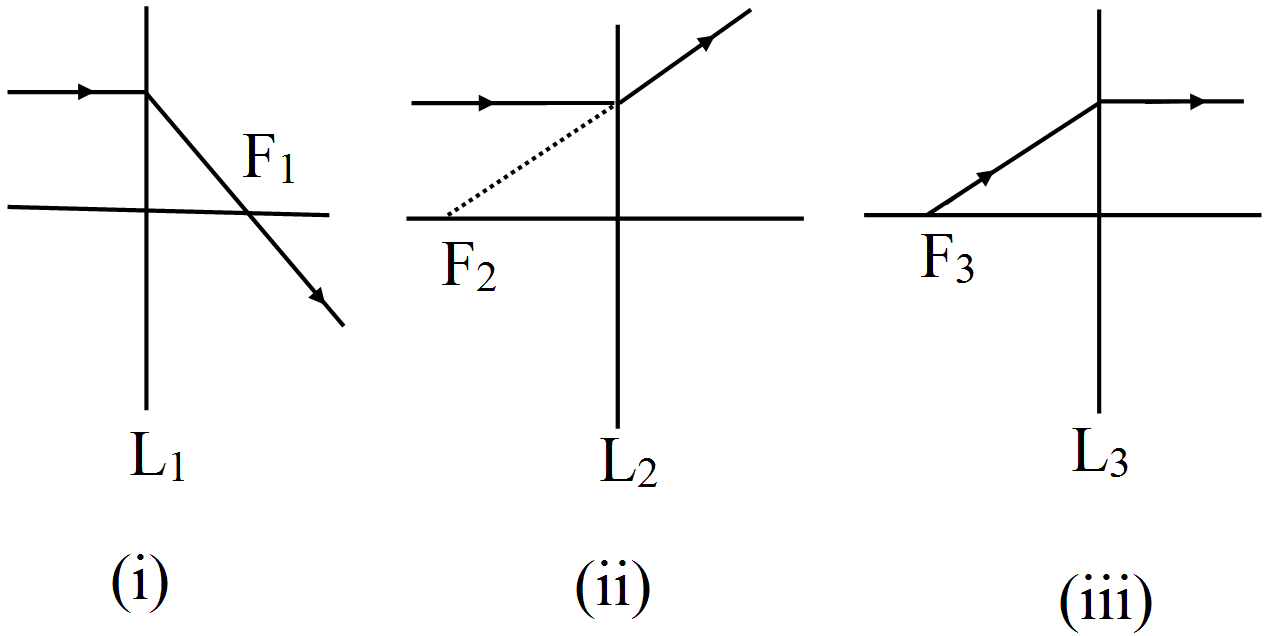
- 6View SolutionDraw the ray diagram and also state the position, the relative size and the nature of image formed by a concave mirror when the object is placed at the centre of curvature of the mirror.
- 7View SolutionHow far should an object be placed from a convex lens of focal length 20 cm to obtain its image at a distance of 30 cm from the lens? What will be the height of the image if the object is 6 cm tall?
- 8View SolutionCalculate the image distance for an object of height 12mm at a distance of 0.20m from a concave lens of focal length 0.30 m, and state the nature and size of the image.
- 9View SolutionA magnifying lens has a focal length of 100mm. An object whose size is 16mm is placed at some distance from the lens so that an image is formed at a distance of 25cm in front of the lens.
- What is the distance between the object and the lens?
- Where should the object be placed if the image is to form at infinity?
- 10View SolutionMake labelled ray diagrams to illustrate the formation of:
- A real image by a converging mirror.
- A virtual image by a converging mirror.