MCQ
Ice formed over lakes has
  • A
    Very high thermal conductivity and helps in further ice formation
  • Very low conductivity and retards further formation of ice
  • C
    It permits quick convection and retards further formation of ice
  • D
    It is very good radiator

Answer

Correct option: B.
Very low conductivity and retards further formation of ice
b
(b) Ice is non-conducting.

Need a full question paper?

Generate a complete, print-ready paper with questions like this in minutes — across 16+ boards, with answer keys.

Start Generating Free

Similar questions

A person standing on a spring balance inside a stationary lift measures $60 \,kg$. The weight of that person if the lift descends with uniform downward acceleration of $1.8\, m / s ^{2}$ will be $_{-} N$. $\left[ g =10\, m / s ^{2}\right]$
If m mass of a substance undergoes a phase change, then amount of heat required will be:
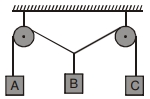
Three blocks $A, B$ and $C$ are suspended as shown in the figure. Mass of each blocks $A$ and $C$ is $m$. If system is in equilibrium and mass of $B$ is $M$, then :
The persistence of sound in a room after the source of sound is turned off is called reverberation. The measure of reverberation time is the time required for sound intensity to decrease by $60 \,dB$. It is given that the intensity of sound falls off as $I_0 \exp \left(-c_1 \alpha\right)$ where $I_0$ is the initial intensity, $c_1$ is a dimensionless constant with value $1 / 4$. Here, $\alpha$ is a positive constant which depends on the speed of sound, volume of the room, reverberation time, and the effective absorbing area $A_e$. The value of $A_e$ is the product of absorbing coefficient (with value between $0$ and $1,1$ being a perfect absorber) and the area of the room. For a concert hall of volume $600 \,m ^3$, the value of $A_e$ (in $m ^2$ ) required to give a reverberation time of $1 s$ is closest to (speed of sound in air $=340 \,m / s$ )
In an experiment to find acceleration due to gravity $(g)$ using simple pendulum, time period of $0.5\,s$ is measured from time of $100$ oscillation with a watch of $1\;s$ resolution. If measured value of length is $10\; cm$ known to $1\; mm$ accuracy. The accuracy in the determination of $g$ is found to be $x \%$. The value of $x$ is
A particle revolves with constant angular acceleration $\pi\, rad/s^2$. If the particle starts from rest, how many revolution will it make in the first $10\, seconds$ ?
A mass of $0.5\,kg$ moving with a speed of $1.5 \,m/s$ on a horizontal smooth surface, collides with a nearly weightless spring of force constant $k = 50\;N/m$. The maximum compression of the spring would be ............. $\mathrm{m}$
A particle moves for $8\, seconds$. It first accelerates from rest and then retards to rest. If the retardation be $3\, times$ the acceleration, then time for which it accelerates will be 
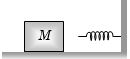
The block of mass $M$  moving on the frictionless horizontal surface collides with the spring of spring constant $K$ and compresses it by length $L$. The maximum momentum of the block after collision is
A ball is moving uniformly in a circular path of radius $1 m$ with a time period of $1.5 \,s$. If the ball is suddenly stopped at $t=8.3 \,s$, the magnitude of the displacement of the ball with respect to its position at $t=0 \,s$ is closest to .......... $m$