MCQ
A particle revolves with constant angular acceleration $\pi\, rad/s^2$. If the particle starts from rest, how many revolution will it make in the first $10\, seconds$ ?
  • A
    $16$
  • B
    $10$
  • C
    $20$
  • $25$

Answer

Correct option: D.
$25$
d
$\alpha=\pi \operatorname{rad} / \mathrm{s}^{2}$

$\theta=\omega_{0} t+\frac{1}{2} \alpha t^{2}$

$\omega_{0}=0$

$\therefore \quad \theta=\frac{1}{2} \alpha t^{2}$

$2 \mathrm{n} \pi=\frac{1}{2} \propto \mathrm{t}^{2}$

$2 \mathrm{n} \pi=\frac{1}{2}(\pi)(10)^{2}$

$\mathrm{x}=25$

Need a full question paper?

Generate a complete, print-ready paper with questions like this in minutes — across 16+ boards, with answer keys.
Start Generating Free

Similar questions

Velocity-time curve for a body projected vertically upwards is
A $10 H.P. $ motor pumps out water from a well of depth $20m$ and fills a water tank of volume $22380 $ $litres $ at a height of $ 10m$  from the ground. the running time of the motor to fill the empty water tank is ........... $\mathrm{minutes}$ $(g = 10m{s^{ - 2}}$)
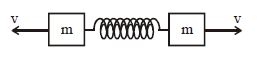
Two blocks each of mass $m$  are connected to a spring of spring constant $k.$  If both are given velocity $v$  in opposite directions, then the maximum elongation of the spring is
A body dropped from a height $1\,m$ on a floor rises to a height $25\,cm$ after first  rebound. The coefficient of restitution is :-
A particle of mass $m$ is tied to one end of $a$ string of length $l$. The particle is held horizontal with the string $mg$ taut. It is then projected upward with $a$ velocity $u$. The tension in the string is $\frac{{mg}}{2}$ when it is inclined at an angle $30^o$ to the horizontal. The value of $u$ is
A spring executes $SHM$ with mass of $10\,kg$ attached to it. The force constant of spring is $10\,N/m$.If at any instant its velocity is $40\,cm/sec$, the displacement will be .... $m$ (where amplitude is $0.5\,m$)
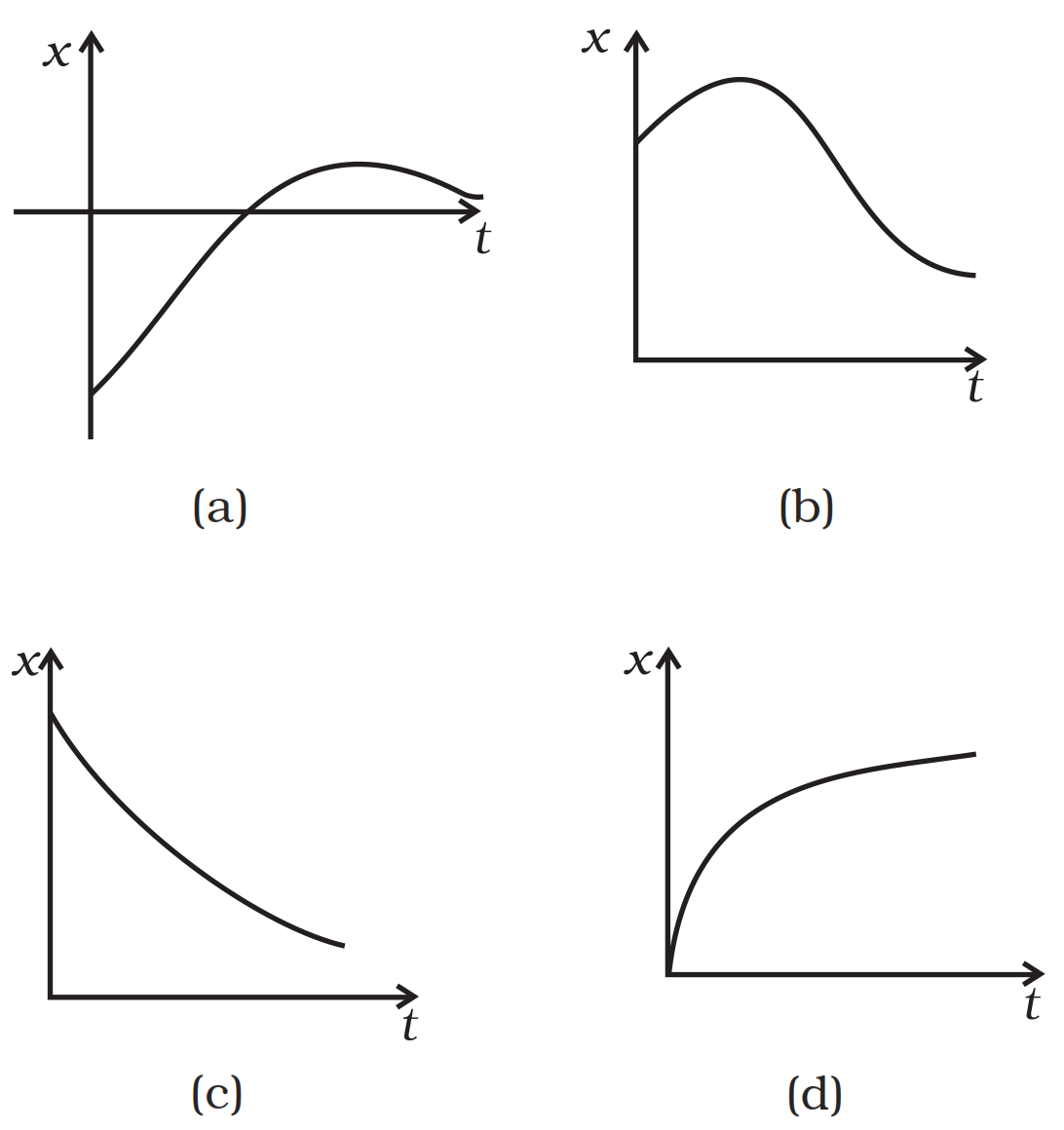
Among the four graphs Fig. there is only one graph for which average velocity over the time intervel (0, T ) can vanish for a suitably chosen T. Which one is it?

The resultant of $\vec{A} \times 0$ will be equal to
A film of water is formed between two straight parallel wires of length $10\,cm$ each separated by $0.5\, cm$. If their separation is increased by $1\, mm$ while still maintaining their parallelism, how much work will have to be done (Surface tension of water = $7.2 \times {10^{ - 2}}\,N/m)$
The equation of a travelling wave is given by$y = 0.5\sin (20x - 400t)$ where $x$ and $y$ are in meter and $t$ is in second. The velocity of the wave is .... $m/s$