Ice is used in a cooler in order to cool its contents. Which of the following will speed up the cooling process?
KVPY 2014, Medium
Download our app for free and get started
(d)
When ice is crushed, total surface area of ice that comes in contact with surrounding air increases. As a result crushing the ice speed up the cooling process.

Download our appand get started for free
Experience the future of education. Simply download our apps or reach out to us for more information. Let's shape the future of learning together!No signup needed.*
Similar Questions
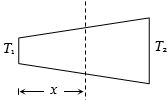
- 1Radius of a conductor increases uniformly from left end to right end as shown in fig.Material of the conductor is isotropic and its curved surface is thermally isolated from surrounding. Its ends are maintained at temperatures $T_1$ and $T_2$ ($T_1$ > $T_2$): If, in steady state, heat flow rate is equal to $H$ , then which of the following graphs is correctView Solution
- 2On a clear sunny day, an object at temperature $T$ is placed on the top of a high mountain. An identical object at the same temperature is placed at the foot of mountain. If both the objects are exposed to sun-rays for two hours in an identical manner, the object at the top of the mountain will register a temperatureView Solution
- 3$Assertion :$ Perspiration from human body helps in cooling the body.View Solution
$Reason :$ A thin layer of water on the skin enhances its emissivity. - 4Liquid cools from $50^oC$ to $45^oC$ in $5\ minutes$ and from $45^oC$ to $41.5^oC$ in the next $5\ minutes$.The temperature of the surrounding is ......... $^oC$View Solution
- 5View SolutionGood absorbers of heat are
- 6View SolutionWoollen clothes are used in winter season because woolen clothes
- 7A container contains hot water at ${100^o}C$. If in time ${T_1}$ temperature falls to ${80^o}C$ and in time ${T_2}$ temperature falls to ${60^o}C$ from ${80^o}C$, thenView Solution
- 8Hot water kept in a beaker placed in a room cools from ${70^o}C$ to $60°C$ in $4$ minutes. The time taken by it to cool from ${69^o}C$ to ${59^o}c$ will beView Solution
- 9Many exoplanets have been discovered by the transit method, where in one monitors, a dip in the intensity of the parent star as the exoplanet moves in front of it. The exoplanet has a radius $R$ and the parent star has radius $100 \,R$. If $I_0$ is the intensity observed on earth due to the parent star, then as the exoplanet transitsView Solution
- 10The temperatures of two bodies $A$ and $B$ are ${727^o}C$ and ${127^o}C$. The ratio of rate of emission of radiations will beView Solution