Question

Need a full question paper?
Generate a complete, print-ready paper with questions like this in minutes — across 16+ boards, with answer keys.
Explore more
Similar questions
Describe the following with one example in each case :
(i) Analgesic
(ii) Disinfectants
(iii) Antibiotics
(i) Analgesic
(ii) Disinfectants
(iii) Antibiotics
Give different examples of nucleophilic addition reactions of carbonyl compounds.
When kept in water, raisin swells in size. Name and explain the phenomenon involved with the help of a diagram. Give three applications of the phenomenon.
(a) (i) Write the disproportionation reaction of $H _3 PO _3$.
(ii) Draw the structure of $XeF _4$.
(b) Account for the following:
(i) Although fluorine has less negative electron gain enthalpy yet $F_2$ is a strong oxidizing agent.
(ii) Acidic character decreases from $N _2 O _3$ to $Bi _2 O _3$ in group 15.
(c) Write a chemical reaction to test Sulphur dioxide gas. Write the chemical equation involved.
→(ii) Draw the structure of $XeF _4$.
(b) Account for the following:
(i) Although fluorine has less negative electron gain enthalpy yet $F_2$ is a strong oxidizing agent.
(ii) Acidic character decreases from $N _2 O _3$ to $Bi _2 O _3$ in group 15.
(c) Write a chemical reaction to test Sulphur dioxide gas. Write the chemical equation involved.
- Account for the following:
- Mn shows the highest oxidation state of +7 with oxygen but with fluorine it shows the highest oxidation state of +4.
- Cr2+ is a strong reducing agent.
- Cu2+ salts are coloured while Zn2+ salts are white.
- Complete the following equations:
- $2\text{MnO}_{2} + 4\text{KOH} + \text{O}_{2} \xrightarrow{\Delta}$
- $\text{Cr}_{2}\text{O}^{2-}_{7}+ 14\text{H}^{+} + 6\text{I}^{-}\xrightarrow{}$
Derive the integral rate equation for the first order reaction and prove that the graph of $\ln k$ and $t$ a straight line.
→- State Raoult’s law for a solution containing volatile components.
How does Raoult’s law become a special case of Henry’s law?
- 1.00 g of a non-electrolyte solute dissolved in 50 g of benzene lowered the freezing point of benzene by 0.40 K. Find the molar mass of the solute. (Kf for benzene= 5.12 kg mol-1).
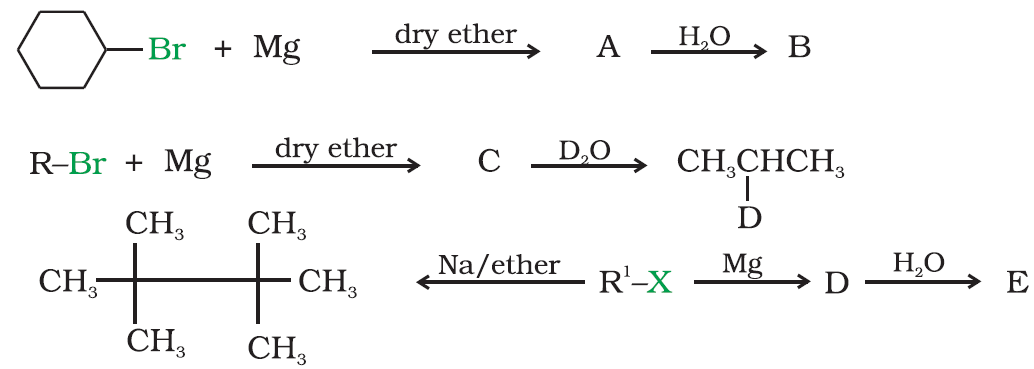
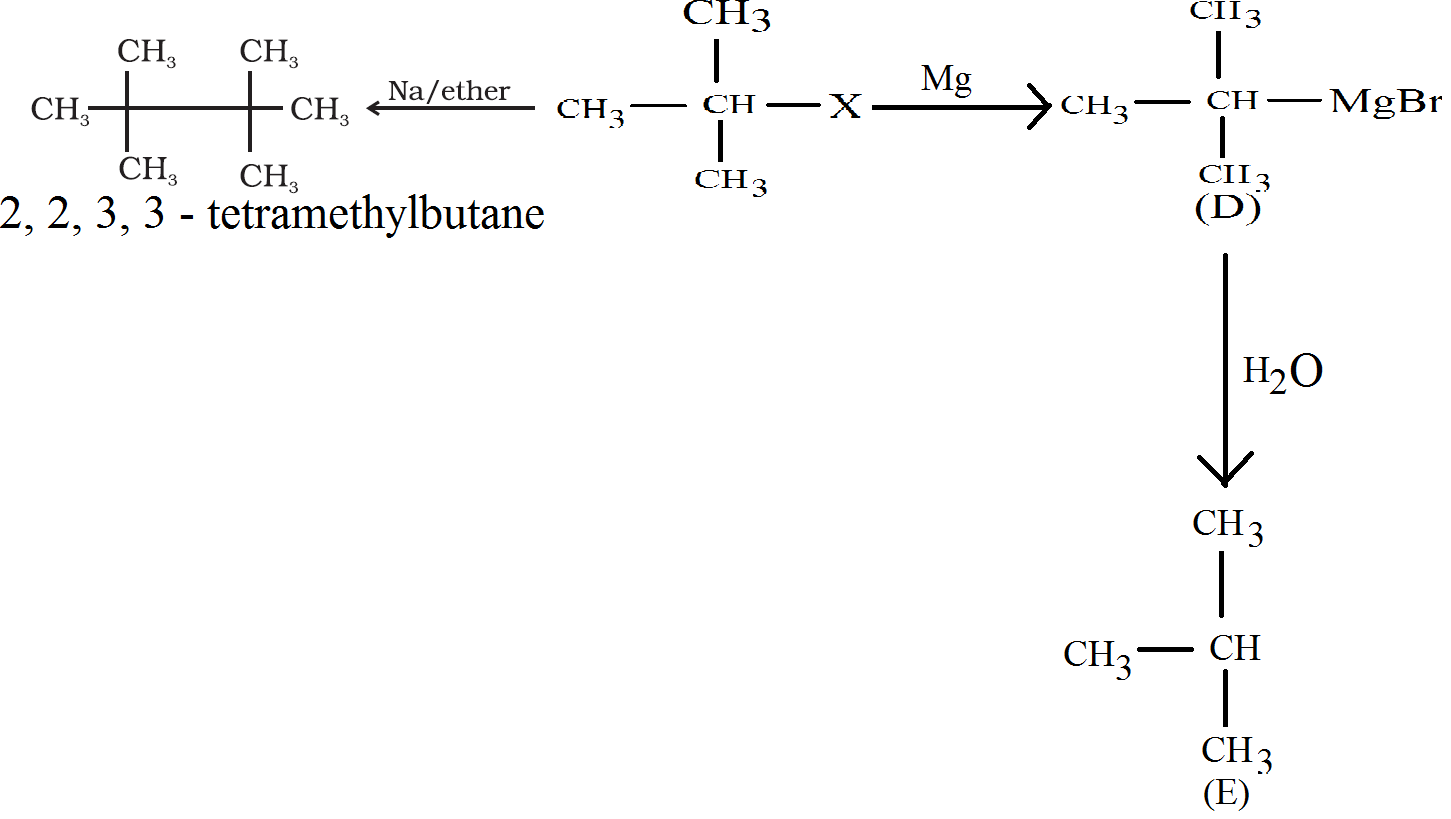
Write the applications of organometallic compounds.
Explain the open chain structure of glucose.
An organic compound A with molecular formula C7H7NO reacts with Br2/aq. KOH to give compound B, which upon reaction with NaNO2 and HCl at 0°C gives C. Compound C on heating with CH3CH2OH gives a hydrocarbon D. Compound B on further reaction with Br2 water gives white precipitate of compound E. Identify the compound A, B, C, D and E; also justify your answer by giving relevant chemical equations.