Question

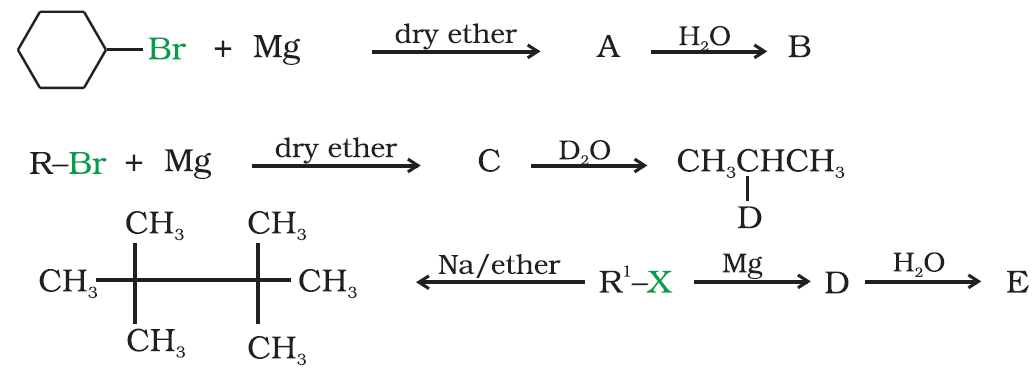
Identify A, B, C, D, E, R and $R^1$ in the following:
Answer


Since D of D2O gets attached to the carbon atom to which MgBr is attached, C is
$\text{CH}_3\text{CHCH}_3\\\ \ \ \ \ \ \ \ \ |\\\ \ \ \ \ \ \ \text{MgBr}\\\text{Isopropylmagnesium bromide}$
Therefore, the compound R - Br is
$\text{CH}_3\text{CHCH}_3\\\ \ \ \ \ \ \ \ \ |\\\ \ \ \ \ \ \ \text{Br}\\2-\text{Bromopropane}$
$\text{CH}_3\text{CHCH}_3+\text{Mg}\xrightarrow[]{\text{dry ether}}\text{CH}_3\text{CHCH}_3\xrightarrow[]{\text{D}_2\text{O}}\text{CH}_3\text{CHCH}_3\\\ \ \ \ \ \ \ \ \ |\ \ \ \ \ \ \ \ \ \ \ \ \ \ \ \ \ \ \ \ \ \ \ \ \ \ \ \ \ \ \ \ \ \ \ \ \ \ \ \ \ \ \ \ \ \ \ |\ \ \ \ \ \ \ \ \ \ \ \ \ \ \ \ \ \ \ \ \ \ \ \ \ \ \ \ \ \ |\\\ \ \ \ \ \ \ \ \text{Br}\ \ \ \ \ \ \ \ \ \ \ \ \ \ \ \ \ \ \ \ \ \ \ \ \ \ \ \ \ \ \ \ \ \ \ \ \ \ \ \ \ \ \text{MgBr}\ \ \ \ \ \ \ \ \ \ \ \ \ \ \ \ \ \ \ \ \ \ \ \text{D}\\\ \ \ \ \ \ \ \ \ \ \ \ \ \ \ \ \ \ \ \ \ \ \ \ \ \ \ \ \ \ \ \ \ \ \ \ \ \ \ \ \ \ \ \ \ \ \ \ \ \ \ \ \ \ \ (\text{C})$
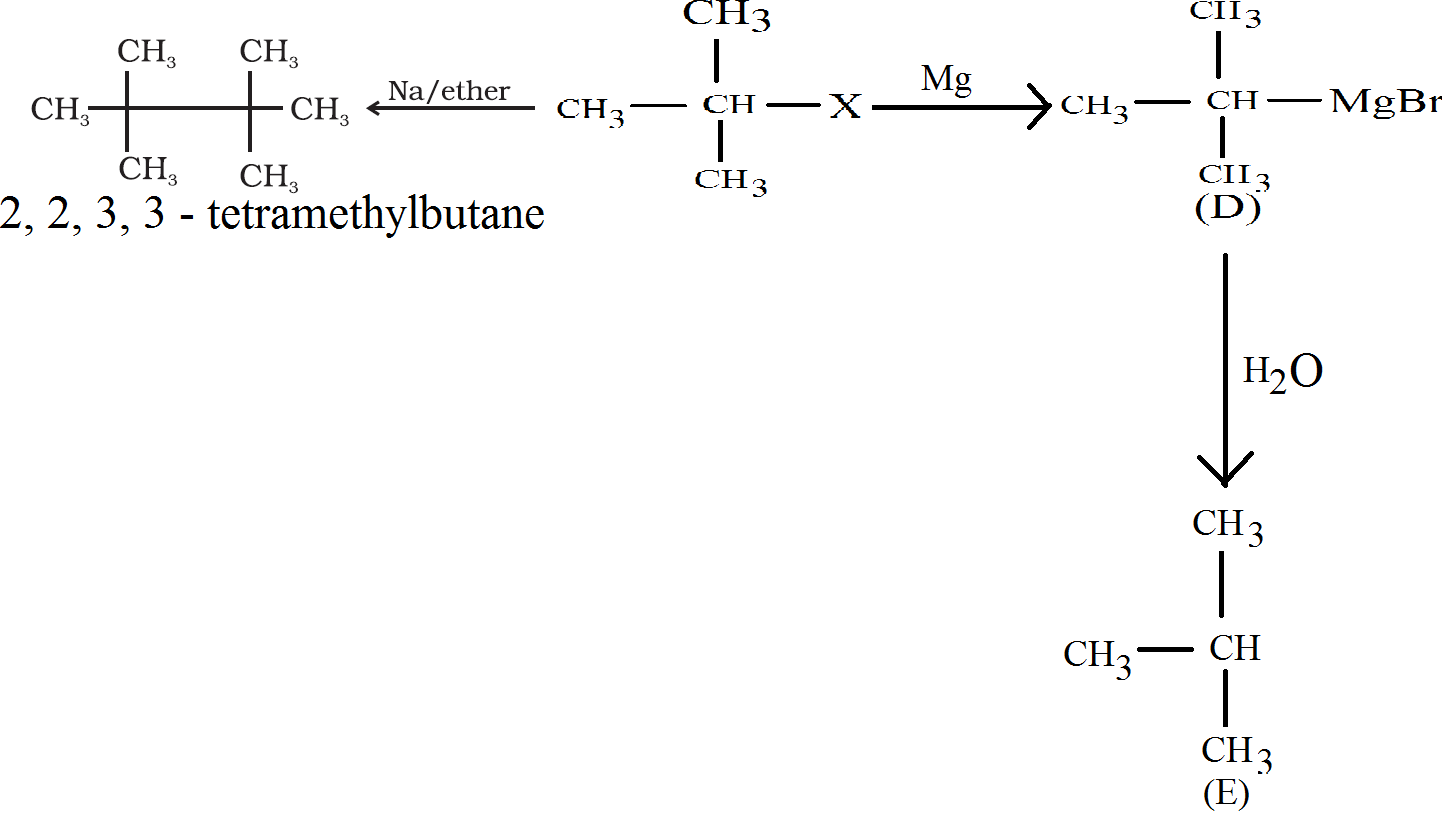
When an alkyl halide is treated with Na in the presence of ether, a hydrocarbon containing double the number of carbon atoms as present in the original halide is obtained as product. This is known as Wurtz reaction. Therefore, the halide, R1-X, is
$\ \ \ \ \ \ \ \ \ \ \ \text{CH}_3\\\ \ \ \ \ \ \ \ \ \ \ \ \ |\\\text{CH}_3-\text{C}-\text{X}\\\ \ \ \ \ \ \ \ \ \ \ \ \ |\\\ \ \ \ \ \ \ \ \ \ \ \text{CH}_3\\\ \text{tert}-\text{Butylhalide}$
Therefore, compound D is
$\ \ \ \ \ \ \ \ \ \ \ \text{CH}_3\\\ \ \ \ \ \ \ \ \ \ \ \ \ |\\\text{CH}_3-\text{C}-\text{MgBr}\\\ \ \ \ \ \ \ \ \ \ \ \ \ |\\\ \ \ \ \ \ \ \ \ \ \ \text{CH}_3\\\ \text{tert}-\text{Butylmagnesiumbromide}$
And, compound E is
$\ \ \ \ \ \ \ \ \ \ \ \text{CH}_3\\\ \ \ \ \ \ \ \ \ \ \ \ \ |\\\text{CH}_3-\text{C}\\\ \ \ \ \ \ \ \ \ \ \ \ \ |\\\ \ \ \ \ \ \ \ \ \ \ \text{CH}_3\\2-\text{Methylpropane}$

Need a full question paper?

Generate a complete, print-ready paper with questions like this in minutes — across 16+ boards, with answer keys.

Start Generating Free

Similar questions

  1. Draw the molecular structures of the following compounds:
  1. $N_2O_5$.
  2. $XeOF_4$.
  1. Explain the following observations:
  1. Sulphur has a greater tendency for catenation than oxygen.
  2. ICl is more reactive than $I_2$.
  3. Despite lower value of its electron gain enthalpy with negative sign, fluorine $(F_2)$ is a stronger oxidising agent than $Cl_2$​​​​​​​.
Explain on the basis of valence bond theory that $\left[ Ni ( CN )_4\right]^{2-}$ ion with square planar structure is diamagnetic and the $\left[ NiCl _4\right]^{2-}$ ion with tetrahedral geometry is paramagnetic.
How are carboxylic acids prepared from the following compounds? Explain with examples:
(a) Primary alcohol
(b) Acyl halide
(c) Acid anhydride
(d) Grignard reagent
(e) Alkyl benzene.
Match the solutions given in Column I and the colours given in Column II.
 
Column I
(Aqueous solution of salt)
 
Column II
(Colour)
$(i)$
$FeSO_4.7H_2O$
$(a)$
Green
$(ii)$
$NiCl_2.4H_2O$
$(b)$
Light pink
$(iii)$
$MnCl_2.4H_2O$
$(c)$
Blue
$(iv)$
$CoCl_2.6H_2O$
$(d)$
Pale green
$(v)$
$Cu_2Cl_2$
$(e)$
Pink
 
 
$(f)$
Colourless
Write the $S _{ N } 2$ mechanism of bimolecular nucleophilic substitution.
  1. Complete the following chemical equations:
  1. $Cu + HNO_3 (dilute) →$
  2. $XeF_4 + O_2F_2 \rightarrow $
  1. Explain the following observations:
  1. Phosphorus has greater tendency for catenation than nitrogen.
  2. Oxygen is a gas but sulphur a solid.
  3. The halogens are coloured. Why?
Explain the elimination reaction of haloalkanes.
Answer the following questions:
Write balanced equations to represent what happens when.
  1. $Cu^{2+}$​​​​​​​ is treated with KI.
  2. Acidified potassium dichromate solution is reacted with iron (II) solution. (ionic equation).
A colorless substance ' $A$ ' $\left( C _6 H _7 N\right)$ is sparingly soluble in water and gives a water-soluble compound ' B ' on treating with a mineral acid. On reacting with CHCl 3 and alcoholic potash ' A ' produces an obnoxious smell due to the formation of compound ' C '. The reaction of ' A ' with benzene sulphonyl chloride gives compound ' D ' which is soluble in alkali. With $NaNO _2$ and HCl , ' A ' forms compound ' E ' which reacts with phenol in alkaline medium to give an orange dye ' $F$ '. Identify compounds ' $A$ ' to ' $F$ '.
Attempt any five of the following:
(a) What is the structural feature characterising reducing sugars?
(b) What type of linkage is present in polysaccharides?
(c) Give examples of fat soluble vitamins.
(d) The two strands in DNA are not identical but are complementary. Explain.
(e) Write uses of B-Complex.
(f) Name the disaccharide which on hydrolysis gives two molecules of glucose.
(g) Name purines present in DNA?