Question
Attempt any five of the following:
(a) What is the structural feature characterising reducing sugars?
(b) What type of linkage is present in polysaccharides?
(c) Give examples of fat soluble vitamins.
(d) The two strands in DNA are not identical but are complementary. Explain.
(e) Write uses of B-Complex.
(f) Name the disaccharide which on hydrolysis gives two molecules of glucose.
(g) Name purines present in DNA?
Answer

Attempt any five of the following:
(i) The reducing sugars have free aldehydic or ketonic groups.
(ii) Glycosidic linkage
(iii)Fat soluble vitamins are absorbed along with fats in the diet and are stored in body's fatty tissue and in the liver. Vitamin A, D, E and K are fat soluble vitamins.
iv)In the helical structure of DNA, the two strands are held together by hydrogen bonds between specific pairs of bases. Cytosine forms hydrogen bond with guanine, while adenine forms hydrogen bond with thymine. As a result, the two strands are complementary to each other.
(v) It is required for making red blood cells, muscles.
(vi)The disaccharide which gives two molecules of glucose on hydrolysis is maltose.
(vii)Adenine and guanine

Need a full question paper?

Generate a complete, print-ready paper with questions like this in minutes — across 16+ boards, with answer keys.

Start Generating Free

Similar questions


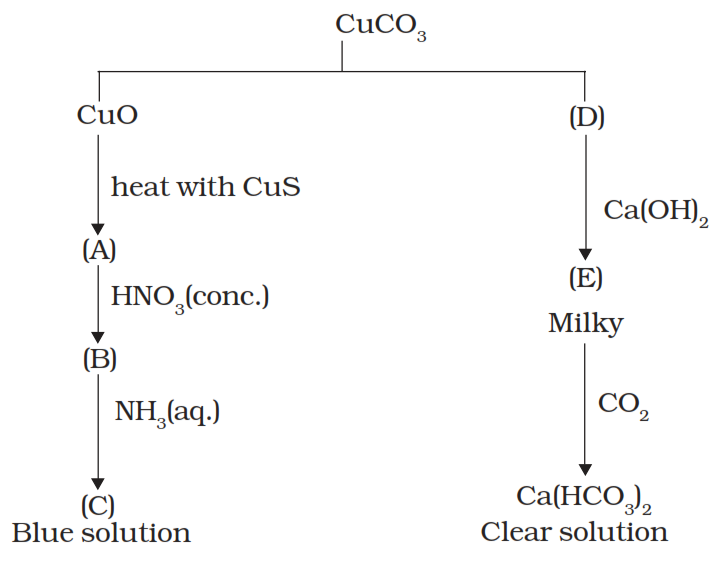
Identify $A$ to $E$ and also explain the reactions involved.
Answer the following questions:
Describe the preparation of potassium permanganate from pyrolusite ore. Write balanced chemical equation for one reaction to show the oxidizing nature of potassium permanganate.
a. Amongst the following, the most stable complex is:
i. $\left[ Fe \left( H _2 O \right)_6\right]^{3+}$
ii. $\left[ Fe \left( NH _3\right)_6\right]^{3+}$
iii. $\left[ Fe \left( C _2 O _4\right)_3\right]^{3-}$
iv. $\left[ FeCl _6\right]^{3+}$
b. What will be the correct order for the wavelength of absorption in the visible region for the following:
$
\left[Ni\left(NO_2\right)_6\right]^{4-},\left[Ni\left(NH_3\right)_6\right]^{2+},\left[Ni\left(H_2 O\right)_6\right]^{2+}
$
Write the formulas for the following coordination compounds:
a. Tetraammineaquachloridocobalt(III) chloride
b. Potassium tetrahydroxidozincate(II)
c. Potassium trioxalatoaluminate(III)
d. Dichloridobis(ethane-1, 2-diamine)cobalt(III)
e. Tetracarbonylnickel(0)
Give the oxidation state, d-orbital occupation and coordination number of the central metal ion in the following complexes:
$i. K_3\left[ Co \left( C _2 O _4\right)_3\right]$
$ii.$ cis- $\left[ Cr (e n)_2 Cl _2\right] Cl$
$iii. \left( NH _4\right)_2\left[ CoF _4\right]$
$iv. \left[ Mn \left( H _2 O \right)_6\right] SO _4$
Answer the following question:
$X_2$​​​​​​​ is a greenish yellow gas with pungent smell and used in purification of water. On dissolving water it gives a solution which turns blue litmus red. When it is passed through NaBr solution $Br_2$ is obtained.
  1. Identify the gas.
  2. What are products obtained when $X_2$​​​​​​​ reacts with ammonia? Give chemical equations.
  3. What happens when $X_2$​​​​​​​ reacts with cold and dilute NaOH solution? Write chemical equation and give the name of reaction.
Account for the following:
  1. When $NaBr$ is heated with conc. $H_2SO_4, Br_2$ is produced but when $NaCl$ is heated with conc. $H_2SO_4,$ $HCl$ is produced.
  2. $H_2S$ acts only as a reducing agent but $SO_2$ acts both as a reducing agent as well as an oxidising agent.
  3. The acid strength decreases in the order: $HCl > H_2S > PH_3.$
Answer the following questions.
Write chemical reaction to show that glucose contains aldehyde as carbonyl group.
The activation energy of a reaction is $75.2 kJ mol ^{-1}$ in the absence of a catalyst and it lowers to $50.14 kJ mol ^{-1}$ with a catalyst. How many times will the rate of reaction grow in the presence of a catalyst if the reaction proceeds at $25^{\circ} C$ ?
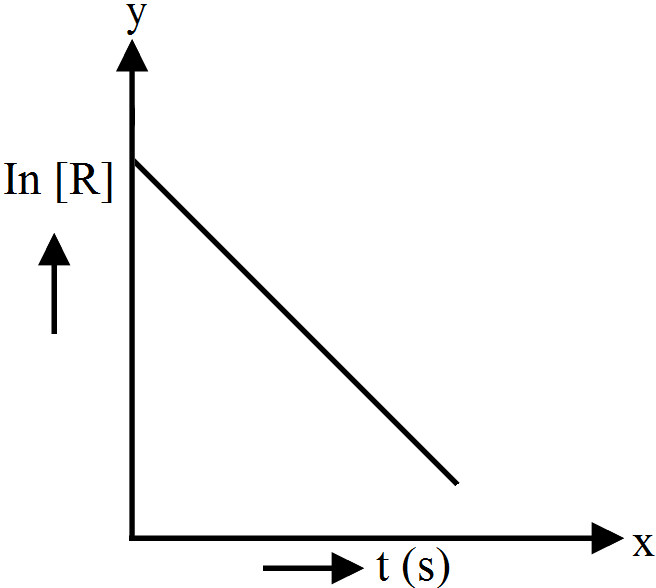
For a certain chemical reaction variation in the concentration ln $[R]$ vs. time plot is given alongside.For this reaction:
  1. What is the order of the reaction?
  2. What are the units of rate constant $k$?
  3. Give the relationship between $k$ and $t1/2$ (half-life period).
  4. What is the slope of the curve?
  5. Draw the plot log $[R]0 /[R]$ vs time $t(s)$.