Question
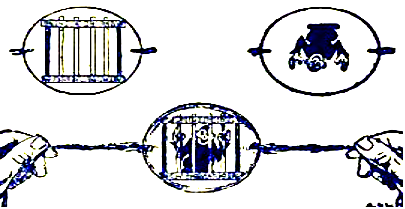
Identify and explain concepts given in this diagram.
Answer

The concept upon which the diagrams are based is the persistence of vision. Explanation:
1. Persistence of vision is a phenomenon that allows the image formed on the retina to remain imprinted there for $\frac{1}{16}$ th of a second after the object is removed from the front of the eyes.
2. When cardboard with a cage drawn on one side and a monkey drawn on the other is tied to a thread and twisted and set into rotation, at one point, the observer gets the illusion of the monkey being inside the cage.
3. This happens due to persistence of vision. Before the image of the cage could disappear from the retina, an image of the monkey gets created on the retina giving the observer the impression that the monkey is inside the cage.

Need a full question paper?

Generate a complete, print-ready paper with questions like this in minutes — across 16+ boards, with answer keys.

Start Generating Free

Similar questions

Asexual reproductionSexual reproduction
1. Reproduction that occurs with the help of somatic cells is called asexual reproduction.1. ___________________________
2. ___________________________2. Male and female parent are necessary for sexual reproduction.
3. This reproduction occurs with the help of mitosis only.3. ___________________________
4. ___________________________4. New individual formed by this method is genetically different from parents.
5. Asexual reproduction occurs in different individuals by various methods like binary fission, multiple fission, budding, fragmentation, regeneration, vegetative propagation, spore production, etc.5. ___________________________
What are the objectives of the space mission?
Explain the following terms with example: Oxidant.
The sea water contains water beetles, tadpole, fish and weeds.
  1. Write a food chain comprising all the given organisms?
  2. Which organisms in the food chain are (i) herbivore, and (ii) carnivores?
  3. Which organisms are (i) predators, and (ii) prey?
  4. Which organisms can trap solar energy to make food?
  5. Which organism is a secondary consumer?
State whether the following reactions are exothermic or endothermic:
(i) $3 CaO \cdot Al _2 O _{3( s )}+6 H _2 O _{(1)} \rightarrow 3 CaO \cdot Al _2 O _3 \cdot 6 H _2 O _{( s )}+$ Heat
(ii) $2 CaSO _4 \cdot H _2 O +3 H _2 O \rightarrow 2 CaSO _4 \cdot 2 H _2 O +$ Heat
(iii) $KNO _{3( aq )}+ H _2 O _{(0)}+$ Heat $\rightarrow KNO _{3 \text { (aq) }}$
(iv) $NaOH _{( s )}+ H _2 O _{( l )} \rightarrow NaOH _{( aq )}+$ Heat
(v) Transformation of ice into water.
(vi) Water turns into ice.
(vii) Cooking of food.
(viii) Burning candle.


Describe the exchange of gases which takes place in the leaves of a plant:
  1. During daytime.
  2. At night.
What would be your role in environment management?
Explain with examples types of asexual reproduction in unicellular organisms.
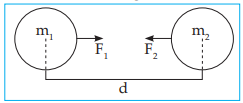
Observe the figure and answer the following questions
Image

Question
(i) What are the masses of the objects shown?
(ii) What is the distance between their centres?
(iii) Write gravitational force between them.
(iv) Why gravitation constant is called universal constant?
(v) What will happen to gravitational force if mass of one of the objects is doubled?
(vi) What is the value of universal constant in SI?
Which projects will you run in relation to environmental conservation? How?