Question
Explain the following terms with example: Oxidant.

Answer

An oxidant is a reactant that oxidizes or removes electrons from other reactants during a redox reaction. An oxidant may also be called an oxidizer or oxidizing agent. When the oxidant includes oxygen, it may be called an oxygenation reagent or oxygen-atom transfer (OT) agent.
Examples of oxidants include:
  1. Hydrogen peroxide
  2. Ozone
  3. Nitric acid
  4. Sulfuric acid

Need a full question paper?

Generate a complete, print-ready paper with questions like this in minutes — across 16+ boards, with answer keys.
Start Generating Free

Similar questions

Write short note: Blue Revolution.
Define fossil. Explain importance of fossils as proof of evolution.
An element A which is a part of common salt and kept under kerosene reacts with another element B of atomic number 17 to give a product C. When an aqueous solution of product C is electrolysed then a compound D is formed and two gases are liberated.
  1. What are A and B?
  2. Identify C and D.
  3. What will be the action of C on litmus solution? Why?
  4. State whether element B is a solid, liquid or gas at room temperature.
  5. Write formula of the compound formed when element B reacts with an element E having atomic number 5.
Draw a figure explaining various terms related to a lens.
A scientist removed some cells from the growing point of a plant and placed it in a suitable medium leading to the formation of a shapeless lump of mass X. X is then transferred to another medium which stimulates it to develop roots. When X with developed roots is placed in a yet another medium, then it develops shoots to form tiny plantlets. These plantlets can then be transplanted in pots or soil where they can grow to form mature plants.
  1. What is the shapeless lump of mass X known as?
  2. What name is given to this method of producing new plants?
  3. The growth medium used in this method contains plant nutrients in the form of a 'jelly'. Name this jelly.
  4. What is the general name of chemicals used to stimulate the growth of plant cells and development of roots and shoots?
  5. Name any two plants which are produced by this method.
  6. State any two advantages of this method of producing plants.
  7. What is the other name of this method [other then that given in (b) above]?
Explain how the specific heat capacity of a solid can be determined (measured) by the method of mixture.
How are threatened species classified? ### What are the different types of threatened species?
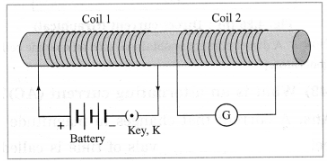
Take two coils of about 50 turns. Insert them over a nonconducting cylindrical roll as shown in Figure.
Image

(A thick paper roll can be used.) Connect coil 1 to a battery with a plug key K. Connect coil 2 to a galvanometer G. (1) Plug the key and observe the deflection in the galvanometer. (2) Unplug the key and again observe the deflection.
Note your observations. What conclusions do you draw from these observations?

Explain with diagram step-by-step energy conversion in Hydroelectric power plant:
Balance the following equation stepwise.
Write down the steps in balancing the equation.
$N_{2(g)} + H_{2(g)}\rightarrow NH_{3(g)}.$