MCQ
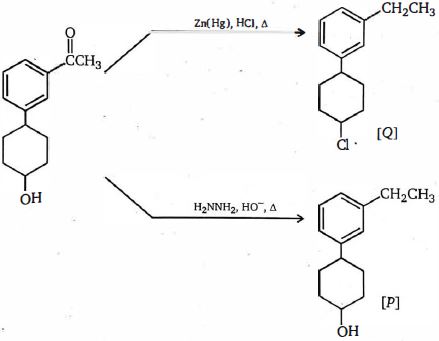
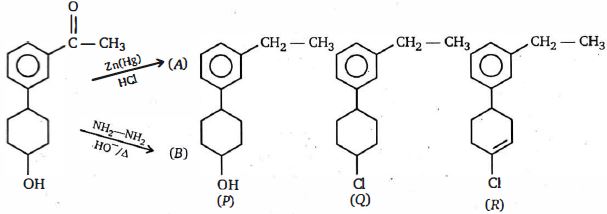
Identify product $(A)$ & $(B)$ from the given product $P, Q, R$
  • A
    $A = P, B = Q$
  • B
    $A = Q, B = R$
  • $A = Q, B = P$
  • D
    $A = R, B = P$

Answer

Correct option: C.
$A = Q, B = P$
c
$(c)$ Heating the following compound with $HCl$ (as required by the  Clemmensen reduction) would cause the alcohol to undergo substitution. Under  the basic conditions of the Wolff-Kishner reduction, the alcohol group would  remain unchanged.

Need a full question paper?

Generate a complete, print-ready paper with questions like this in minutes — across 16+ boards, with answer keys.

Start Generating Free

Similar questions

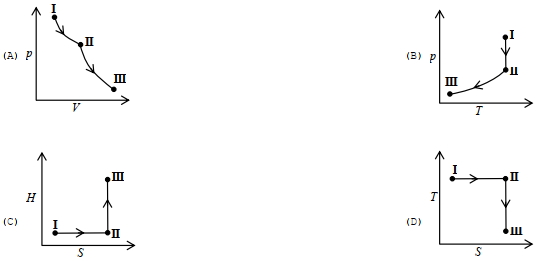
An ideal gas undergoes a reversible isothermal expansion from state $I$ to state $II$ followed by a reversible adiabatic expansion from state $II$ to state $III$. The correct plot($s$) representing the changes from state $I$ to state $III$ is(are)

( $p$ : pressure, $V$ : volume, $T$ : temperature, $H$ : enthalpy, $S$ : entropy)
One of the constituent of german silver is
The number of correct statements from the following

$A.$ For 1 s orbital, the probability density is maximum at the nucleus.

$B.$ For $2 s$ orbital, the probability density first increases to maximum and then decreases sharply to zero.

$C.$ Boundary surface diagrams of the orbitals encloses a region of $100 \%$ probability of finding the electron.

$D.$ $p$ and d-orbitals have $1$ and $2$ angular nodes respectively.

$E.$ Probability density of p-orbital is zero at the nucleus.

Which of the following compounds exhibits optical isomerism
Incorrect match is
The complex compounds which result from the coordination of carbon monoxide are known as
For a $d ^{4}$ metal ion in an octahedral field, the correct electronic configuration is:
Polysaccharides have .............. linkage ?
Ammonia gas can be collected by the displacement of
A $50\, watt$ bulb emits monochromatic red light of wavelength of $795\, \mathrm{~nm}$. The number of photons emitted per second by the bulb is $\mathrm{x} \times 10^{20}$. The value of $\mathrm{x}$ is ...... .

$\left[\right.$ Given $: \mathrm{h}=6.63 \times 10^{-34} \,\mathrm{Js}$ and $\left.\mathrm{c}=3.0 \times 10^{8} \,\mathrm{~ms}^{-1}\right]$