MCQ
Identify the correct order for the given property for following compounds.Choose the correct answer from the option given below :-
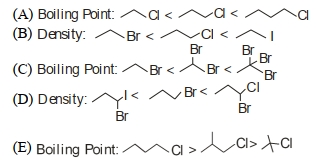
- A$(B), (C)$ and $(D)$ only
- ✓$(A), (C)$ and $(E)$ only
- C$(A), (C)$ and $(D)$ only
- D$(A), (B)$ and $(E)$ only
Boiling point of isomeric alkyl halide decreases with increase in branching
Density increases with increase in atomic mass of halogen atom
Generate a complete, print-ready paper with questions like this in minutes — across 16+ boards, with answer keys.
The correct statement($s$) regarding $P , Q , R$ and $S$ is(are)
$(A)$ Reaction of $P$ with $R$ in the presence of $KOH$ followed by acidification gives
$(B)$ Reaction of $R$ with $O _2$ in the presence of light gives phosgene gas
$(C)$ $Q$ reacts with aqueous $NaOH$ to produce $Cl _3 CCH _2 OH$ and $Cl _3 CCOONa$
$(D)$ $S$ on heating gives $P$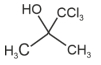
$Zn^{2 + }(aq.) + 2e⇔ Zn(s)$; $→$ $ -0.762$
$Cr^{3 + }(aq) + 3e ⇔ Cr(s)$; $→$ $-0.740$
$2H^ +(aq) + 2e⇔ {H_2}(g)$; $→$ $0.00$
$Fe^{3+}(aq) + e ⇔ Fe^{2+}(aq)$; $→$ $0.770$
Which is the strongest reducing agent
$A: \left[ Ni ( en )_{3}\right]^{2+}, B :\left[ Ni \left( NH _{3}\right)_{6}\right]^{2+}, C :\left[ Ni \left( H _{2} O \right)_{6}\right]^{2+}$