MCQ
In the following compounds, the decreasing order of basic strength will be:
  • $ \left(\mathrm{C}_2 \mathrm{H}_5\right)_2 \mathrm{NH} > \mathrm{C}_2 \mathrm{H}_5 \mathrm{NH}_2 > \mathrm{NH}_3 $
  • B
    $ \left(\mathrm{C}_2 \mathrm{H}_5\right)_2 \mathrm{NH} > \mathrm{NH}_3 > \mathrm{C}_2 \mathrm{H}_5 \mathrm{NH}_2 $
  • C
    $ \mathrm{NH}_3 > \mathrm{C}_2 \mathrm{H}_5 \mathrm{NH}_2 > \left(\mathrm{C}_2 \mathrm{H}_5\right)_2 \mathrm{NH} $
  • D
    $ \mathrm{C}_2 \mathrm{H}_5 \mathrm{NH}_2 > \mathrm{NH}_3 > \left(\mathrm{C}_2 \mathrm{H}_5\right)_2 \mathrm{NH} $
Answer

Correct option: A.
$ \left(\mathrm{C}_2 \mathrm{H}_5\right)_2 \mathrm{NH} > \mathrm{C}_2 \mathrm{H}_5 \mathrm{NH}_2 > \mathrm{NH}_3 $
$ \left(\mathrm{C}_2 \mathrm{H}_5\right)_2 \mathrm{NH} > \mathrm{C}_2 \mathrm{H}_5 \mathrm{NH}_2 > \mathrm{NH}_3 $​
Basic strength order
$\left(\mathrm{CH}_3 \mathrm{CH}_2\right)_2 \mathrm{NH}>\mathrm{CH}_3 \mathrm{CH}_2 \mathrm{NH}_2>\mathrm{NH}_3$
$2^\circ $ amine$, 1^\circ $ amine
Alkyl group shows $+I$ effect, and hence increases basicity.

Need a full question paper?

Generate a complete, print-ready paper with questions like this in minutes — across 16+ boards, with answer keys.

Start Generating Free

Similar questions

Assertion : For the Daniel cell, $Zn|Zn^{2+} ||Cu^{2+}|Cu$ with, $E_{cell} = 1.1\,V$, the application of opposite potential greater than $1.1\,V$ results into flow of electron from cathode to anode.

Reason : $Zn$ is deposited at anode, and $Cu$ is deposited at cathode.

Best method of preparing alkyl chloride is
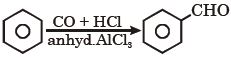
this reaction known as 
The order of energy absorbed which is responsible for the color of complexes

$(A)$ $\left[ Ni \left( H _{2} O \right)_{2}( en )_{2}\right]^{2+}$

$(B)$ $\left[ Ni \left( H _{2} O \right)_{4}(\text { en })\right]^{2+}$ and

$(C)$ $\left[ Ni ( en )_{3}\right]^{2+}$ is ...... .

Zero group elements are known as $.......$
Chlorine cannot displace
Which of the following reaction will not produce "Acetaldehyde" ?
The standard electrode potential of the half cells are given below

$Z{n^{2 + }} + 2{e^ - } \to Zn$ ;          $E = - 7.62\,\,V,$

$F{e^{2 + }} + 2{e^ - } \to Fe$ ;          $E = - 7.81\,\,V$

The emf of the cell $F{e^{2 + }} + Zn \to Z{n^{2 + }} + Fe$ is ............ $\mathrm{V}$

The following experimental rate data were obtained for a reaction carried out at $25^{\circ} C :$
$A_{(g)}+B_{(g)} \rightarrow C_{(g)}+D_{(g)}$
Initial $[A_{(g)}]/mol \ dm^{-3}$ Initial $[B_{(g)}]/mol \ dm^{-3}$ Initial rate$/mol \ dm^{-3}S^{-1}$
$3.0 \times 10^{-2}$ $2.0 \times 10^{-2}$ $1.89 \times 10^{-4}$
$3.0 \times 10^{-2}$ $4.0 \times 10^{-2}$ $1.89 \times 10^{-4}$
$6.0 \times 10^{-2}$ $4.0 \times 10^{-2}$ $7.56 \times 10^{-4}$
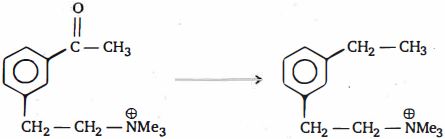
Above conversion can be achieved by