MCQ
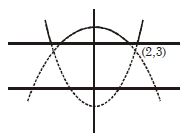
Identify the correct statement about function $f(x) = max(x^2 -1, 7 -x^2, 5)$
  • $f(x)$ is not differentiable at $4$ points
  • B
     range of $f(x)$ is $\left[ {3,\infty } \right)$
  • C
    $f(x)$ is an injective function
  • D
    $f(x)$ is discontinuous at $4$ points.

Answer

Correct option: A.
$f(x)$ is not differentiable at $4$ points
a

Need a full question paper?

Generate a complete, print-ready paper with questions like this in minutes — across 16+ boards, with answer keys.

Start Generating Free

Similar questions

Inverse matrix of $\left[ {\begin{array}{*{20}{c}}4&7\\1&2\end{array}} \right]$
The value of $\int_{-\frac{\pi}{2}}^{\frac{\pi}{2}} \frac{x^2 \cos x}{1+e^x} d x$ is equal to
Let $\alpha \in(0,1)$ and $\beta=\log _{ c }(1-\alpha)$. Let $P_n(x)=x+\frac{x^2}{2}+\frac{x^3}{3}+\ldots . .+\frac{x^n}{n}, x \in(0,1)$ Then the integral $\int \limits_0^\alpha \frac{ t ^{50}}{1- t } dt$ is equal to
The value of $\int \limits_{\frac{\pi}{3}}^{\frac{\pi}{2}} \frac{(2+3 \sin x)}{\sin x(1+\cos x)} d x$ is equal to
A person writes 4 letters and addresses 4 envelopes. If the letters are placed in the envelopes at random, then the probability that all letters are not placed in the right envelopes, is
Let the function $f, g$ and $h$ be defined as follows :

$f(x)\, = \left\{ {\begin{array}{*{20}{c}}{x\,\sin \,\left( {\frac{1}{x}}\right)\,\,\,\,\,\,\,for\,\, - 1 \le x \le 1\,\,and\,\,x \ne \,0}\\
{0\,\,\,\,\,\,\,\,\,\,\,\,for\,\,\,\,\,\,\,\,\,\,\,\,\,\,\,\,\,\,\,\,\,\,\,x\, = \,0}
\end{array}} \right.$

$g(x)\, = \left\{ {\begin{array}{*{20}{c}}{{x^2}\,\sin \,\left( {\frac{1}{x}} \right)\,\,\,\,\,\,\,for\,\, - 1 \le x \le 1\,\,and\,\,x \ne \,0}\\{0\,\,\,\,\,\,\,\,\,\,\,\,for\,\,\,\,\,\,\,\,\,\,\,\,\,\,\,\,\,\,\,\,\,\,\,x\, = \,0}\end{array}} \right.$ $h (x) = | x |^3$ for $- 1 \le x \le 1$ Which of these functions are differentiable at $x = 0$ ?
Kapila is trying to find the general solution of the following differential equations.
(i) $x e^{\frac{x}{y}} d x-y e^{\frac{3 x}{y}} d y=0$
(ii) $(2 x+1) \frac{d y}{d x}=3-2 y$
(iii) $\frac{d y}{d x}=\sin x-\cos y$
Which of the above become variable separable by substituting $y=b . x$, where $b$ is a variable?
If $\text{g(f(x))}=|\sin\text{x}|$ and $\text{f(g(x))}=(\sin\sqrt{\text{x}})^2,$ then

  1. $\text{f(x)}=\sin^2\text{x},\ \text{g(x)}=\sqrt{\text{x}}$

  2. $\text{f(x)}=\sin\text{x},\ \text{g(x)}=|\text{x}|$

  3. $\text{f(x)}=\text{x}^2,\ \text{g(x)}=\sin\sqrt{\text{x}}$

  4. $\text{f and g cannot be determined.}$

Let $H$ be the set of all houses in a village where each house is faced in one of the directions, East, West, North, South. Let $R = \{ (x,y)|(x,y) \in H \times H$ and $x, y$ are faced in same direction $\}$ . Then the relation $' R '$ is
Let $f$ and $g$ be functions defined by $f(x) = \frac{x}{{x + 1}},$ $g(x) = \frac{x}{{1 - x}}$, then $(fog)(x)$ is