MCQ
Identify the correct statement from below:
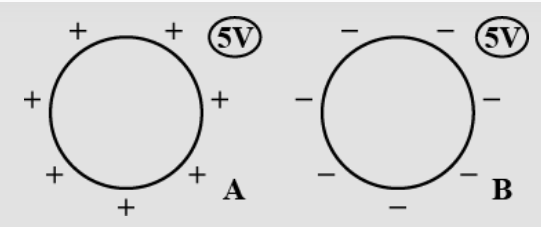
- AA will be at higher potential.
- BB will be at higher potential.
- CBoth will be at same potential.
- DCan't be said.
Explanation:
Point A have positive charge.
More is the positive charge, more will be the potential. So, A will be at higher potential.
Generate a complete, print-ready paper with questions like this in minutes — across 16+ boards, with answer keys.
A cable of resistance 10 Ω carries electric power from a generator producing 250 kW at 10000 volt. The current in the cable is
|
(a) 25 A |
(b) 250 A
|
(c) 100 A |
(d) 1000 A |
Zener breakdown takes place if
|
(a) Doped impurity is low |
(b) Doped impurity is high |
|
(c) Less impurity in N-part |
(d) Less impurity in P-type |
A small cylindrical soft iron piece is kept in a galvanometer so that
|
(a) A radial uniform magnetic field is produced |
|
(b) A uniform magnetic field is produced |
|
(c) There is a steady deflection of the coil |
|
(d) All of these |
Two wires A and B of same material and mass have their lengths in the ratio 1 : 2. On connecting them to the same source, the rate of heat dissipation in B is found to be 5W. The rate of heat dissipation in A is
|
(a) 10W |
(b) 5W |
(c) 20W |
(d) None of these |
There is an electric field E in X-direction. If the work done on moving a charge 0.2 C through a distance of 2 m along a line making an angle 60° with the X-axis is 4.0, what is the value of E
|
(a) |
(b) 4 N/C |
(c) 5 N/C |
(d) None of these |
The triode constant is out of the following
|
(a) Plate resistance |
(b) Amplification factor |
(c) Mutual conductance |
(d) All the above |
