MCQ
Identify the correct statement from the following about discharging of a cell.
  • A
    The direction of current in the cell is from positive to negative terminal.
  • B
    Terminal potential difference is greater than emf of the cell.
  • Terminal potential difference is lesser than emf of the cell.
  • D
    The current increases and decreases frequently.
Answer

Correct option: C.
Terminal potential difference is lesser than emf of the cell.

During discharging of a cell terminal potential difference, the terminal potential difference is lesser than the emf of the cell. The direction of current inside the cell is from negative terminal to positive terminal.

Need a full question paper?

Generate a complete, print-ready paper with questions like this in minutes — across 16+ boards, with answer keys.

Start Generating Free

Similar questions

A bullet of mass 2 gm is having a charge of 2μC. Through what potential difference must it be accelerated, starting from rest, to acquire a speed of 10 m/s
According to classical theory, the circular path of an electron in Rutherford atom is
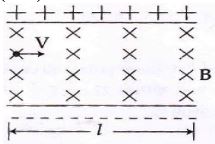
An electron moves straight inside a charged parallel plate capacitor of uniform charge density. The space between the plates is filled with uniform magnetic field of intensity $B ,$ as shown in the figure, Neglecting effect of gravity, the time of straight line motion of the electron in the capacitor is 
Assertion : The surface charge densities of two spherical conductors of different radii are equal. Then the electric field intensities near their surface are also equal.
Reason : Surface charge density is equal to charge per unit area.
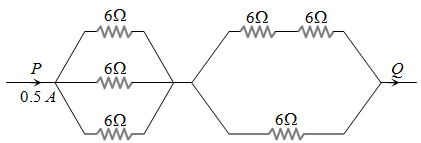
Resistances of 6 ohm each are connected in the manner shown in adjoining figure. With the current 0.5 ampere as shown in figure, the potential difference $V_P - V_Q$ is
The length of a metallic wire is increased by $20 \%$ and its area of cross section is reduced by $4 \%$. The percentage change in resistance of the metallic wire is $.......$
The working of dynamo is based on principle of
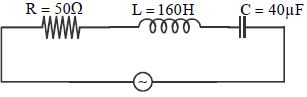
At what angular frequency $\omega $ the following circuit consumes maximum power?.......$rad/s$
The focal length of the objective and eye lenses of a microscope are $1.6\,cm$ and $2.5\, cm$ respectively. The distance between the two lenses is $21.7\,cm$. If the final image is formed at infinity, what is the linear magnification ?
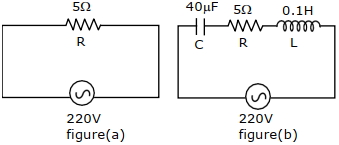
Two circuit are shown in the figure $(a)$ and $(b).$ At a frequency of $....\,rad/s$ the average power dissipated in one cycle will be same in both the circuits.