Question

Identify the error, if any 
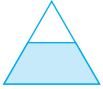
this is $\frac{1}{2}$

Answer

We know that,
A fraction is a number that represents part of a whole and the parts need to be equally divided.

Here,
The whole may be a single object or a group of objects.
But from the above, figure, we can see that,
It is not divided into equal parts.
Hence,
The given figures do not represent the given fraction.

Need a full question paper?

Generate a complete, print-ready paper with questions like this in minutes — across 16+ boards, with answer keys.

Start Generating Free

Similar questions

How many right angle do you make if you start facing north and turn anti-clockwise to east?
Compare $\frac{4}{5}$ and $\frac{5}{6}$.
A square piece of paper is folded in half. The square is then cut into two rectangles along the fold. Regardless of the size of the square, one of the following statements is always true. Which statement is true here?
(a) The area of each rectangle is larger than the area of the square.
(b) The perimeter of the square is greater than the perimeters of both the rectangles added together.
(c) The perimeters of both the rectangles added together are always $1 \frac{1}{2}$ times the perimeter of the square.
(d) The area of the square is always three times as large as the areas of both rectangles added together.
If $57 : x = 51 : 85,$ then the value of $x$ is:
What least number must be subtracted from $13801$ to get a number exactly divisible by $87?$
$12$ men can finish a piece of work in $25$ days. The number of days in which the same piece of work can be done by $20$ men, is:
Draw a line segment $AB$ of length $8\ cm.$ At each end of this line segment, draw a line perpendicular to $AB.$ Are these two lines parallel?
Roma gave a wooden board of length $150\frac14 \ cm$ to a carpenter for making a shelf. The Carpenter sawed off a piece of $40\frac15 \ cm$ from it. What is the length of the remaining piece?
Match the items of Column $I$ with that of Column $II:$
  Column $I$   Column $II$
$(i)$ The number of corners of a quadrilateral $(A)$ $=$
$(ii)$ The variable in the equation $2p + 3 = 5$ $(B)$ constant
$(iii)$ The solution of the equation $x + 2 = 3$ $(C)$ $+1$
$(iv)$ Solution of the equation $2p + 3 = 5$ $(D)$ $-1$
$(v)$ A sign used in an equation $(E)$ $p$
    $(F)$ $x$
Draw a number line and answer the given statement:
Which number will we reach if we move $5$ numbers to the left of $1.$