Question
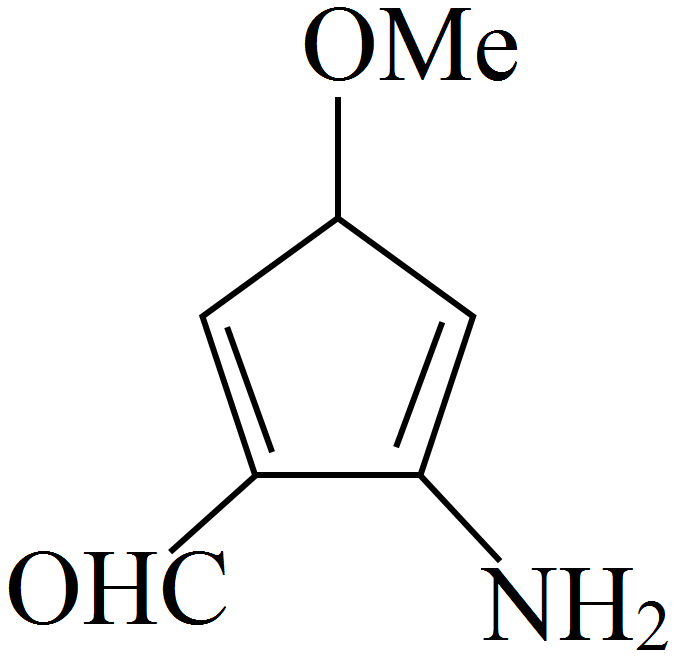
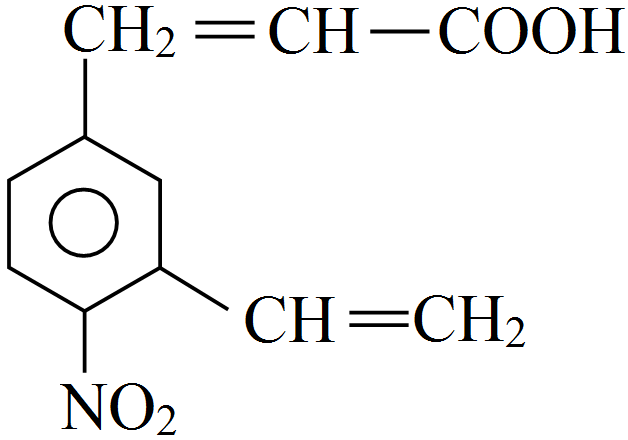
✓
Answer
- Functional groups are -NH2(amino), -OMe(methoxy) and -CHO(aldehydic)
- Carbon-carbon double bond, -NO2(nitro)and -COOH(carboxylic)
- -CO-(keto), -COCl(acylchloride)
- $ \ \ \ \ \ | \ \ \ \ \ \ \ |\\-\text{C}=\text{C}-$ (carbon-carbon double bond), $ \ \ \ \ \ \text{O}\\ \ \ \ \ \ \|\\-\text{C}-\text{NH}_2$ (acitamide).
Need a full question paper?
Generate a complete, print-ready paper with questions like this in minutes — across 16+ boards, with answer keys.
Explore more
Similar questions
Describe the change in hybridisation (if any) of the Al atom in the following reaction.
$\text{AlCl}_3\text{Cl}^-\rightarrow\text{AlCl}^-_4$
→$\text{AlCl}_3\text{Cl}^-\rightarrow\text{AlCl}^-_4$
A vessel contains 1.6g of dioxygen at STP (273.15K, 1 atm pressure). The gas is now transferred to another vessel at constant temperature, where pressure becomes half of the original pressure. Calculate
- Volume of the new vessel.
- Number of molecules of dioxygen.
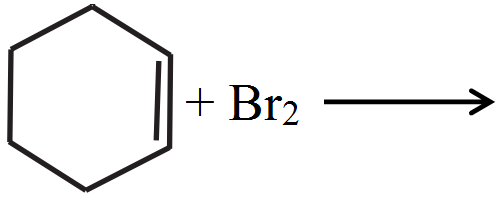
$\text{Pent-1-yne}\xrightarrow[(\text{ii})\ \text{CH}_3-\text{I}]{(\text{i})\ \text{NaNH}_2/\text{NH}_3}\text{A}\xrightarrow[\text{Lindlar's catalyst}]{\text{H}_2}\text{B}\xrightarrow{\text{Br}_2}\text{‘C’}$
→Identify A, B and C compounds and give their reactions.
For the following reactions, complete and Identify the type of reactions:
→-
$\text{CH}_3-\text{CH}_2-\text{CH}_2\text{Br}+\text{KOH(alc.)}\overrightarrow{\ \ \ \ \ \ }$
-
$\text{CH}_3-\text{CH}-\text{CH}_3+\text{KOH(aq)}\overrightarrow{ \ \ \ \ \ \ }\\ \ \ \ \ \ \ \ \ \ \ \ \ \ |\\ \ \ \ \ \ \ \ \ \ \ \ \ \text{Br}$
In a process, 701J of heat is absorbed by a system and 394J of work is done by the system. What is the change in internal energy for the process?
Write the atomic number of the element present in the third period and seventeenth group of the periodic table.
Explain why the electron gain enthalpy of fluorine is less negative than that of chlorine.
Among the elements of second period Li to Ne, pick out element:
- With the highest first ionisation energy.
- With highest electronegativity.
- With largest atomic radius.
- That is most reactive non-metal.
- That is most reactive metal.
- With valency equal to 4.
What is the maximum concentration of equimolar solutions of ferrous sulphate and sodium sulphide so that when mixed in equal volumes, there is no precipitation of iron sulphide? (For iron sulphide, $\left.K_{s p}=6.3 \times 10^{-18}\right)$
→Suggest the name of a Lewis acid other than anhydrous aluminium chloride which can be used during ethylation of benzene.