Question

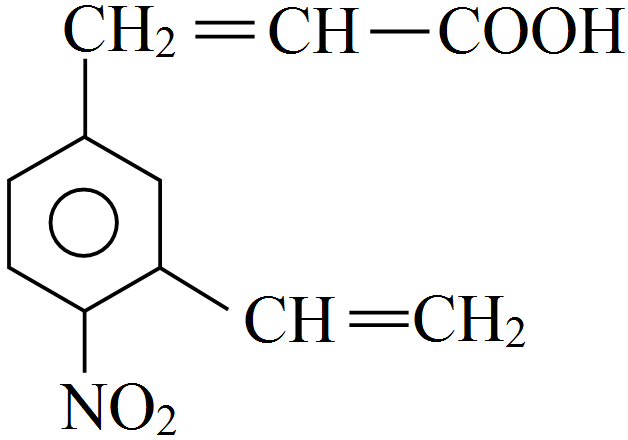
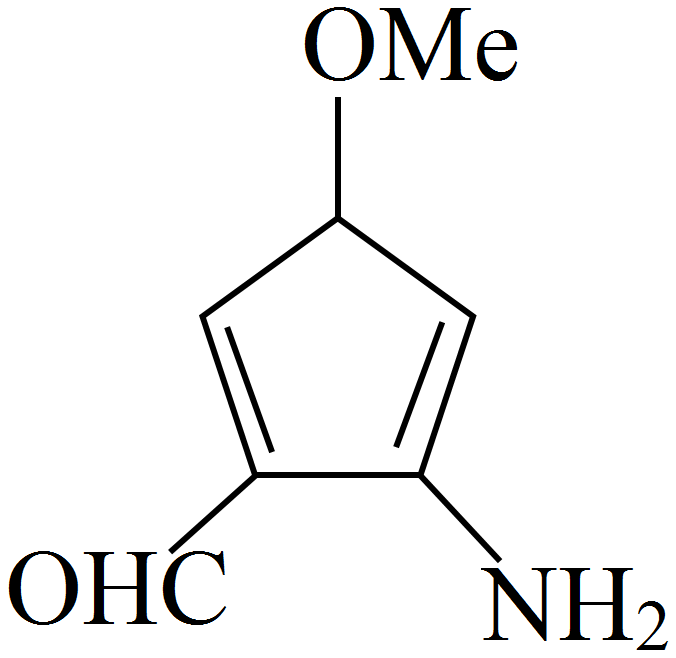
Identify the functional groups present in the following compounds.
  1.  
  1.  
  1. $\text{CH}_3-\text{CH}_2-\text{CO}-\text{CH}_2\\ \ \ \ \ \ \ \ \ \ \ \ \ \ \ \ \ \ \ \ \ \ \ \ \ \ \ \ \ \ \ \ \ \ \ \ \ \ |\\ \ \ \ \ \ \ \ \ \ \ \ \ \ \ \ \ \ \ \ \ \ \ \ \ \text{CH}_2-\text{COCl}$
  2. $\ \ \ \ \ \ \ \ \ \ \ \ \ \ \ \ \ \ \ \ \ \ \ \ \ \ \ \ \ \ \ \ \ \ \ \ \ \text{O}\\ \ \ \ \ \ \ \ \ \ \ \ \ \ \ \ \ \ \ \ \ \ \ \ \ \ \ \ \ \ \ \ \ \ \ \ \ \ \|\\\text{CH}_2=\text{CH}-\text{CH}_2-\text{C}-\text{NH}_2$

Answer

  1. Functional groups are $-NH_2(amino)$, -OMe(methoxy) and -CHO(aldehydic)
  2. Carbon-carbon double bond, $-NO_2(nitro)$ and -COOH(carboxylic)
  3. -CO-(keto), -COCl(acylchloride)
  4. $ \ \ \ \ \ | \ \ \ \ \ \ \ |\\-\text{C}=\text{C}-$ (carbon-carbon double bond), $ \ \ \ \ \ \text{O}\\ \ \ \ \ \ \|\\-\text{C}-\text{NH}_2$ (acitamide).

Need a full question paper?

Generate a complete, print-ready paper with questions like this in minutes — across 16+ boards, with answer keys.

Start Generating Free

Similar questions

The first $\left(\mathrm{IE}_1\right)$ and second $\left(\mathrm{IE}_2\right)$ ionisation enthalpies $\left(\mathrm{kJ} \mathrm{~mol}^{-1}\right)$ of three elements $\mathrm{I}, \mathrm{II}$ and III are given below:
Element
$\mathrm{IE}_1$
$\mathrm{IE}_2$
I
403
2640
II
549
1060
III
1142
2080
Identify the element which is likely to be:
  1. Non-metal.
  2. An alkali metal.
  3. An alkaline earth metal.
Describe the industrial use of hydrogen which depends on
  1. the heat liberated when it burns.
  2. its ability to react with vegetable oil in the presence of a catalyst.
  3. its ability to unite with $\mathrm{N}_2$.
How much energy is required to ionise a H atom if the electron occupies n = 5 orbit? Compare your answer with the ionization enthalpy of H atom (energy required to remove the electron from n = 1 orbit).
Reaction $\text{X} → \text{Y}\Delta\text{H}= \text{+ve}$ is spontaneous at temperature ‘T'. Determine:
  1. Sign of AS for this reaction.
  2. Sign of AG for ‘Y' to 'X'
  3. Sign of AG at temperature < T.
Calculate the pH of the resultant mixtures:
10 mL of $0.2 \mathrm{M} \mathrm{~Ca}(\mathrm{OH})_2+25 \mathrm{~mL}$ of 0.1 M HCl
What is the energy in joules, required to shift the electron of the hydrogen atom from the first Bohr orbit to the fifth Bohr orbit and what is the wavelength of the light emitted when the electron returns to the ground state? The ground state electron energy is $-2.18 \times 10^{-11}$ erg.
Give the relationship between $\Delta U$ and $\Delta H$ for gases.
A mixture of oxalic acid and formic acid is heated with concentrated $H_2SO_4$ and the gas evolved is collected. On treating the solution with KOH, the volume of the solution decreases by $\frac{1}{6}^\text{th}$ Calculate the molar ratios of two acids in the original mixture.
  1. A compound contains 21.6% sodium, 33.3% chlorine, 45.1 % oxygen. Derive its empirical formula.
  2. Write the empirical formulae for the following compounds:
  • $H_2O$
  • $B_2H_6$
  1. State the number of significant figures in each of the following numbers:
  • $638$
  • $0.000315$
i. Arrange $CO _2, H _2 O , H _2 O _2$ in increasing order of acidity.
ii. The correct order of bond length $O _2, H _2 O _2, O _3$.
iii. What is the use of EDTA?