Questions

3 Marks Question

Take a timed test

49 questions · self-marked practice — reveal the answer and mark yourself.

Question 13 Marks
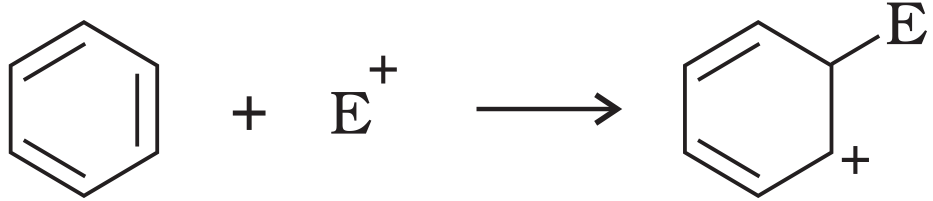
For the following bond cleavages, use curved-arrows to show the electron flow and classify each as homolysis or heterolysis. Identify reactive intermediate produced as free radical, carbocation and carbanion.
Answer
The bond cleavage using curved-arrows to show the electron flow of the given reaction can be represented as
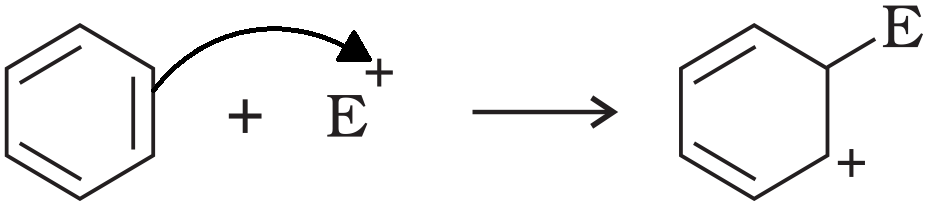
It is a heterolytic cleavage as the bond breaks in such a manner that the shared pair of electrons remains with one of the fragments. The intermediate formed is a carbocation.
View full question & answer
Question 23 Marks
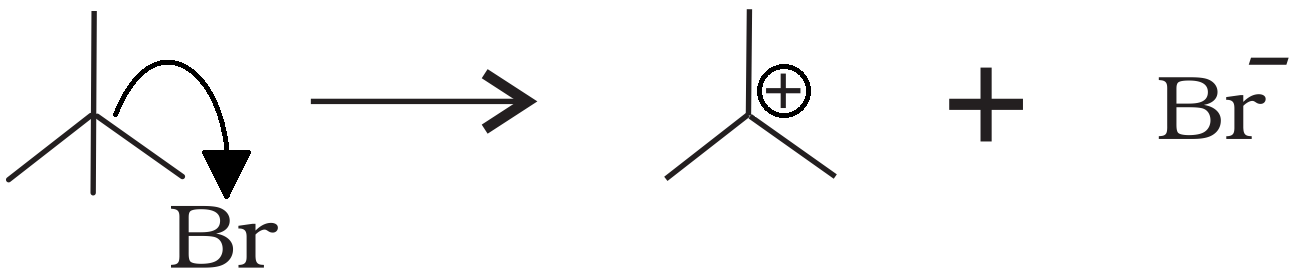
For the following bond cleavages, use curved-arrows to show the electron flow and classify each as homolysis or heterolysis. Identify reactive intermediate produced as free radical, carbocation and carbanion.
Answer
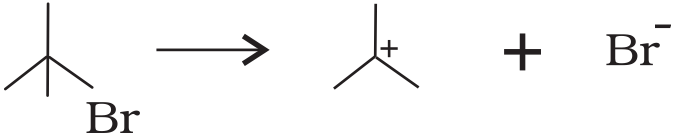
The bond cleavage using curved-arrows to show the electron flow of the given reaction can be represented as

It is an example of heterolytic cleavage as the bond breaks in such a manner that the shared pair of electrons remains with the bromine ion. The reaction intermediate formed is a carbocation.
View full question & answer
Question 33 Marks
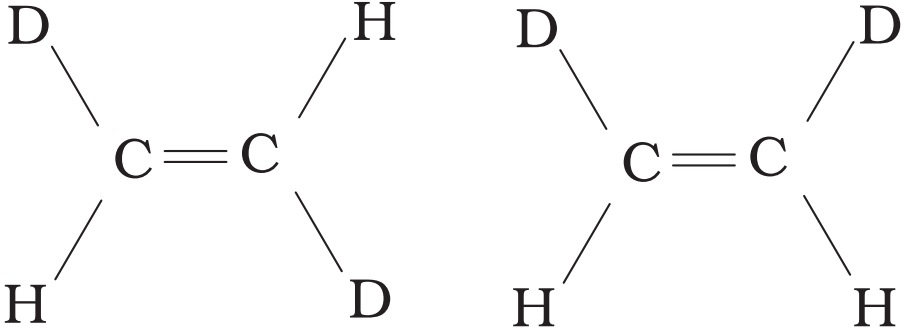
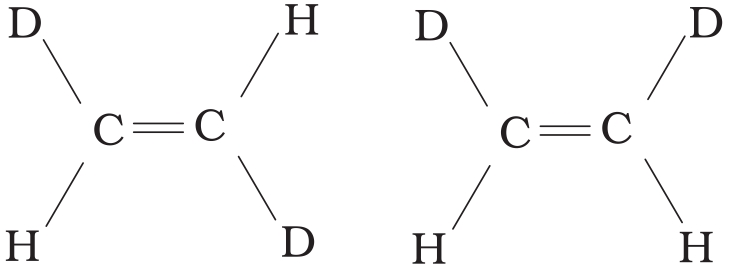
What is the relationship between the members of following pairs of structures? Are they structural or geometrical isomers or resonance contributors?
Answer
Compounds having the same molecular formula, the same constitution, and the sequence of covalent bonds, but with different relative position of their atoms in space are called geometrical isomers.

In structures I and II, the relative position of Deuterium (D) and hydrogen (H) in space are different. Hence, the given pairs represent geometrical isomers.
View full question & answer
Question 53 Marks
Why is nitric acid added to sodium extract before adding silver nitrate for testing halogens?
Answer
While testing the Lassaigne's extract for the presence of halogens, it is first boiled with dilute nitric acid. This is done to decompose NaCN to HCN and $\mathrm{Na}_2 \mathrm{~S}$ to $\mathrm{H}_2 \mathrm{~S}$ and to expel these gases. That is, if any nitrogen and sulphur are present in the form of NaCN and $\mathrm{Na}_2 \mathrm{~S}$, then they are removed. The chemical equations involved in the reaction are represented as
$\mathrm{NaCN}+\mathrm{HNO}_3 \rightarrow \mathrm{NaNO}_3+\mathrm{HCN}$
$\mathrm{Na}_2 \mathrm{~S}+2 \mathrm{HNO}_3 \rightarrow 2 \mathrm{NaNO}_3+\mathrm{H}_2 \mathrm{~S}$
View full question & answer
Question 63 Marks
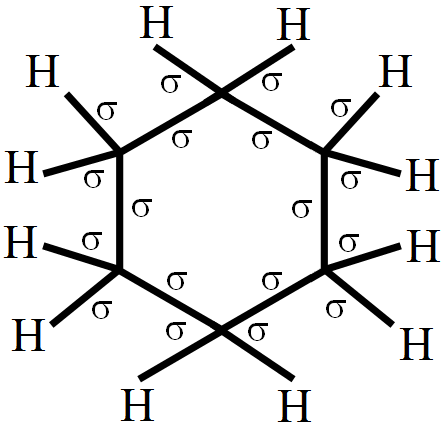
Indicate the $\sigma$ and $\pi$ bonds in the following molecules:
$\mathrm{C}_6 \mathrm{H}_{12}$,
Answer
The $\sigma$ and $\pi$ bonds are indicated below:

$\begin{matrix}6\text{C} - \text{C} & \sigma- \text{ bonds}\\12 \text{C} - \text{H} & \sigma-\text{bonds} \end{matrix}\Bigg\}$ Other cyclic isomers will also have same no. of $\sigma$ and $\pi$-bonds.
View full question & answer
Question 73 Marks
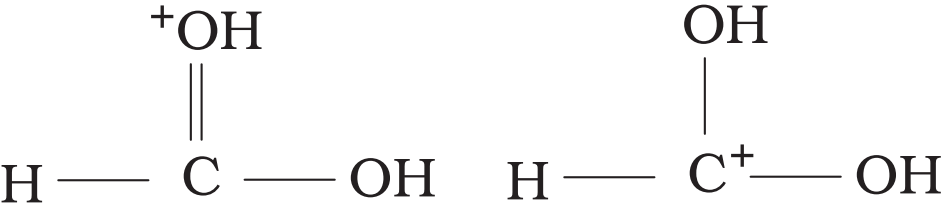
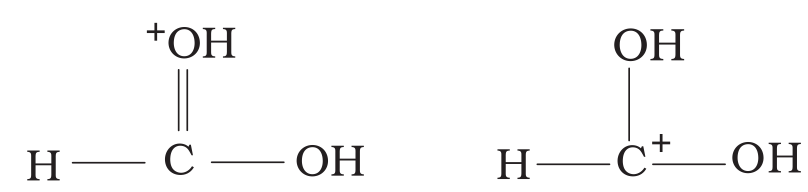
What is the relationship between the members of following pairs of structures? Are they structural or geometrical isomers or resonance contributors?
Answer
The given structures are canonical structures or contributing structures. They are hypothetical and individually do not represent any real molecule. Hence, the given pair represents resonance structures, called resonance isomers.
View full question & answer
Question 83 Marks
For the following bond cleavages, use curved-arrows to show the electron flow and classify each as homolysis or heterolysis. Identify reactive intermediate produced as free radical, carbocation and carbanion.
Answer
The bond cleavage using curved-arrows to show the electron flow of the given reaction can be represented as

It is an example of heterolytic cleavage as the bond breaks in such a manner that the shared pair of electrons remains with the carbon of propanone. The reaction intermediate formed is carbanion.
View full question & answer
Question 93 Marks
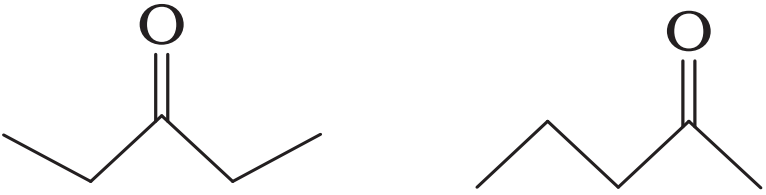
What is the relationship between the members of following pairs of structures? Are they structural or geometrical isomers or resonance contributors?
Answer
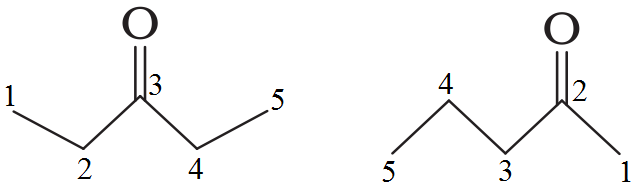
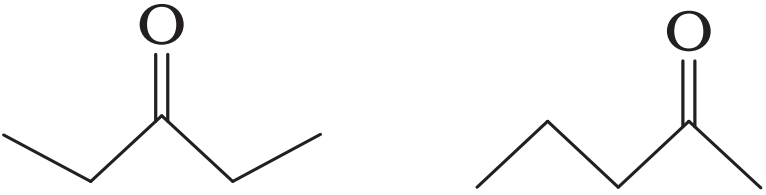
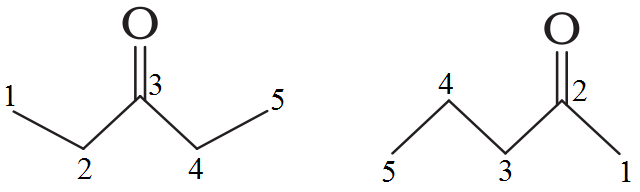
Compounds having the same molecular formula but with different structures are called structural isomers. The given compounds have the same molecular formula but they differ in the position of the functional group (ketone group).

In structure I, ketone group is at the C-3 of the parent chain (hexane chain) and in structure II, ketone group is at the C-2 of the parent chain (hexane chain). Hence, the given pair represents structural isomers.
View full question & answer
Question 103 Marks
Name a suitable technique of separation of the components from a mixture of calcium sulphate and camphor.
Answer
The process of sublimation is used to separate a mixture of camphor and calcium sulphate. In this process, the sublimable compound changes from solid to vapour state without passing through the liquid state. Camphor is a sublimable compound and calcium sulphate is a non-sublimable solid. Hence, on heating, camphor will sublime while calcium sulphate will be left behind.
View full question & answer
Question 113 Marks
For the following bond cleavages, use curved-arrows to show the electron flow and classify each as homolysis or heterolysis. Identify reactive intermediate produced as free radical, carbocation and carbanion.
Answer
The bond cleavage using curved-arrows to show the electron flow of the given reaction can be represented as

It is an example of homolytic cleavage as one of the shared pair in a covalent bond goes with the bonded atom. The reaction intermediate formed is a free radical.
View full question & answer
Question 123 Marks
What are electrophiles and nucleophiles? Explain with examples.
Answer
Electrophiles: The name electrophiles means electron loving. Electrophiles are electron deficient. They may be positive ions or neutral molecules. $\mathbf{E x}: \mathrm{H}^{+}, \mathrm{Cl}^{+}, \mathrm{Br}^{+}, \mathrm{NO}_2{ }^{+}, \mathrm{R}_3 \mathrm{C}^{+}, \mathrm{RN}_2{ }^{+}, \mathrm{AlCl}_3, \mathrm{BF}_3$ Nucleophiles: The name nucleophiles means 'nucleus loving' and indicates that it attacks the region of low electron density (positive centres) in a substrate molecule. They are electron rich they may be negative ions or neutral molecules.Ex: $\mathrm{Cl}^{-} \mathrm{Br}^{-}, \mathrm{CN}^{-}, \mathrm{OH}^{-}$, $\mathrm{RCR}_2{ }^{-}, \mathrm{NH}_3, \mathrm{RNH}_2, \mathrm{H}_2 \mathrm{O}, \mathrm{ROH}$ etc.
View full question & answer
Question 133 Marks
Which of the two: $\mathrm{O}_2 \mathrm{NCH}_2 \mathrm{CH}_2 \mathrm{O}$ - or $\mathrm{CH}_3 \mathrm{CH}_2 \mathrm{O}$ - is expected to be more stable and why?
Answer
$\mathrm{NO}_2$ group is an electron-withdrawing group. Hence, it shows -l effect. By withdrawing the electrons toward it, the $\mathrm{NO}_2$ group decreases the negative charge on the compound, thereby stabilising it. On the other hand, ethyl group is an electron-releasing group. Hence, the ethyl group shows +1 effect. This increases the negative charge on the compound, thereby destabilising it. Hence, $\mathrm{O}_2 \mathrm{NCH}_2 \mathrm{CH}_2 \mathrm{O}$ - is expected to be more stable than $\mathrm{CH}_3 \mathrm{CH}_2 \mathrm{O}$ -.
View full question & answer
Question 143 Marks
0.3780g of an organic chloro compound gave 0.5740g of silver chloride in Carius estimation. Calculate the percentage of chlorine present in the compound.
Answer
Mass of the compound = 0.3780g
Mass of silver chloride = 0.5740g
$\text{Percentage of chlorine}=\frac{35.5}{143.5}\times\frac{\text{Mass of siliver chloride}}{\text{Mass of compound}}\times100$
$=\frac{35.5}{143.5}\times\frac{(0.5740\text{g})}{(0.3780\text{g})}\times100=37.57\text{g}$
View full question & answer
Question 153 Marks
What is the hybridisation of each carbon in $\mathrm{H}_2 \mathrm{C}=\mathrm{C}=\mathrm{CH}_2$.
Answer
In $\ \ \ (1)\ \ \ (2)\ \ \ (3)\\\text{H}_2\text{C}=\text{C}=\text{CH}_2,$ carbon (1) and (3) are $\mathrm{sp}^2$ hybridised and carbon (2) is sp hybridized.
View full question & answer
Question 163 Marks
For testing halogens in an organic compound with $\mathrm{AgNO}_3$ solution, sodium extract (Lassaigne's test) is acidified with dilute $\mathrm{HNO}_3$. What will happen if a student acidifies the extract with dilute $\mathrm{H}_2 \mathrm{SO}_4$ in place of dilute $\mathrm{HNO}_3$ ?
Answer
On adding dilute $\mathrm{H}_2 \mathrm{SO}_4$ for testing halogens in an organic compound with $\mathrm{AgNO}_3$, white precipitate of $\mathrm{Ag}_2 \mathrm{SO}_4$ is formed. This will interfere with the test of chlorine and this $\mathrm{Ag}_2 \mathrm{SO}_4$ may be mistaken for white precipitate of chlorine as AgCl . Hence, dilute $\mathrm{HNO}_3$ should be used instead of dilute $\mathrm{H}_2 \mathrm{SO}_4$.
View full question & answer
Question 173 Marks
“Stability of carbocations depends upon the electron releasing inductive effect of groups adjacent to positively charged carbon atom involvement of neighbouring groups in hyperconjugation and resonance.”
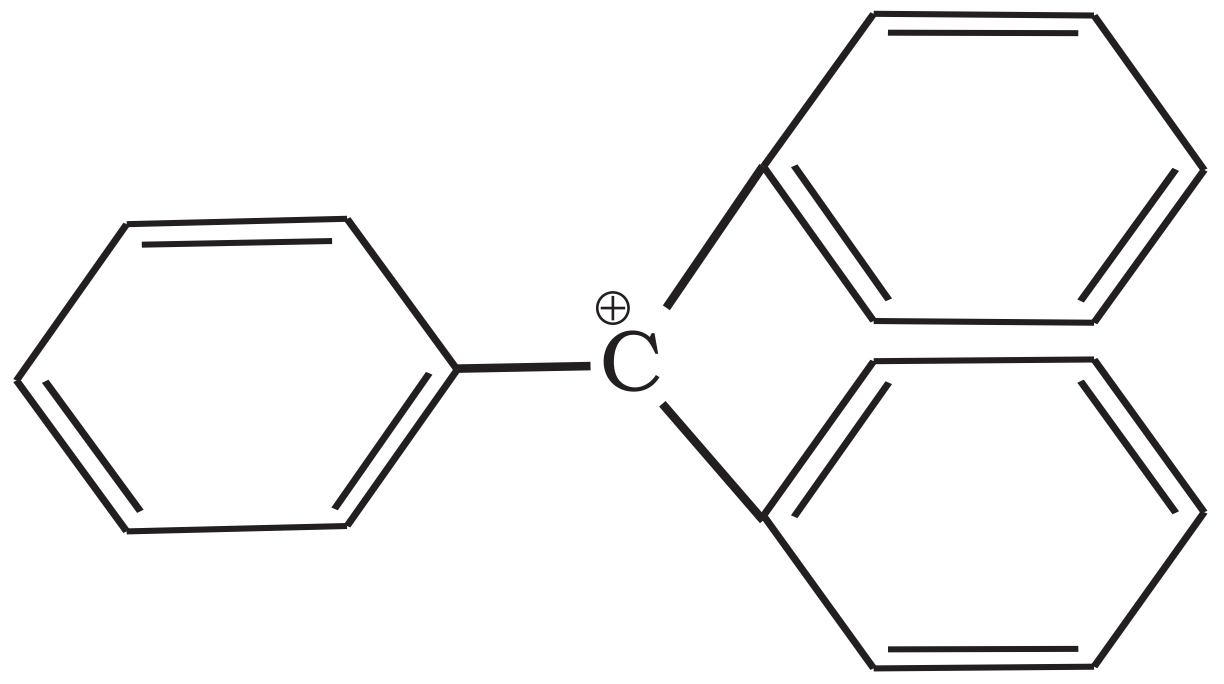
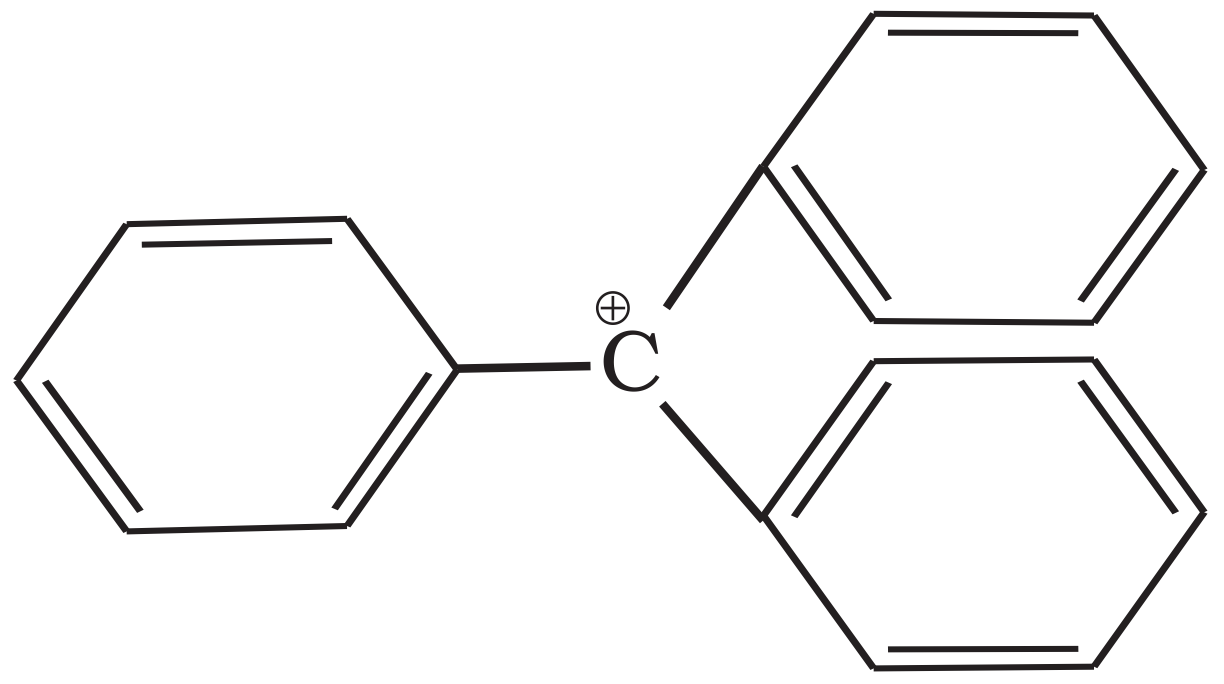
The structure of triphenylmethyl cation is given below. This is very stable and some of its salts can be stored for months. Explain the cause of high stability of this cation.
Answer
Triphenylmethyl cation is very stable because +ve charge of methyl carbon is delocalized in three phenyl rings. In each phenyl ring, +ve charge is developed on 2 ortho position and para position, i.e. three resonating structures. Total resonating structures given by triphenylmethyl cation are nine. Hence, it is very stable. These structures can be shown as.

View full question & answer
Question 183 Marks
  1. Give one example of position isomerism.
  2. What are electrophiles? Give one example of electrophilic substitution reaction.
  3. Write the chemistry of Lassaigne's test for qualitative analysis of nitrogen.
Answer
  1.  
$\ \ \ \ \ \ \ \ \ \ \ \ \ \ \ \ \ \ \ \ \ \ \ \ \ \ \ \ \ \ \ \ \ \ \ \ \ \ \ \ \ \ \ \ \ \ \ \text{Cl}\\ \ \ \ \ \ \ \ \ \ \ \ \ \ \ \ \ \ \ \ \ \ \ \ \ \ \ \ \ \ \ \ \ \ \ \ \ \ \ \ \ \ \ \ \ \ \ \ \ |\\\text{CH}_3\text{CH}_2\text{CH}_2\text{Cl}\text{ and }\text{CH}_3-\text{CH}-\text{CH}_3\\1-\text{Cholropropane}\ \ \ \ \ \ \ \ \ \ \ \ \ \ \ 2-\text{Cholropropane}$
  1. Those species which are positively charged or electron deficient are called electrophiles. e.g. $H^+, AlCl_3, Cl^+$
  1. Fuse the organic compound with sodium metal. Sodium reacts with 'C' and 'N' present in organic compound to form NaCN.
$\text{Na}+\text{C}+\text{N}\xrightarrow{\ \ \ \ \ \ \ \ \ \ \ \ }\text{NaCN}$
Add $FeSO_4$ to L.E. (Lassaigne's extract)
$6\text{NaCl}+\text{FeSO}_4\xrightarrow{\ \ \ \ \ \ \ \ \ }\text{Na}_4[\text{Fe(CN)}_6]+\text{NaSO}_4$
Dilute $H_2SO_4​​​​​​​$ is added to convert $Fe^{2+}$ to $Fe^{3+}$ and blue colour is formed due to formation of ferric ferrocyanide.
$4\text{Fe}^{3+}+\text{3Na}_4[\text{Fe(CN)}_6]\xrightarrow{\ \ \ \ \ \ \ \ \ }\text{Fe}_4[\text{Fe}(\text{CN})_6]_3+12\text{Na}^+\\ \ \ \ \ \ \ \ \ \ \ \ \ \ \ \ \ \ \ \ \ \ \ \ \ \ \ \ \ \ \ \ \ \ \ \ \ \ \ \ \ \ \ \ \ \ \ \ \ \ \ \ \text{Blue colouration}$
View full question & answer
Question 193 Marks
0.25g of an organic compound gave $30cm^3$ of moist dinitrogen at 288K and 745mm pressure. Calculate the percentage of nitrogen.
(Aq. tension at 288K = 12.7mm).
Answer
Pressure of moist dinitrogen obtained = 745mm
Aq. tension at same temperature = 12.7mm
$\therefore$ Pressure due to nitrogen = 745 - 12.7 = 732.3mm
To calculate the volume of $N_2$ at S.T.P.
$\frac{\text{P}_1\text{V}_1}{\text{T}_1}=\frac{\text{P}_2\text{V}_2}{\text{T}_2}$
$\Rightarrow\text{V}_2=\frac{\text{P}_1\text{V}_1}{\text{T}_1}$
$=\frac{732.3\times30\times273}{288\times760}=27.4\text{cm}^3$
$\therefore\%\text{ of Nitrogen}=\frac{28\times27.4\times100}{22400\times0.25}$
$=13.7\%$
View full question & answer
Question 203 Marks
Write structural formulae for all the isomeric amines with molecular formula $\mathrm{C}_4 \mathrm{H}_{11} \mathrm{~N}$.
Answer
  1. $\text{CH}_3-\text{CH}_2-\text{CH}_2-\text{CH}_2-\text{NH}_2$
  2. $\text{CH}_3-\text{CH}_2-\text{CH}-\text{CH}_3\\ \ \ \ \ \ \ \ \ \ \ \ \ \ \ \ \ \ \ \ \ \ \ \ \ \ \ |\\ \ \ \ \ \ \ \ \ \ \ \ \ \ \ \ \ \ \ \ \ \ \ \ \ \ \text{NH}_2$
  3. $\text{CH}_3-\text{CH}-\text{CH}_2-\text{NH}_2\\ \ \ \ \ \ \ \ \ \ \ \ \ \ |\\ \ \ \ \ \ \ \ \ \ \ \ \ \text{CH}_3$
  4. $ \ \ \ \ \ \ \ \ \ \ \ \ \text{CH}_3\\ \ \ \ \ \ \ \ \ \ \ \ \ \ |\\\text{CH}_3-\text{C}-\text{NH}_2\\ \ \ \ \ \ \ \ \ \ \ \ \ \ |\\ \ \ \ \ \ \ \ \ \ \ \ \ \text{CH}_3$
  5. $\text{CH}_3-\text{CH}_2-\text{CH}_2-\text{NH}-\text{CH}_3$
  6. $\text{CH}_3-\text{CH}-\text{NH}-\text{CH}_3\\ \ \ \ \ \ \ \ \ \ \ \ \ \ |\\\ \ \ \ \ \ \ \ \ \ \ \ \text{CH}_3$
  7. $\text{CH}_3-\text{CH}_2-\text{NH}-\text{CH}_2-\text{CH}_3$
  8. $\text{CH}_3-\text{CH}_2-\text{N}-\text{CH}_3\\ \ \ \ \ \ \ \ \ \ \ \ \ \ \ \ \ \ \ \ \ \ \ \ \ \ \ |\\ \ \ \ \ \ \ \ \ \ \ \ \ \ \ \ \ \ \ \ \ \ \ \ \ \ \text{CH}_3$
View full question & answer
Question 213 Marks
  1. Write IUPAC name of the following:
$\text{CH}_3\text{CHCH}\equiv\text{CH}\\\ \ \ \ \ \ \ \ \ |\\ \ \ \ \ \ \ \ \ \text{CH}=\text{CH}_2$
  1. Draw the structure of Pent-4-en-2-ol.
  2. What is nucleophile? Give one example.
Answer
  1. $\text{CH},-\stackrel{3\ \ \ \ \ }{\text{CH}}-\stackrel{4\ \ \ \ \ }{\text{CH}}\equiv\stackrel{5 \ \ \ \ }{\text{CH}}\\\ \ \ \ \ \ \ \ \ \ \ \ |\\\ \ \ \ \ \ \ \ \ \ \ \text{CH}=\text{CH}_2\\\ \ \ \ \ \ \ \ \ \ ^{{\ \ 2\ \ \ \ \ \ \ \ \ \ \ \ \ \ 1}}\\ \ \ \ \ \ \ \ ^{\text{3-methyl pent-1-en-4yne}}$
  2. $\stackrel{1\ \ \ \ \ }{\text{CH}_3}-\stackrel{2\ \ \ \ }{\text{CH}}-\stackrel{3\ \ \ \ \ }{\text{CH}}-\stackrel{4\ \ \ \ }{\text{CH}}=\stackrel{5 \ \ \ \ \ }{\text{CH}_2}\\\ \ \ \ \ \ \ \ \ \ \ \ \ \ |\\\ \ \ \ \ \ \ \ \ \ \ \ \ \text{OH}$
  3. Nucleophile is a species which is either negatively charged or has lone pair of electron.
View full question & answer
Question 223 Marks

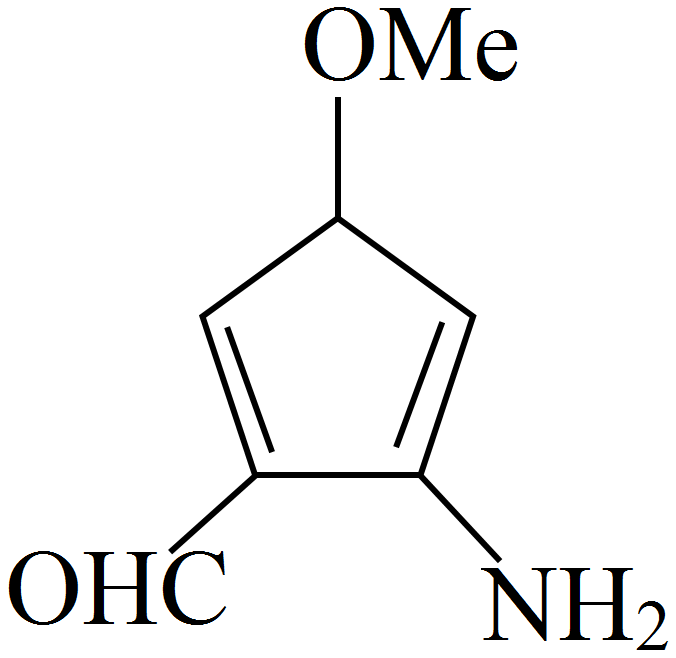
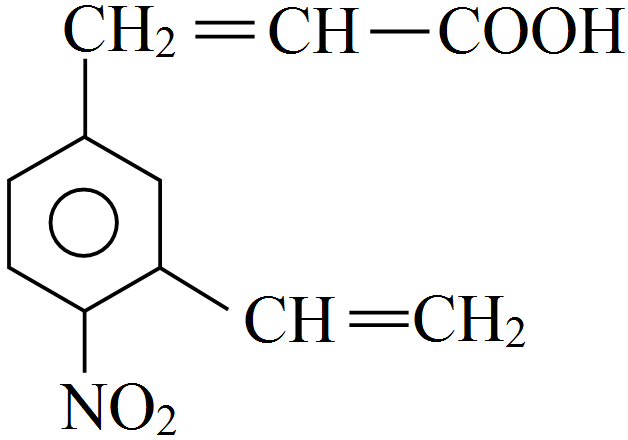
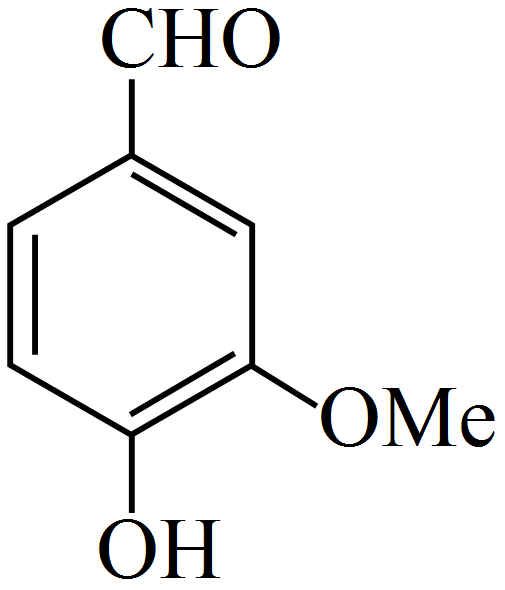
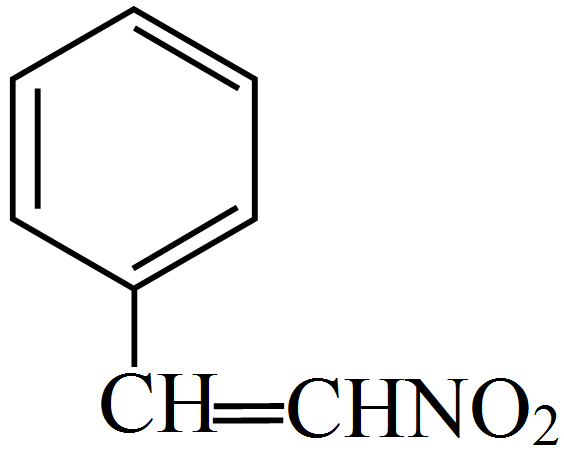
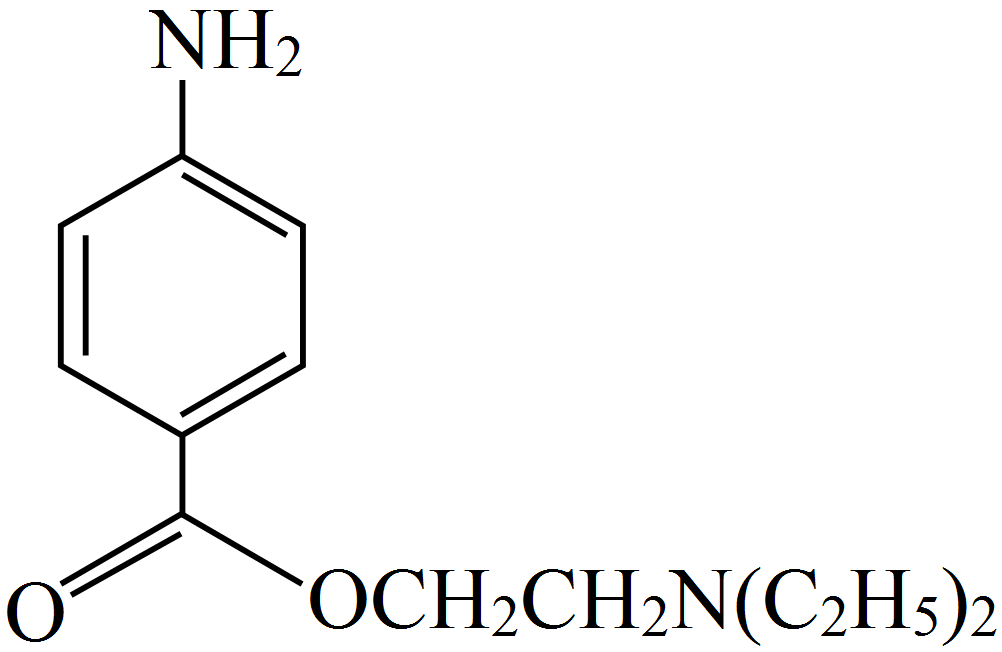
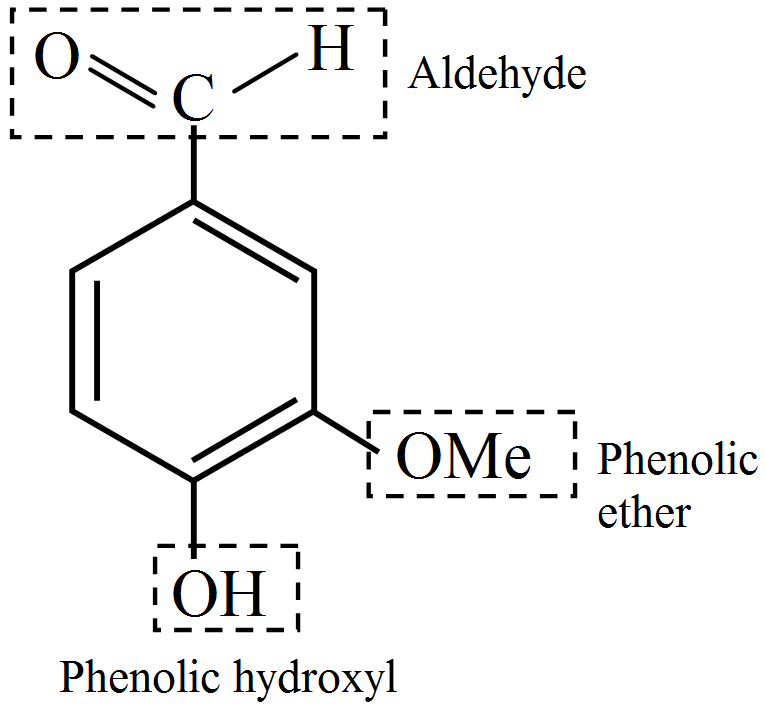
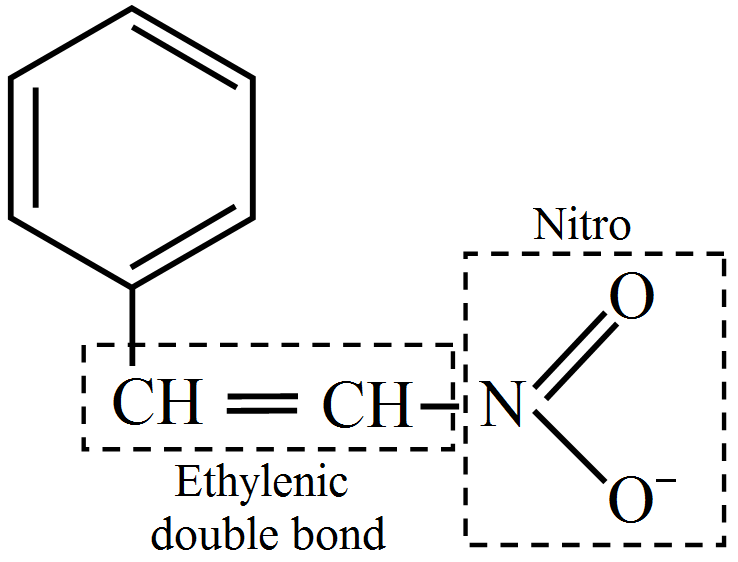
Identify the functional groups present in the following compounds.
  1.  
  1.  
  1. $\text{CH}_3-\text{CH}_2-\text{CO}-\text{CH}_2\\ \ \ \ \ \ \ \ \ \ \ \ \ \ \ \ \ \ \ \ \ \ \ \ \ \ \ \ \ \ \ \ \ \ \ \ \ \ |\\ \ \ \ \ \ \ \ \ \ \ \ \ \ \ \ \ \ \ \ \ \ \ \ \ \text{CH}_2-\text{COCl}$
  2. $\ \ \ \ \ \ \ \ \ \ \ \ \ \ \ \ \ \ \ \ \ \ \ \ \ \ \ \ \ \ \ \ \ \ \ \ \ \text{O}\\ \ \ \ \ \ \ \ \ \ \ \ \ \ \ \ \ \ \ \ \ \ \ \ \ \ \ \ \ \ \ \ \ \ \ \ \ \ \|\\\text{CH}_2=\text{CH}-\text{CH}_2-\text{C}-\text{NH}_2$
Answer
  1. Functional groups are $-NH_2(amino)$, -OMe(methoxy) and -CHO(aldehydic)
  2. Carbon-carbon double bond, $-NO_2(nitro)$ and -COOH(carboxylic)
  3. -CO-(keto), -COCl(acylchloride)
  4. $ \ \ \ \ \ | \ \ \ \ \ \ \ |\\-\text{C}=\text{C}-$ (carbon-carbon double bond), $ \ \ \ \ \ \text{O}\\ \ \ \ \ \ \|\\-\text{C}-\text{NH}_2$ (acitamide).
View full question & answer
Question 233 Marks
Match the intermediates given in Column I with their probable structure in Column II.
 
Column I
 
Column II
(i)
Free radical
(a)
Trigonal planar
(ii)
Carbocation
(b)
Pyramidal
(iii)
Carbanion
(c)
Linear
 
Answer
 
Column I
 
Column II
(i)
Free radical
(a)
Trigonal planar
(ii)
Carbocation
(a)
Trigonal planar
(iii)
Carbanion
(b)
Pyramidal
View full question & answer
Question 243 Marks

In which of the following compounds the C-Cl bond ionisation shall give most stable carbocation?
  1. $\text{CH}_3-\text{CH}-\text{Cl}\\ \ \ \ \ \ \ \ \ \ \ \ \ \ |\\\\ \ \ \ \ \ \ \ \ \ \ \ \ \text{CH}_3$
  2. $\ \ \ \ \ \ \ \ \ \ \ \ \text{Cl}\\ \ \ \ \ \ \ \ \ \ \ \ \ \ |\\\text{CH}_3-\text{C}-\text{CH}_3\\ \ \ \ \ \ \ \ \ \ \ \ \ \ |\\ \ \ \ \ \ \ \ \ \ \ \text{CH}_3$
  3.  
  1. $\ \ \ \ \ \ \ \ \ \ \ \ \ \ \ \ \ \ \ \ {\text{H}}\\ \ \ \ \ \ \ \ \ \ \ \ \ \ \ \ \ \ \ \ \ \ |\\\text{O}_2\text{NH}_2\text{C}-\text{C}-\text{Cl}\\ \ \ \ \ \ \ \ \ \ \ \ \ \ \ \ \ \ \ \ \ \ |\\ \ \ \ \ \ \ \ \ \ \ \ \ \ \ \ \ \ \ \ \ \text{H}$
View full question & answer
Question 253 Marks
In DNA and RNA, nitrogen atom is present in the ring system. Can Kjeldahl method be used for the estimation of nitrogen present in these? Give reasons.
Answer
DNA and RNA have nitrogen in the heterocyclic rings. Nitrogen present in rings, azo groups and nitro groups cannot be removed as ammonia. So, Kjeldahl’s method cannot be used for the estimation of nitrogen present in these.
View full question & answer
Question 263 Marks
The following techniques are used to quantitatively estimate extra elements in organic compound. Identify the name of the method and the element estimated by this method.
i. A known mass of an organic compound is heated with fuming $\mathrm{HNO}_3$ in presence of $\mathrm{AgNO}_3$.
ii. Organic compound is heated with dry copper oxide in atmosphere of $\mathrm{CO}_2$.
iii. Organic compound is heated with conc. $\mathrm{H}_2 \mathrm{SO}_4$.
Answer
  1. Estimation of halogen by Carius method.
  2. Estimation of nitrogen by Dumas method.
  3. Estimation of nitrogen by Kjeldahl's method.
View full question & answer
Question 273 Marks
Write down the formulae of the first four members of each homologous series beginning with the following compounds.
  1. $\text{CH}_2=\text{CH}_2$
  2. $\text{HCOOH}$
  3. $\text{CH}_3\text{COCH}_3$
  4. $\text{CH}_3\text{OH}$
  5. $\text{HC}\equiv\text{CH}$
Answer
  1. $\text{CH}_2=\text{CH}_2,\ \text{CH}_3\text{CH}=\text{CH}_2,$
$\text{CH}_3\text{CH}_2\text{CH}=\text{CH}_2,\ \text{CH}_3\text{CH}_2\text{CH}_2\text{CH}=\text{CH}_2$
  1. $\text{HCOOH},\text{ CH}_3\text{COOH},\ \text{CH}_3\text{CH}_2\text{COOH},$
$\text{CH}_3\text{CH}_2\text{CH}_2\text{COOH}$
  1. $\text{CH}_3\text{COCH}_3,\text{ CH}_3\text{CH}_2\text{COCH}_3,\text{CH}_3\text{CH}_2\text{CH}_2\text{COCH}_3,$
$\text{CH}_3\text{CH}_2\text{CH}_2\text{CH}_2\text{COCH}_3$
  1. $\text{CH}_3\text{OH},\text{CH}_3\text{CH}_2\text{OH},\text{CH}_3\text{CH}_2\text{CH}_2\text{OH},\\\text{CH}_3\text{CH}_2\text{CH}_2\text{CH}_2\text{OH}$
  2. $\text{HC}\equiv\text{CH},\text{ CH}_3\text{C}\equiv\text{CH, CH}_3\text{CH}_2\text{C}\equiv\text{CH}\\\text{CH}_3\text{CH}_2\text{CH}_2\text{C}\equiv\text{CH}$
View full question & answer
Question 283 Marks
  1. Write IUPAC name of the following:
  1. $\text{CH}_2\text{CH}_2\text{CHO}\text{ and }\text{CH}_3\text{C}-\text{CH}_3\\ \ \ \ \ \ \ \ \ \ \ \ \ \ \ \ \ \ \ \ \ \ \ \ \ \ \ \ \ \ \ \ \ \ \ \ \ \ \ \ \ \ ||\\ \ \ \ \ \ \ \ \ \ \ \ \ \ \ \ \ \ \ \ \ \ \ \ \ \ \ \ \ \ \ \ \ \ \ \ \ \ \ \ \ \ \text{O}$
  2. Draw the structure of 3-oxopentanal.
Answer
  1.  
  1. Functional isomerism.
  2. $ \ \ \ \ \ \ \ \ \ \ \ \ \ \ \ \ \ \ \ \ \ \ \ \ \ \ \ \ \ \ \ \ \ \ \ \ \ \ \ \ \ \ \ \ \ \text{O}\\ \ \ \ \ \ \ \ \ \ \ \ \ \ \ \ \ \ \ \ \ \ \ \ \ \ \ \ \ \ \ \ \ \ \ \ \ \ \ \ \ \ \ \ \ \ \|\\\text{CH}_3-\text{CH}_2-\text{C}-\text{CH}_2-\text{C}-\text{H}\\ \ \ \ \ \ \ \ \ \ \ \ \ \ \ \ \ \ \ \ \ \ \ \ \ \ \|\\ \ \ \ \ \ \ \ \ \ \ \ \ \ \ \ \ \ \ \ \ \ \ \ \ \ \text{O}\\\ \ \ \ \ \text{is structive of 3-oxo pentanal.}$
View full question & answer
Question 293 Marks
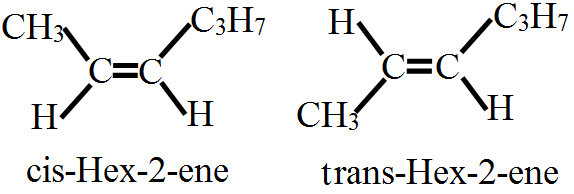
  1. Draw cis and trans-structures for Hex-2-ene. Which isomer will have higher boiling point and why?
  2.  
Answer
  1.  

cis-Hex-2-ene has higher dipole moment and therefore, it has higher boiling point.
  1.  

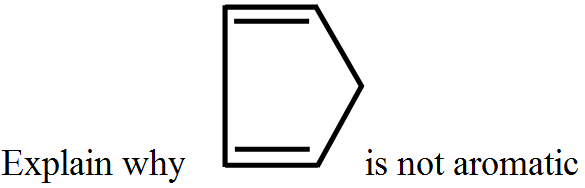
is not aromatic, Due to the presence of $\mathrm{sp}^3$
carbon (carbon 3), the system is not planar, Futher, it contains only four n electsons. Hence, it is not aromatic because it does not contain planar delocalised cloud with $\text{(4n} + 2)\pi$ electrons.
View full question & answer
Question 303 Marks
  1. What is role of copper oxide in estimation of carbon and hydrogen?
  2. How do we test phosphorus in given organic compound?
  3. What is shape of $\stackrel{\oplus\ \ }{\text{CH}_3}$ (methyl carbocation) and $\stackrel{\oplus\ \ }{\text{CH}_3}$ (methyl carbanion)?
Answer
  1. It acts as oxidising agent. It oxidises $C$ to $CO_2$ and $H_2$ to $H_2O$.
  2.  
  • Fuse the given organic compound with $Na_2O_2$
  • The solution is boiled with conc. $HNO_3$​​​​​​​ and then added ammonium molybdate. Canary yellow precipatate confirms the presence of phosphorus.
View full question & answer
Question 313 Marks
QUESTION "Stability of carbocations depends upon the electron releasing inductive effect of groups adjacent to positively charged carbon atom involvement of neighbouring groups in hyperconjugation and resonance."
Write structures of various carbocations that can be obtained from 2-methylbutane. Arrange these carbocations in order of increasing stability.
Answer
2-Methylbutane has four possible carbocations$\ \ \ \ \ \ \ \ \ \ \ \ \ \ \ \ \ \ \ \ \ \ \ \ \ \ \ \ \ \ \ \ \ \ \ +\ \ \ \ \ \ \ \ \ \ \ \ \ \ \ \ \ \ \ \ \ \ \ \ \ \ \ \ \ +\\\text{CH}_3-\text{CH}-\text{CH}_2-\text{CH}_2\ \ \ \ \text{CH}_3-\text{CH}-\text{CH}-\text{CH}_3\\\ \ \ \ \ \ \ \ \ \ \ \ \ | \ \ \ \ \ \ \ \ \ \ \ \ \ \ \ \ \ \ \ \ \ \ \ \ \ \ \ \ \ \ \ \ \ \ \ \ \ \ \ \ \ \ \ \ |\\\ \ \ \ \ \ \ \ \ \ \ \ \text{CH}_3\ \ \ \ \ \ \ \ \ \ \ \ \ \ \ \ \ \ \ \ \ \ \ \ \ \ \ \ \ \ \ \ \ \ \ \ \ \text{CH}_3\\\ \ \ \ \ \ \ \ \ \ \ \ \ \ \text{I}(1^\circ)\ \ \ \ \ \ \ \ \ \ \ \ \ \ \ \ \ \ \ \ \ \ \ \ \ \ \ \ \ \ \ \ \ \ \ \ \text{II}(2^\circ)$
$\ \ \ \ \ \ \ \ \ \ \ \ +\ \ \ \ \ \ \ \ \ \ \ \ \ \ \ \ \ \ \ \ \ \ \ \ \ \ +\\\text{CH}_3-\text{C}-\text{CH}_2-\text{CH}_3\ \ \ \ \text{CH}_2-\text{CH}_2\text{CH}-\text{CH}_2-\text{CH}_3\\\ \ \ \ \ \ \ \ \ \ \ \ \ |\ \ \ \ \ \ \ \ \ \ \ \ \ \ \ \ \ \ \ \ \ \ \ \ \ \ \ \ \ \ \ |\\\ \ \ \ \ \ \ \ \ \ \ \ \text{CH}_3\ \ \ \ \ \ \ \ \ \ \ \ \ \ \ \ \ \ \ \ \ \ \ \ \ \text{CH}_3\\\ \ \ \ \ \ \ \ \ \ \text{III}(3^\circ)\ \ \ \ \ \ \ \ \ \ \ \ \ \ \ \ \ \ \ \ \ \ \text{IV}(1^\circ)$ I < IV < II < III Stability of carbocation increases in the order $1^\circ < 2^\circ < 3^\circ$. Out of I and IV, IV is more stable than I because in IV, $CH_3$​​​​​​​ group is at a-carbon and in I, it is at β-carbon and +I-effect decreases with distance
View full question & answer
Question 323 Marks
Note: Consider structures I to VII and answer the questions:
  1. $\text{CH}_3-\text{CH}_2-\text{CH}_2-\text{CH}_2-\text{OH}$
  2. $\text{CH}_3-\text{CH}_2-\text{CH}-\text{CH}_3\\\ \ \ \ \ \ \ \ \ \ \ \ \ \ \ \ \ \ \ \ \ \ \ \ \ \ |\\\ \ \ \ \ \ \ \ \ \ \ \ \ \ \ \ \ \ \ \ \ \ \ \ \ \text{OH}$
  3. $\ \ \ \ \ \ \ \ \ \ \ \ \text{CH}_3\\\ \ \ \ \ \ \ \ \ \ \ \ \ |\\\text{CH}_3-\text{C}-\text{CH}_3\\\ \ \ \ \ \ \ \ \ \ \ \ \ |\\\ \ \ \ \ \ \ \ \ \ \ \ \text{OH}$
  4. $\text{CH}_3-\text{CH}-\text{CH}_2-\text{OH}\\\ \ \ \ \ \ \ \ \ \ \ \ \ \ \ \ \ \ \ \ \ \ \ \ |\\\ \ \ \ \ \ \ \ \ \ \ \ \ \ \ \ \ \ \ \ \ \ \ \text{CH}_3$
  5. $\text{CH}_3-\text{CH}_2-\text{O}-\text{CH}_2-\text{CH}_3$
  6. $\text{CH}_3-\text{O}-\text{CH}_2-\text{CH}_2-\text{CH}_3$
  7. $\text{CH}_3-\text{O}-\text{CH}-\text{CH}_3\\\ \ \ \ \ \ \ \ \ \ \ \ \ \ \ \ \ \ \ \ \ \ |\\\ \ \ \ \ \ \ \ \ \ \ \ \ \ \ \ \ \ \ \ \ \text{CH}_3$
Identify the pairs of compounds which are functional group isomers.
Answer
Compounds I to IV, i.e., alcohols, and V to VII, i.e., ethers, are functional group isomers with molecular formula $\mathrm{C}_4 \mathrm{H}_{10} \mathrm{O}$ and different functional groups (-OH in I to IV and -O - in V to VII).
Hence, I and V, I and VI, I and VII; II and V, II and VI, II and VII; HI and V, IH and VI; IH and VII; IV and V, IV and VI, IV and VH are functional group isomers.
View full question & answer
Question 343 Marks
Which is more stable and why?
  1. $\text{C}_6\text{H}_5-\stackrel{\oplus\ \ \ \ }{\text{CH}_2}\text{ or }\text{C}_6\text{H}_{11}\stackrel{\oplus\ \ \ \ }{\text{CH}_2}$
  2. $(\text{C}_6\text{H}_5)\stackrel{\bf.\ \ \ }{\text{CH}}\text{ or }\text{C}_6\text{H}_5\stackrel{\bf.\ \ \ \ \ }{\text{CH}_2}$
  3. $(\text{C}_6\text{H}_5)\stackrel{\bf.\ \ \ }{\text{CH}}_2\text{ or }\text{CH}_2=\text{CH}-\stackrel{\bf.\ \ \ \ \ }{\text{CH}_2}$
Answer
  1. $\text{C}_6\text{H}_5\stackrel{\oplus\ \ \ \ }{\text{CH}_2}$ is more stable due to resonance (5 resonating structures).
  2. $(C_6H_5)CH$ is more stable due to more resonating structures.
  3. $C_6H_5CH_2$ is more stable due to 5 resonating structures whereas $CH_2=CH-CH_2$​​​​​​​ has two resonating structures.
View full question & answer
Question 353 Marks
Explain, how is the electronegativity of carbon atoms related to their state of hybridisation in an organic compound?
Answer
Electronegativity increases with increasing s-character. This is because s-electrons are more strongly attracted by the nucleus than p-electrons.
$\mathrm{sp}^3$ - 25% s-character, 75% P-character
$\mathrm{sp}^2$ - 33% s-character, 67% P-character
$\mathrm{sp}$ - 50% s-character, 50% P-character
Hence, the order of electronegativity is $\mathrm{sp}^3<\mathrm{sp}^2<\mathrm{sp}$
View full question & answer
Question 363 Marks
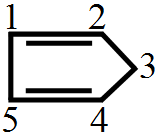
What is meant by hybridisation? Compound $\mathrm{CH}_2=\mathrm{C}=\mathrm{CH}_2$ contains sp or $\mathrm{sp}^2$ hybridised carbon atoms. Will it be a planar molecule?
Answer
Hybridization is defined as an intermixing of a set of atomic orbitals of slightly different energies, thereby forming a new set of orbitals having equivalent energies and shapes. For example, one 2 s -orbital hybridizes with two 2 p orbitals of carbon to form three new sp2 hybrid orbitals. These hybrid orbitals have minimum repulsion between their electron pairs and thus, are more stable. Hybridization helps indicate the geometry of the molecule.
In $\mathrm{CH}_2=\mathrm{C}=\mathrm{CH}_2$ (allene)
Carbon atom land $\mathrm{Sp}^2$ hybridized as each one has $3 \sigma$ bonds while carbon atom 2 has $2 \sigma$ bonds and it is sp hybridized. allene molecule as a whole is non-planar.
View full question & answer
Question 373 Marks

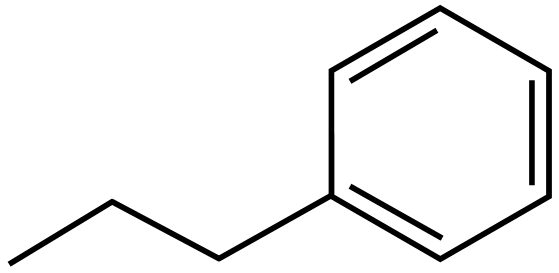
Give the IUPAC names of the following compounds:
  1.  
  1.  
  1.  
  1.  
  1.  
  1. $\text{Cl}_2\text{CHCH}_2\text{OH}$
Answer
  1. Propylbenzene.
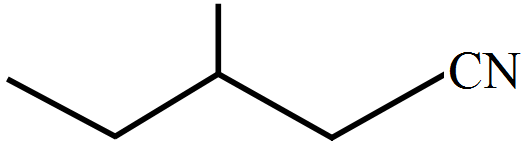
  2. 3-methylpentanitrile.
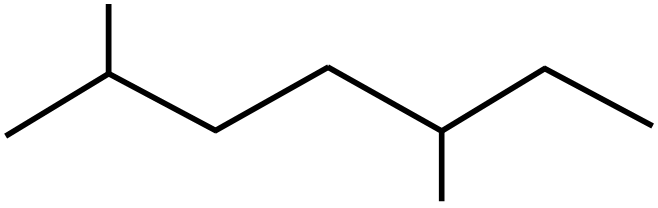
  3. 2, 5-dimethylheptane.
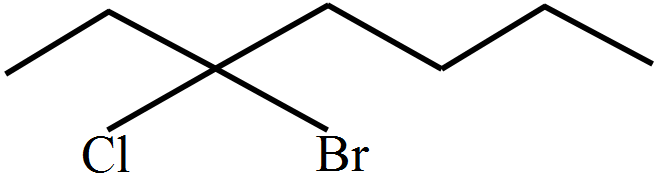
  4. 3-bromo-3-chloroheptane.
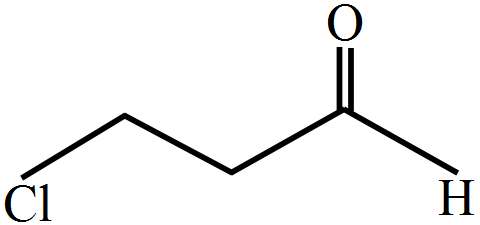
  5. 3-chloropropanal.
  6. 2, 2-dichloroethanol.
View full question & answer
Question 383 Marks
0.90 g of organic compound on combustion gave $2.64 \mathrm{g}$ of $\mathrm{CO}_2$, and 0.63 g of $\mathrm{H}_2 \mathrm{O}$. Calculate the percentage of C and H in the compound.
Answer
$\%\text{ of C}=\frac{12}{44}\times\frac{\text{Weight of CO}_2\text{ formed}}{\text{Weight of organic compound}}\times100$
$=\frac{12}{44}\times\frac{2.64}{0.90}\times100=\frac{3168}{39.6}=80\%$
$\%\text{ of H}=\frac{2}{18}\times\frac{\text{Weight of H}_2\text{O formed}}{\text{Weight of organic compound}}\times100$
$=\frac{12}{18}\times\frac{0.63}{0.90}\times100=\frac{126}{16.2}=7.77\%$
View full question & answer
Question 393 Marks
Note: Consider structures I to VII and answer the questions:
  1. $\text{CH}_3-\text{CH}_2-\text{CH}_2-\text{CH}_2-\text{OH}$
  2. $\text{CH}_3-\text{CH}_2-\text{CH}-\text{CH}_3\\\ \ \ \ \ \ \ \ \ \ \ \ \ \ \ \ \ \ \ \ \ \ \ \ \ \ |\\\ \ \ \ \ \ \ \ \ \ \ \ \ \ \ \ \ \ \ \ \ \ \ \ \ \text{OH}$
  3. $\ \ \ \ \ \ \ \ \ \ \ \ \text{CH}_3\\\ \ \ \ \ \ \ \ \ \ \ \ \ |\\\text{CH}_3-\text{C}-\text{CH}_3\\\ \ \ \ \ \ \ \ \ \ \ \ \ |\\\ \ \ \ \ \ \ \ \ \ \ \ \text{OH}$
  4. $\text{CH}_3-\text{CH}-\text{CH}_2-\text{OH}\\\ \ \ \ \ \ \ \ \ \ \ \ \ \ \ \ \ \ \ \ \ \ \ \ |\\\ \ \ \ \ \ \ \ \ \ \ \ \ \ \ \ \ \ \ \ \ \ \ \text{CH}_3$
  5. $\text{CH}_3-\text{CH}_2-\text{O}-\text{CH}_2-\text{CH}_3$
  6. $\text{CH}_3-\text{O}-\text{CH}_2-\text{CH}_2-\text{CH}_3$
  7. $\text{CH}_3-\text{O}-\text{CH}-\text{CH}_3\\\ \ \ \ \ \ \ \ \ \ \ \ \ \ \ \ \ \ \ \ \ \ |\\\ \ \ \ \ \ \ \ \ \ \ \ \ \ \ \ \ \ \ \ \ \text{CH}_3$
Identify the pairs of compounds that represents position isomerism.
Answer
In position isomerism, two or more compounds differ in the position of substituent, functional group or multiple bonds but molecular formula is same. In the given structures, I and II, III and IV, and VI and VII are position isomers.
  1. $\text{CH}_3-\text{CH}_2-\text{CH}_2-\text{CH}_2-\text{OH}$
  2. $\text{CH}_3-\text{CH}_2-\text{CH}-\text{CH}_3\\\ \ \ \ \ \ \ \ \ \ \ \ \ \ \ \ \ \ \ \ \ \ \ \ \ \ |\\\ \ \ \ \ \ \ \ \ \ \ \ \ \ \ \ \ \ \ \ \ \ \ \ \ \text{OH}$ are position isomers.
  3. $\ \ \ \ \ \ \ \ \ \ \ \ \text{CH}_3\\\ \ \ \ \ \ \ \ \ \ \ \ \ |\\\text{CH}_3-\text{C}-\text{CH}_3\\\ \ \ \ \ \ \ \ \ \ \ \ \ |\\\ \ \ \ \ \ \ \ \ \ \ \ \text{OH}$
  4. $\text{CH}_3-\text{CH}-\text{CH}_2-\text{OH}\\\ \ \ \ \ \ \ \ \ \ \ \ \ \ \ \ \ \ \ \ \ \ \ \ |\\\ \ \ \ \ \ \ \ \ \ \ \ \ \ \ \ \ \ \ \ \ \ \ \text{CH}_3$ are position isomers.
  1. $\text{CH}_3-\text{O}-\text{CH}_2-\text{CH}_2-\text{CH}_3$ and
  2. $\text{CH}_3-\text{O}-\text{CH}-\text{CH}_3\\\ \ \ \ \ \ \ \ \ \ \ \ \ \ \ \ \ \ \ \ \ \ |\\\ \ \ \ \ \ \ \ \ \ \ \ \ \ \ \ \ \ \ \ \ \text{CH}_3$ are position isomers.
View full question & answer
Question 403 Marks
Note: Consider structures I to VII and answer the questions:
  1. $\text{CH}_3-\text{CH}_2-\text{CH}_2-\text{CH}_2-\text{OH}$
  2. $\text{CH}_3-\text{CH}_2-\text{CH}-\text{CH}_3\\\ \ \ \ \ \ \ \ \ \ \ \ \ \ \ \ \ \ \ \ \ \ \ \ \ \ |\\\ \ \ \ \ \ \ \ \ \ \ \ \ \ \ \ \ \ \ \ \ \ \ \ \ \text{OH}$
  3. $\ \ \ \ \ \ \ \ \ \ \ \ \text{CH}_3\\\ \ \ \ \ \ \ \ \ \ \ \ \ |\\\text{CH}_3-\text{C}-\text{CH}_3\\\ \ \ \ \ \ \ \ \ \ \ \ \ |\\\ \ \ \ \ \ \ \ \ \ \ \ \text{OH}$
  4. $\text{CH}_3-\text{CH}-\text{CH}_2-\text{OH}\\\ \ \ \ \ \ \ \ \ \ \ \ \ \ \ \ \ \ \ \ \ \ \ \ |\\\ \ \ \ \ \ \ \ \ \ \ \ \ \ \ \ \ \ \ \ \ \ \ \text{CH}_3$
  5. $\text{CH}_3-\text{CH}_2-\text{O}-\text{CH}_2-\text{CH}_3$
  6. $\text{CH}_3-\text{O}-\text{CH}_2-\text{CH}_2-\text{CH}_3$
  7. $\text{CH}_3-\text{O}-\text{CH}-\text{CH}_3\\\ \ \ \ \ \ \ \ \ \ \ \ \ \ \ \ \ \ \ \ \ \ |\\\ \ \ \ \ \ \ \ \ \ \ \ \ \ \ \ \ \ \ \ \ \text{CH}_3$
Identify the pairs of compounds that represents chain isomerism.
Answer
When two are more compounds have similar molecular formula but differnt carbon skeletone, these are referred to as chain as isomers and the phenomenon is termed as chain isomerism.
  1. $\text{CH}_3-\text{CH}_2-\text{CH}_2-\text{CH}_2-\text{OH}$
  2. $\text{CH}_3-\text{CH}_2-\text{CH}-\text{CH}_3\\\ \ \ \ \ \ \ \ \ \ \ \ \ \ \ \ \ \ \ \ \ \ \ \ \ \ |\\\ \ \ \ \ \ \ \ \ \ \ \ \ \ \ \ \ \ \ \ \ \ \ \ \ \text{OH}$ are position isomers.
  3. $\ \ \ \ \ \ \ \ \ \ \ \ \text{CH}_3\\\ \ \ \ \ \ \ \ \ \ \ \ \ |\\\text{CH}_3-\text{C}-\text{CH}_3\\\ \ \ \ \ \ \ \ \ \ \ \ \ |\\\ \ \ \ \ \ \ \ \ \ \ \ \text{OH}$
  4. $\text{CH}_3-\text{CH}-\text{CH}_2-\text{OH}\\\ \ \ \ \ \ \ \ \ \ \ \ \ \ \ \ \ \ \ \ \ \ \ \ |\\\ \ \ \ \ \ \ \ \ \ \ \ \ \ \ \ \ \ \ \ \ \ \ \text{CH}_3$ are position isomers.
View full question & answer
Question 413 Marks
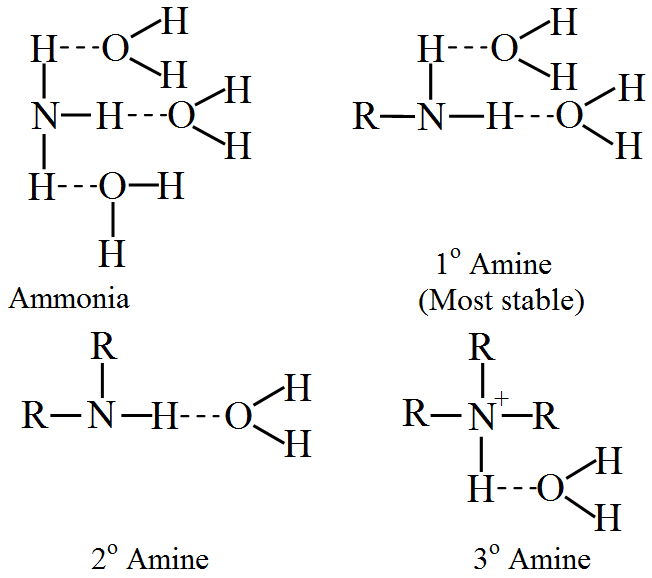
The order of basicity of amines expected on the basis of inductive effect is $NH _3< RNH _2< R _3 N$. However, the observed order of basicity is $NH _3< RNH _2< R _2 NH > R _3 N$. How will you account for the difference?
Answer
This order of basicity is observed in case of solvent phase as the energy of hydration also becomes important here. The following important factors can be considered.
i. Effect of electrion releasing groups: More the number of electron-releasing groups present in a molecule, more is the increase in its electron density and more is the basic character. So, according to this effect, the order should be $NH _3> RNH _2 2 NH 3 N$.
ii. Hydration enthalpy: The more hydrogen bonds a molecule (ammonium ion) can form with water, the more will be its basic character. So, the order should be $NH _3> RNH _2< R _2 NH < R _3 N$.
  1. Inductive effect: The more is the crowding of groups in a molecule, the lesser will be its basicity. So, the order should be $NH_3 > RNH_2> R_2NH > R_3N.$
Combining all the factors, we get the order of basicity as $NH_3 > RNH_2 > R_2N.$
View full question & answer
Question 423 Marks
Identify the type of reactions:
  1. $\text{CH}_4+\text{Cl}_2\xrightarrow{\text{sunlight}}\text{CH}_3\text{Cl}+\text{HCl}$
  2. $\text{C}_6\text{H}_6+(\text{conc.})\text{HNO}_36\xrightarrow{\text{conc.}\text{H}_2\text{SO}_4}\text{C}_6\text{H}_5\text{NO}_2+\text{H}_2\text{O}$
  3. $ \ \ \ \ \ \ \ \ \ \ \ \ \ \ \ \ \ \ \ \ \ \ \ \ \ \ \ \ \ \ \ \ \ \ \ \ \ \ \ \ \ \ \ \ \ \ \ \ \ \ \ \ \ \ \ \ \ \ \ \ \ \ \ \ \ \text{Br}\\\ \ \ \ \ \ \ \ \ \ \ \ \ \ \ \ \ \ \ \ \ \ \ \ \ \ \ \ \ \ \ \ \ \ \ \ \ \ \ \ \ \ \ \ \ \ \ \ \ \ \ \ \ \ \ \ \ \ \ \ \ \ \ \ \ \ |\\\text{CH}_3-\text{CH}=\text{CH}_2+\text{HBr}\xrightarrow{\ \ \ \ \ \ \ }\text{CH}_3-\text{CH}-\text{CH}_3$
  4. $\ \ \ \ \ \ \ \ \ \ \ \ \ \text{O}\ \ \ \ \ \ \ \ \ \ \ \ \ \ \ \ \ \ \ \ \ \ \ \ \ \ \ \ \ \ \ \ \ \ \ \ \ \ \ \ \ \ \ \ \ \ \ \text{OH}\\\ \ \ \ \ \ \ \ \ \ \ \ \ \| \ \ \ \ \ \ \ \ \ \ \ \ \ \ \ \ \ \ \ \ \ \ \ \ \ \ \ \ \ \ \ \ \ \ \ \ \ \ \ \ \ \ \ \ \ \ \ \ \ \ |\\ \text{CH}_3-\text{C}-\text{CH}_3+\text{HCN}\xrightarrow{\ \ \ \ \ \ \ \ }\text{CH}_3-\text{C}-\text{CH}_3\\\ \ \ \ \ \ \ \ \ \ \ \ \ \ \ \ \ \ \ \ \ \ \ \ \ \ \ \ \ \ \ \ \ \ \ \ \ \ \ \ \ \ \ \ \ \ \ \ \ \ \ \ \ \ \ \ \ \ \ \ \ \ \ \ \ |\\\ \ \ \ \ \ \ \ \ \ \ \ \ \ \ \ \ \ \ \ \ \ \ \ \ \ \ \ \ \ \ \ \ \ \ \ \ \ \ \ \ \ \ \ \ \ \ \ \ \ \ \ \ \ \ \ \ \ \ \ \ \ \ \ \text{CN}$
  5. $\text{CH}_3-\text{CH}=\text{CH}_2\xrightarrow[\text{peroxide}]{\text{HBr}}\text{CH}_3\text{CH}_2\text{CH}_2\text{Br}$
  6. $\text{CH}_3\text{Cl}+\text{KOH}(\text{aq})\xrightarrow{\ \ \ \ \ \ \ \ \ }\text{CH}_3\text{OH}+\text{KCl}$
Answer
  1. Free radical substitution.
  2. Electrophilic substitution reaction.
  3. Electrophilic addition reaction.
  4. Nucleophilic addition reaction.
  5. Free radical addition.
  6. Nucleophilic substitution reactions.
View full question & answer
Question 433 Marks

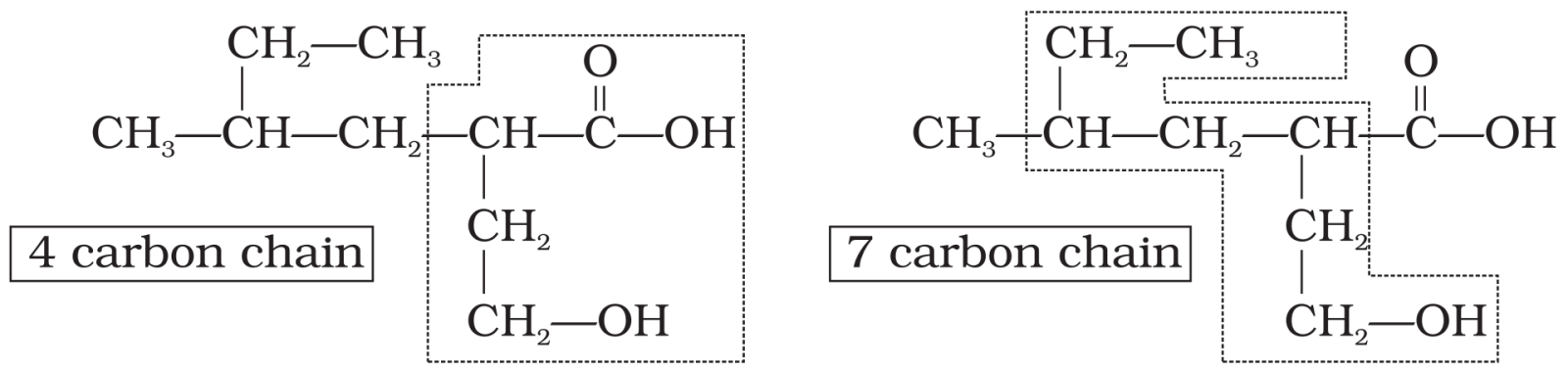
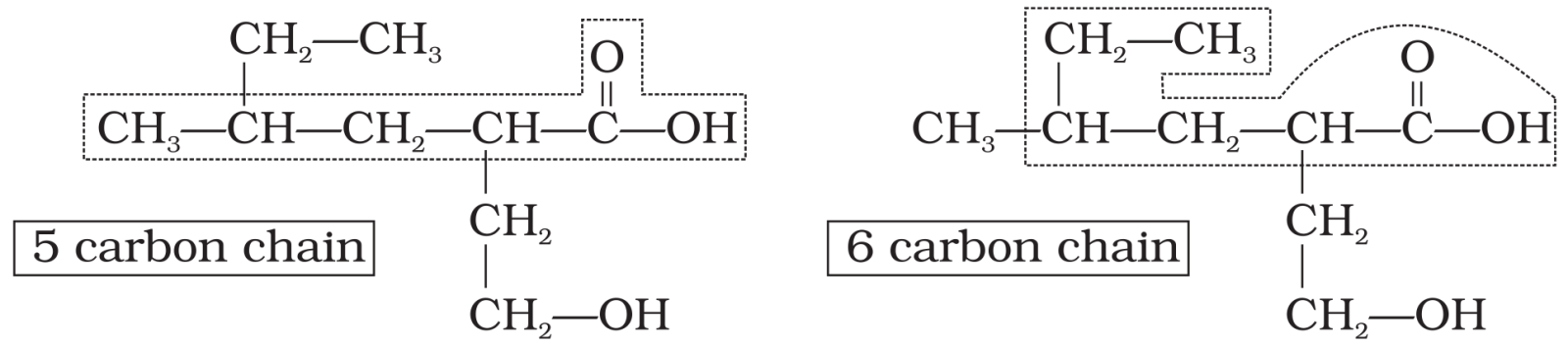
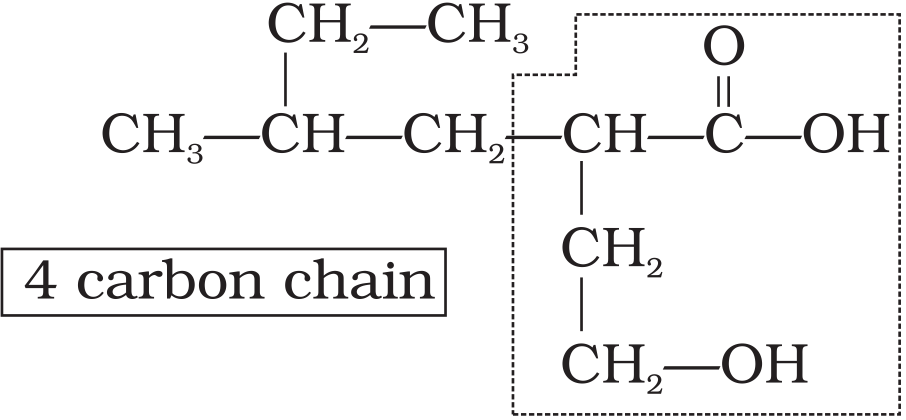
Which of the following selected chains is correct to name the given compound according to IUPAC system.

Answer
According to IUPAC nomenclature, the selected longest carbon chain must have maximum functional groups present in the compound. Therefore, only in one selected chain of 4 carbon atoms including both the functional group is corrected one.

In other three, carbon atoms are in selected chain but both the functional groups are not included.
View full question & answer
Question 443 Marks
Arrange the following:
  1. $\text{C}_6\text{H}_5\stackrel{+\ \ \ \ \ \ \ \ \ \ \ \ }{\text{CHCH}}_3, \text{C}_6\text{H}_5\stackrel{+\ \ \ \ \ \ \ \ \ \ \ \ }{\text{CHCH}}=\text{CH}_2,$ $\text{C}_6\text{H}_5\text{CH}_2\stackrel{+ \ \ \ }{\text{CH}}_2,\text{C}_6\text{H}_5\stackrel{+\ \ \ \ \ \ \ \ \ }{\text{C(CH}}_3)_2$ in order of increasing stability.
  2. $\text{CH}_3\text{CH}_2^+,\text{C}_6\text{H}_5\text{CH}_2^+,(\text{CH}_3)_3\text{C}^+,\text{CH}_2=\text{CHCH}_2^+$ in order of decreasing stability.
  3. $\text{HC}\equiv\text{C}^-,\text{CH}_2=\text{CH}^-,\text{CH}_3\text{CH}_2^-,\text{CH}^-_3,$ $(\text{CH}_3)_2\text{CH}^-,\text{C}_6\text{H}_5\text{CH}^-_2$ in order of increasing stability.
Answer
  1. $\text{C}_6\text{H}_5\text{CH}_2\stackrel{+ \ \ \ }{\text{CH}}_2<\text{C}_6\text{H}_5\stackrel{+\ \ \ \ \ \ \ \ \ \ \ \ }{\text{CHCH}}_3< \text{C}_6\text{H}_5\stackrel{+\ \ \ \ \ \ \ \ \ }{\text{C(CH}}_3)_2\\<\text{C}_6\text{H}_5\stackrel{+\ \ \ \ \ \ \ \ \ \ \ \ }{\text{CHCH}}=\text{CH}_2$
  2. $(\text{CH}_3)_3\text{C}^+>\text{C}_6\text{H}_5\text{CH}_2^+>\text{CH}_2=\text{CHCH}_2^+>\text{CH}_3\text{CH}_2^+$
  3. $(\text{CH}_3)_2\text{CH}^-<,\text{CH}_3\text{CH}_2^-<\text{CH}_3^-<\text{CH}_2=\text{CH}^-\\<\text{C}_6\text{H}_5\text{CH}^-_2<\text{HC}\equiv\text{C}^-$
View full question & answer
Question 453 Marks
What is the relationship between the members of following pairs of structures? Are they structural or geometrical isomers or resonance contributors?
Answer
Compounds having the same molecular formula but with different structures are called structural isomers. The given compounds have the same molecular formula but they differ in the position of the functional group (ketone group).

In structure I, ketone group is at the C-3 of the parent chain (hexane chain) and in structure II, ketone group is at the C-2 of the parent chain (hexane chain). Hence, the given pair represents structural isomers.
View full question & answer
Question 463 Marks
Name the electrophile/ nucleophile generated by following species:
i. $\mathrm{HNO}_3+\mathrm{H}_2 \mathrm{SO}_4$
ii. $\mathrm{CH}_3 \mathrm{COCl}$
iii. alc. KCN
Answer
  1.  
  1. $\ \ \ {\ \ \ \ \ \ \ \ \ \ \ {\text{O}}\\ \ \ \ \ \ \ \ \ \ \ \ \|\\\text{CH}-{\text{C}}\oplus\text{is electrophile}\\ \ \ \ \ \ \ \ \ \ \ {\text{O}}\ \ \ \ \ \ \ \ \ \ \ \ \ \ \ \ \ \ \ \ \ \ \ \ \ \ \ \ \ \ \ \ \text{O}\\\\ \ \ \ \ \ \ \ \ \ \ \|\ \ \ \ \ \ \ \ \ \ \ \ \ \ \ \ \ \ \ \ \ \ \ \ \ \ \ \ \ \ \ \ \ \ \|}\\ \text{CH}_3-\text{C}-\text{Cl}^-\xrightarrow{\ \ \ \ \ \ \ }\text{CH}_3-\text{C}\oplus+\text{Cl}^-$
  2. $\text{CN}^-$ is nucleophile
$\text{KCN}\xrightarrow{\ \ \ \ \ \ \ \ \ \ }\text{K}^++\text{CN}^-$
View full question & answer
Question 473 Marks
Suggest a method to purify:
  1. Camphor containing traces of common salt.
  2. Kerosene oil containing water.
  3. A liquid which decomposes at its boiling point.
Answer
  1. Sublimation camphor sublimes while common salt remains as residue in the China dish.
  2. Since the two liquids are immiscible, the technique of solvent extraction with a separating funnel is used. The mixture is throughly shaken and the separating funnel is allowed to stand. Kerosene being lighter than water forms the upper layer while water forms the lower layer.
The lower water layer is run off using the stop cock of the funnel and kerosene oil is obtained. It is dried over anhydrous $\mathrm{CaCl}_2$ or $\mathrm{MgSO}_4$ and then distilled to give pure kerosene oil.
  1. Distillation under reduced pressure.
View full question & answer
Question 483 Marks
If a liquid compound decomposes at its boiling point, which method (s) can you choose for its purification. It is known that the compound is stable at low pressure, steam volatile and insoluble in water.
Answer
Steam distillation can be used for its purification. This method is applied to separate substances which are steam volatile and immiscible with water.
View full question & answer
Question 493 Marks
For the following bond cleavages, use curved-arrows to show the electron flow and classify each as homolysis or heterolysis. Identify reactive intermediate produced as free radical, carbocation and carbanion.
Answer
The bond cleavage using curved-arrows to show the electron flow of the given reaction can be represented as

It is an example of homolytic cleavage as one of the shared pair in a covalent bond goes with the bonded atom. The reaction intermediate formed is a free radical.
View full question & answer