MCQ
Identify the incorrect statement.
  • The oxidation states of chromium in $CrO _{4}\,^{2-}$ and $Cr _{2} O _{7}\,^{2-}$ are not the same
  • B
    $Cr ^{2+}\left( d ^{4}\right)$ is a stronger reducing agent than $Fe ^{2+}\left( d ^{6}\right)$ in water.
  • C
    The transition metals and their compounds are known for their catalytic activity due to their ability to adopt multiple oxidation states and to form complexes.
  • D
    Interstitial compounds are those that are formed when small atoms like $H , C$ or $N$ are trapped inside the crystal lattices of metals.

Answer

Correct option: A.
The oxidation states of chromium in $CrO _{4}\,^{2-}$ and $Cr _{2} O _{7}\,^{2-}$ are not the same
a
Chromate $\left( CrO _{4}\,^{-2}\right) \Rightarrow$ oxidation state $=+6$

dichromate $\left( Cr _{2} O _{7}\,^{-2}\right) \Rightarrow$ oxidation state $=+6$

oxidation state are same.

Need a full question paper?

Generate a complete, print-ready paper with questions like this in minutes — across 16+ boards, with answer keys.

Start Generating Free

Similar questions

Which of the following reacting is used for production of $K_2Cr_2O_7$ ?
......... $c{m^3}$ is the volume of $0.1\,N\,HCl$ required to react completely with $1.0g$ of pure calcium carbonate $(Ca = 40,\,C = 12$ and $O = 16)$
When $2-$ ethylanthraquinol dissolved in a mixture of benzene and cyclohexanol is oxidised, the product is
$XeF_6$ on partial hydrolysis gives
Which one of the following orders is not in accordance with the property stated against it ?
When a metal rod ${M}$ is dipped into an aqueous colourless concentrated solution of compound ${N}$, the solution turns light blue. Addition of aqueous $\mathrm{NaCl}$ to the blue solution gives a white precipitate ${O}$. Addition of aqueous $\mathrm{NH}_3$ dissolves ${O}$ and gives an intense blue solution.

$1.$ The metal rod ${M}$ is

$(A)$ $\mathrm{Fe}$ $(B)$ $\mathrm{Cu}$ $(C)$ $\mathrm{Ni}$ $(D)$ $\mathrm{Co}$

$2.$ The compound ${N}$ is

$(A)$ $\mathrm{AgNO}_3$ $(B)$ $\mathrm{Zn}\left(\mathrm{NO}_3\right)_2$

$(C)$ $\mathrm{Al}\left(\mathrm{NO}_3\right)_3$ $(D)$ $\mathrm{Pb}\left(\mathrm{NO}_3\right)_2$

$3.$ The final solution contains

$(A)$ $\left[\mathrm{Pb}\left(\mathrm{NH}_3\right)_4\right]^{2+}$ and $\left[\mathrm{CoCl}_4\right]^{2-}$

$(B)$ $\left[\mathrm{Al}\left(\mathrm{NH}_3\right)_4\right]^{3+}$ and $\left[\mathrm{Cu}\left(\mathrm{NH}_3\right)_4\right]^{2+}$

$(C)$ $\left[\mathrm{Ag}\left(\mathrm{NH}_3\right)_2\right]^{+}$and $\left[\mathrm{Cu}\left(\mathrm{NH}_3\right)_4\right]^{2+}$

$(D)$ $\left[\mathrm{Ag}\left(\mathrm{NH}_3\right)_2\right]^{+}$and $\left[\mathrm{Ni}\left(\mathrm{NH}_3\right)_6\right]^{2+}$

Give the answer question $1,2$ and $3.$
Which of the following is not an amino acid
Effective atomic number of $Co(CO)_4$ is $35$, hence it is less stable. It attains stability by
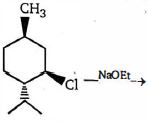
Major product of the reaction is
$KMnO_4$ is the oxo-salt of the acid of following oxide :-