MCQ
Identify the incorrect statements about group $15$ elements :
$(A)$ Dinitrogen is a diatomic gas which acts like an inert gas at room temperature.
$(B)$ The common oxidation states of these elements are $–3, +3$ and $+5.$
$(C)$ Nitrogen has unique ability to form $p \pi- p \pi$ multiple bonds.
$(D)$ The stability of $+5$ oxidation states increases down the group.
$(E)$ Nitrogen shows a maximum covalency of $6.$
Choose the correct answer from the options given below.
  • A
    (A), (B), (D) only
  • B
    (A), (C), (E) only
  • C
    (B), (D), (E) only
  • D
    (D) and (E) only

Answer

$(D)$ Due to inert pair effect lower oxidation state is more stable.
$(E)$ Nitrogen belongs to $2^{nd}$ period and cannot expand its octet.

Need a full question paper?

Generate a complete, print-ready paper with questions like this in minutes — across 16+ boards, with answer keys.

Start Generating Free

Similar questions

From the following thermochemical equations, find out the heat of ionisation $Z$ for a weak acid $HA$
$HA \to A^- + H^+ \,,\, \Delta H = Z$
$H^+ + OH^-\to H_2O\,, \, \Delta H = X$
$HA + OH^-\to A^-+ H_2O\,, \, \Delta H = Y$
Which one of the following compounds is inactive towards $S _{ N } 1$ reaction?
$\begin{array}{*{20}{c}}
  {O\,\,\,\,\,\,\,\,\,\,\,\,\,\,\,\,\,\,\,\,\,\,\,\,\,\,\,\,\,\,\,\,\,\,} \\ 
  {||\,\,\,\,\,\,\,\,\,\,\,\,\,\,\,\,\,\,\,\,\,\,\,\,\,\,\,\,\,\,\,\,\,\,\,} \\ 
  {R - C - N{H_2}\xrightarrow[{(2){H_3}{O^ \oplus }}]{{(1)LiAl{H_4}}}P} 
\end{array}\, (Major)$, $P$ should be
In the reaction $C + 2S\, \to \,C{S_2} + \Delta H,\,\Delta H$ is the
Identify the correct set of reagents or reaction conditions 'X' and 'Y' in the following set of transformation.

Image
$[Co(NH3)_6]^{3+}$ and $[CoF_6]^{3–}$ are respectively known as:
Identify the product in the following reaction : 

Image
$10\ gm$ of a piece of marble $(CaCO_3)$ was put into excess of $dilute HCl$ acid. When the reaction was complete, $1120\ ml$ of $CO_2$ was obtained at $STP$. The percentage of pure $CaCO_3$ in the marble is ............. $\%$
Reaction of an inorganic sulphite $X$ with dilute $H _{2} SO _{4}$ generates compound $Y$. Reaction of $Y$ with $NaOH$ gives $X$. Further, the reaction of $X$ with $Y$ and water affords compound $Z$. $Y$ and $Z ,$ respectively, are:
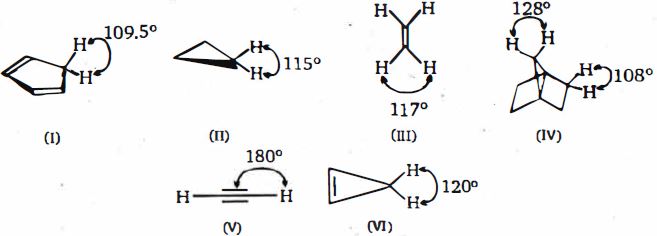
Selected bond angles for six hydrocarbons are shown below. Arrange these hydrocarbons according to their $pK_a$ values, from the lowest to the highest