MCQ
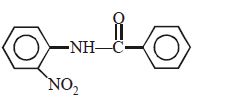
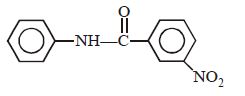
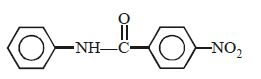
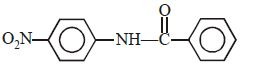
Identify the major product ?

  • A

  • B

  • C


Answer

Correct option: D.

d
$\sigma -$ complex of $p-$ attack to $—\ddot{N}H—$ is most stable

Need a full question paper?

Generate a complete, print-ready paper with questions like this in minutes — across 16+ boards, with answer keys.

Start Generating Free

Similar questions

Predict the major product of the following reaction sequence.
The freezing point of a $0.05\, m \,BaCl_2$ solution in water ($100\%$ ionisation) is about  $(K_f = 1.86\, km^{-1})$
Iodoform test is not given by
Some amount of dichloromethane $\left( CH _2 Cl _2\right)$ is added to $671.141\,mL$ of chloroform $\left( CHCl _3\right)$ to prepare $2.6 \times 10^{-3}\,M$ solution of $CH _2 Cl _2( DCM )$. The concentration of $DCM$ is $.........ppm$ (by mass).Given: Atomic mass : $C =12 ; H : 1 ; Cl =35.5$ density of $CHCl _3=1.49\,g\,cm ^{-3}$
It has been observed that gaseous hydrogen chloride is a very poor conductor of electricity but a solution of hydrogen chloride gas in water is a good conductor of electricity. This is due to the fact that
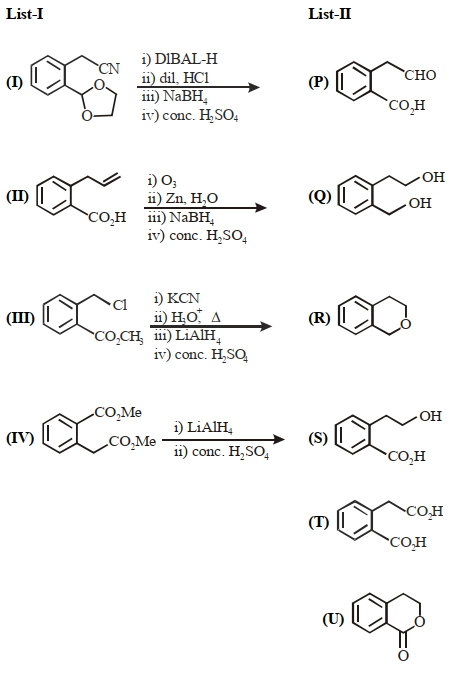
Answer the following by appropriately matching the lists based on the information given in the paragraph $List-I$ includess starting materials and reagents of selected chemical reactions. $List-II$ gives structures of compounds that may be formed as intermediate products and/or final products from the reactions of $List-I$

($1$) Which of the following options has correct combination considering $List-I$ and $List-II$?

$(1) (III), (S), (R)$ $(2) (IV), (Q), (R)$ $(3) (III), (T), (U)$ $(4) (IV), (Q), (U)$

($2$) Which of the following options has correct combination considering $List-I$ and $List-II$?

$(1) (I), (Q), (T), (U)$ $(2) (II), (P), (S), (U)$ $(3) (II), (P), (S), (T)$ $(4) (I), (S), (Q), (R)$

Give the answer quetion ($1$) and ($2$)
EMF of a cell in terms of reduction potential of its left and right electrodes is
$C{H_3}COOH\mathop {\xrightarrow{\Delta }}\limits_{{P_2}{O_5}} X$ . Identify $X$
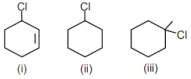
Correct order of $SN^1$ reaction is:
${\left[ Fe ( CN )_{6}\right]^{4-}}$; ${\left[ Fe ( CN )_{6}\right]^{3-}}$; ${\left[ Ti ( CN )_{6}\right]^{3-}}$; ${\left[ Ni ( CN )_{4}\right]^{2-}}$; ${\left[ Co ( CN )_{6}\right]^{3-}}$

Among the given complexes, number of paramagnetic complexes is .... .