MCQ
Identify the physical quantity that cannot be measured using spherometer :
  • A
     Radius of curvature of concave surface
  • Specific rotation of liquids
  • C
     Thickness of thin plates
  • D
     Radius of curvature of convex surface

Answer

Correct option: B.
Specific rotation of liquids
b
Spherometer can be used to measure curvature of surface.

Need a full question paper?

Generate a complete, print-ready paper with questions like this in minutes — across 16+ boards, with answer keys.

Start Generating Free

Similar questions

Which of the following when added as an impurity into silicon produces $n-$ type semiconductor ?
The electric field due to a charge at a distance of $3\, m$ from it is $500\, N/coulomb$. The magnitude of the charge is.......$\mu C$ $\left[ {\frac{1}{{4\pi {\varepsilon _0}}} = 9 \times {{10}^9}\,\frac{{N - {m^2}}}{{coulom{b^2}}}} \right]$
Which of the following acts as a circuit protection device?
Half life of a radioactive element is $10\, days$. The time during which quantity remains $1/10$ of initial mass will be .........$days$
Two identical samples of a gas are allowed to expand $(i)$ isothermally $(ii)$ adiabatically. Work done is
Let the refractive index of a denser medium with respect to a rarer medium be $n_{12}$ and its critical angle be $\theta_C$.  At an angle of incidence $A$ when light is travelling from denser medium to rarer medium, a part of the light is reflected and the rest is refracted and the angle between reflected and refracted rays is $90^o$.  Angle $A$ is given by
Before jumping in water from above, a swimmer bends his body to
There is a rough black spot on a polished metallic plate. It is heated upto $1400 K$ approximately and then at once taken in a dark room. Which of the following statements is true
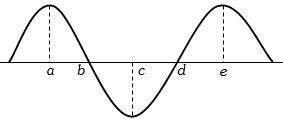
The rope shown at an instant is carrying a wave travelling towards right, created by a source vibrating at a frequency $n$. Consider the following statements

$I.$ The speed of the wave is $4n \times ab$

$II.$ The medium at $a$ will be in the same phase as $d$ after $\frac{4}{{3n}}s$

$III.$ The phase difference between $b$ and $e$ is $\frac{{3\pi }}{2}$

Which of these statements are correct
To get maximum current through a resistance of $2.5\,\Omega $, one can use $m$ rows of cells, each row having $n$ cells. The internal resistance of each cell is $0.5\,\Omega $. What are the values of $n$ and $m$ if the total number of cells is $45$ ?