Question
Identify the plants in the given figure and match the columns.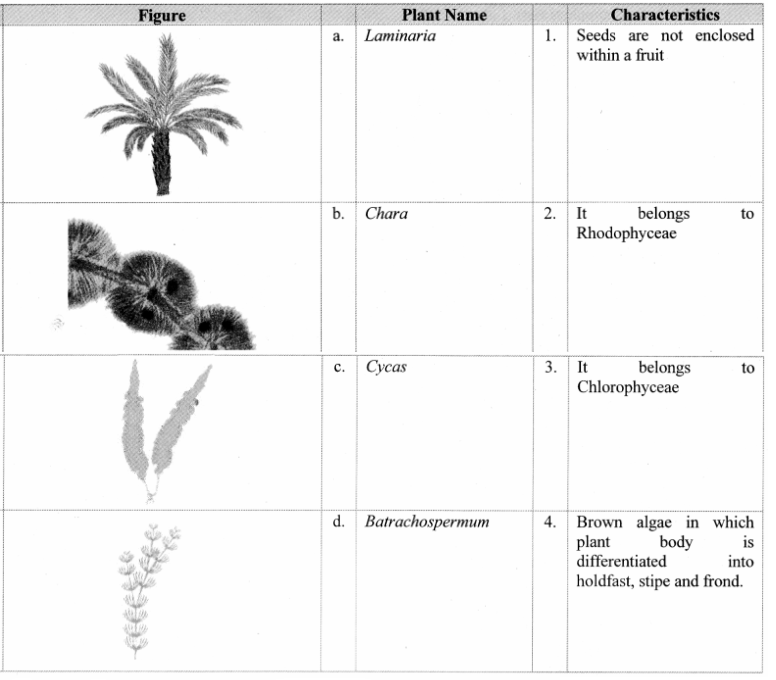
Generate a complete, print-ready paper with questions like this in minutes — across 16+ boards, with answer keys.
| Column I | Column 11 |
| 1. RNA | (a) Induced fit model |
| 2. Yam plant | (b) Flax seeds |
| 3. Koshland | (c) Hydrolase |
| 4. Omega – 3 – fatty acid | (d) Uracil |
| 5. Sucrase | (e) Anti-fertility pills |
| Column I | Column II | Column III |
| 1. Krebs cycle | (a) 1,3-Bisphosphoglycerate → 3-Phosphoglycerate | (p) Pyruvate dehydrogenase |
| 2. Glycolysis | (b) Succinyl CoA → Succinate | (q) NADH dehydrogenase |
| 3. ETS | (c) Pyruvic acid → Acetyl CoA | (r) Two ATP are produced |
| 4. Link reaction | (d) Transfer of electrons from Complex to Ubiquinone | (s) Succinyl CoA – synthetase |
| Column I | Column II |
| 1. Cuboidal epithelium | a. Fallopian tube |
| 2. Squamous epithelium | b. Kidney |
| 3. Ciliated epithelium | c. Intestine |
| 4. Columnar epithelium | d. Endothelium |
| i. | Crypts of Lieberkuhn | P | Pancreas |
| ii. | Glisson’s Capsule | q. | Duodenum |
| iii. | Islets of Langerhans | r. | Small intestine |
| iv. | Brunner’s Glands | s. | Liver |
| Column I | Column II |
| 1. Protoxylem | (a) Xylem with larger vessels |
| 2. Endarch Xylem | (b) Protoxylem arranged towards pith |
| 3. Metaxylem | (c) Metaxylem arranged towards pith |
| 4. Exarch xylem | (d) First formed xylem vessels |
| Column – I | Column – II |
| 1. Saprophyte | (a) Symbiotic association of fungi with plants roots |
| 2. Parasite | (b) Decomposition of dead |
| 3. Lichens | (c) Living on living plants or animals |
| 4. Mycorrhiza | (d) Symbiotic association of algae and fungi |
| Column I (Function) | Column II (Part of excretory system) | ||
| i. | Ultrafiltration | a. | Henle’s loop |
| ii. | Concentration of urine | b. | Ureter |
| iii. | Transport of urine | c. | Urinary bladder |
| iv. | Storage of urine | d. | Malpighian corpuscle |
| v. | e. | Proximal convoluted tubule |
| Column I (Organism) | Column II (Characteristic Feature) |
| 1. Euplectella | (a) Exoskeleton formed of placoid scales |
| 2. Periplaneta | (b) Presence of mantle |
| 3. Sepia | (c) Water canal system |
| 4. Scoliodon | (d) Jointed appendages |
| 5. Clarias | (e) Exoskeleton formed of cycloid scales |
| Column $I$ | Column $II$ |
| $1. \ G:$ Phase | $(a) \ 1-3$ Hours |
| $2. \ G_i$ Phase | $(b) \ 2-5$ Hours |
| $3. \ M$ Phase | $(c) \ 6-8$ Hours |
| $4. \ S$ Phase | $(d) \ 8$ Hours |