MCQ
Identify the process in which change in the oxidation state is five :
  • A
    $\mathrm{C}_{2} \mathrm{O}_{4}^{2-} \rightarrow 2 \mathrm{CO}_{2}$
  • B
    $\mathrm{CrO}_{4}^{2-} \rightarrow \mathrm{Cr}^{3+}$
  • C
    $\mathrm{Cr}_{2} \mathrm{O}_{7}^{2-} \rightarrow 2 \mathrm{Cr}^{3+}$
  • $\mathrm{MnO}_{4}^{-} \rightarrow \mathrm{Mn}^{2+}$
Answer

Correct option: D.
$\mathrm{MnO}_{4}^{-} \rightarrow \mathrm{Mn}^{2+}$
d
$\underset{(+7)}{\mathrm{MnO}_{4}^{-}} \rightarrow \underset{(+2)}{\mathrm{Mn}^{2+}} 5 \mathrm{e}^{-}$change

Need a full question paper?

Generate a complete, print-ready paper with questions like this in minutes — across 16+ boards, with answer keys.

Start Generating Free

Similar questions

Compound $PdCl_4 .6H_2O$ is a hydrated complex; $1\, molal$ aqueous solution of it has freezing point $269.28\, K$. Assuming $100\%$ ionization of complex, calculate the molecular formula of the complex ($K_f$ for water $= 1.86\, K\, kg\, mol^{-1}$)
The $C - Cl$ bond in chlorobenzene as compared with $C - Cl$ bond in methyl chloride is
The electrode potentials for

$C{u^{2 + }}_{{\text{(aq)}}}\, + \,\,{e^ - }\, \to \,C{u^ + }_{{\text{(aq)}}}$

 and $C{u^+}_{{\text{(aq)}}}\, + \,\,{e^ - }\, \to \,C{u }_{{\text{(s)}}}$

are $+0.15\,V$ and $+0.50\,V$ respectively. The value of   will be ............ $\mathrm{V}$

Which one of the following complexes is an outer orbital complex

Atomic no. : $Mn = 25,\,Fe = 26,\,Co = 27,\,Ni = 28$

Choose the $CORRECT$ reason for fluorine being a stronger oxidising agent than chlorine 

$(I)$ Low enthalpy of dissociation of $F-F$ bond

$(II)$ High hydration enthalpy of $F^-$

$(III)$ Low atomisation enthalpy of $F_2$

A toxic compound "A" when reacted with NaCN in aqueous acidic medium yields an edible cooking component and food preservative 'B'. "B" is converted to "C" by diborane and can be used as an additive to petrol to reduce emission. "C" upon reaction with oleum at $140^{\circ} C$ yields an inhalable anesthetic "D". Identify "A", "B", "C" and "D", respectively.
Which of the following condition is used to find atomic $C{l_2}$ from molecular $C{l_2}$
Which of the following is not a resonance structure of the others ?
During Kinetic study of reaction $2 A+B \rightarrow C+D$, the following results were obtained :

  $A[M]$ $B[M]$

initial rate of

formation of $D$

$i$ $0.1$ $0.1$ $6.0 \times 10^{-3}$
$ii$ $0.3$ $0.2$ $7.2 \times 10^{-2}$
$ii$ $0.3$ $0.4$ $2.88 \times 10^{-1}$
$iv$ $0.4$ $0.1$ $2.40 \times 10^{-2}$

Based on above data, overall order of the reaction is $\qquad$

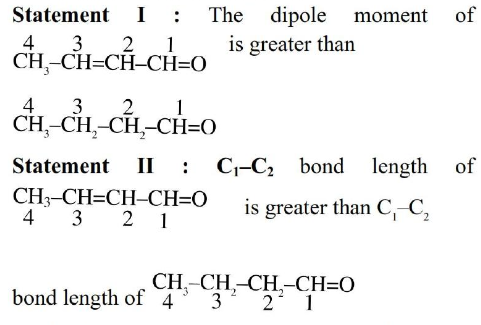
Given below are two statements.
Image
In the light of the above statements, choose the correct answer from the options given below :