MCQ
Identify the transition element
  • A
    $1{s^2},\;2{s^2}2{p^6},\;3{s^2},\;3{p^6},\;4{s^2}$
  • $1{s^2},\;2{s^2}2{p^6},\;3{s^2},\;3{p^6}3{d^2},\;4{s^2}$
  • C
    $1{s^2},\;2{s^2}2{p^6},\;3{s^2},\;3{p^6}3{d^{10}},\;4{s^2}4{p^2}$
  • D
    $1{s^2},\;2{s^2}2{p^6},\;3{s^2},\;3{p^6}3{d^{10}},\;4{s^2}4{p^1}$

Answer

Correct option: B.
$1{s^2},\;2{s^2}2{p^6},\;3{s^2},\;3{p^6}3{d^2},\;4{s^2}$
b
(b)We know that transition element are those element which have partially filled $ d-$ subshell in their elementary form. Therefore, the general electronic configuration of $ d-$ block element is $(n - 1)\;{d^{1 - 10}}n{s^{1 - 2}}$.

Need a full question paper?

Generate a complete, print-ready paper with questions like this in minutes — across 16+ boards, with answer keys.

Start Generating Free

Similar questions

Acetophenone is prepared from
Which of the following is correct statement?
The van't Hoff factor $(i)$ for a dilute aqueous solution of the strong electrolyte barium hydroxide is
Major product $(R)$ of following reaction is :

Figure $\xrightarrow[{pyridine}]{{C{H_3}COCl}}$ $P$ $\xrightarrow[{C{H_3}COOH}]{{B{r_2}}}Q\,\xrightarrow{{{H_3}{O^ + }}}R$

Cations are present in the interstitial sites in $......$
The main reason for larger number of oxidation states exhibited by the actinoids than the corresponding lanthanoids is
When primary amine is heated with $C{S_2}$ in presence of excess mercuric chloride, it gives isothiocyanate. This reaction is called
$C{{H}_{3}}CH=CHCHO\xrightarrow[\begin{smallmatrix} 
 Aldol \\ 
 condensation 
\end{smallmatrix}]{O{{H}^{-}}}\xrightarrow{\Delta }A;$ Product $A$ is
The ammonia prepared by treating ammonium sulphate with calcium hydroxide is completely used by $\mathrm{NiCl}_2 .6 \mathrm{H}_2 \mathrm{O}$ to form a stable coordination compound. Assume that both the reactions are $100 \%$ complete. If $1584 \mathrm{~g}$ of ammonium sulphate and $952 \mathrm{~g}$ of $\mathrm{NiCl}_2 \cdot 6 \mathrm{H}_2 \mathrm{O}$ are used in the preparation, the combined weight (in grams) of gypsum and the nickelammonia coordination compound thus produced is $\qquad$ (Atomic weights in $\mathrm{g} \mathrm{mol}^{-1}: \mathrm{H}=1, \mathrm{~N}=14, \mathrm{O}=16, \mathrm{~S}=32, \overline{\mathrm{Cl}=35.5}, \mathrm{Ca}=40, \mathrm{Ni}=59$ )
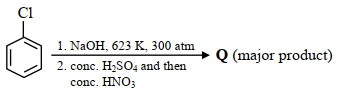
The weight percentage of hydrogen in $Q$, formed in the following reaction sequence, is. . . . 

[Given : Atomic mass of $H =1, C =12, N =14, O =16, S =32, Cl =35$ ]