Questions · Page 1 of 21

M.C.Q (1 Marks)

🎯

Test yourself on this topic

50 questions · timed · auto-graded

MCQ 11 Mark
The $\mathrm{E}^{\circ}$ value for the $\mathrm{Mn}^{3 *} / \mathrm{Mn}^{2+}$ couple is more positive than that of $\mathrm{Cr}^{3+} / \mathrm{Cr}^{2+}$ or $\mathrm{Fe}^{3+} / \mathrm{Fe}^{2 *}$ due to change of
  • A
     $d^5$ to $d^2$ configuration
  • $d^4$ to $d^5$ configuration
  • C
     $d^3$ to $d^5$ configuration
  • D
     $d^5$ to $d^4$ configuration
Answer
Correct option: B.
$d^4$ to $d^5$ configuration
b
$\mathrm{E}_{\mathrm{Mn}^{3+} / \mathrm{Mn}^{2+}}^0>\mathrm{E}_{\mathrm{Cr}^{3+} / \mathrm{Cr}^{2+}}^0 \text { or } \mathrm{E}_{\mathrm{Fe}^{3+} / \mathrm{Fe}^{2+}}^0$

Electronic configuration of $\mathrm{Mn}^{3+}=[\mathrm{Ar}] 3 d^4$

Electronic configuration of $\mathrm{Mn}^{2+}=[\mathrm{Ar}] 3 d^5$

Electronic configuration of $\mathrm{Cr}^{3+}=[\mathrm{Ar}] 3 d^\beta$

Electronic configuration of $\mathrm{Cr}^{2+}=[\mathrm{Ar}] 3 d^4$

As $\mathrm{Mn}^{3+}$ from $d^4$ configuration goes to more stable $d^5$ configuration (Half filled), due to more exchange energy in $d^5$ configuration.
View full question & answer
MCQ 21 Mark
'Spin only' magnetic moment is same for which of the following ions?

$A$. $\mathrm{Ti}^{3+}$   $B$. $\mathrm{Cr}^{2+}$   $C$. $\mathrm{Mn}^{2+}$   $D$.$\mathrm{Fe}^{2+}$  $E$. $\mathrm{Sc}^{3+}$

Choose the most appropriate answer from the options given below.

  • A
    $A$ and $E$ only
  • B
    $B$ and $C$ only
  • C
    $A$ and $D$ only
  • $B$ and $D$ only
Answer
Correct option: D.
$B$ and $D$ only
d
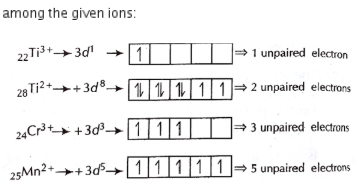
lons No. of unpaired electrons Configuration
$ \mathrm{Ti}^{3+} $ $1$ $3 d^1$
$ \mathrm{Cr}^{2+} $ $4$ $3 d^4$
$ \mathrm{Mn}^{2+} $ $5$ $3 d^5$
$ \mathrm{Fe}^{2+} $ $4$ $3 d^6$
$ \mathrm{Sc}^{3+}$ $0$ $3 d^0$

Spin only magnetic moment is given by $\sqrt{n(n+2)} \mathrm{BM}$

$\therefore \mathrm{Cr}^{2+}$ and $\mathrm{Fe}^{2+}$ will have same spin only magnetic moment.

View full question & answer
MCQ 31 Mark
The pair of lanthanoid ions which are diamagnetic is
  • A
    $\mathrm{Ce}^{3+}$ and $\mathrm{Eu}^{2+}$
  • B
    $\mathrm{Gd}^{3+}$ and $\mathrm{Eu}^{3+}$
  • C
    $\mathrm{Pm}^{3+}$ and $\mathrm{Sm}^{3+}$
  •  $\mathrm{Ce}^{4+}$ and $\mathrm{Yb}^{2+}$
Answer
Correct option: D.
 $\mathrm{Ce}^{4+}$ and $\mathrm{Yb}^{2+}$
d
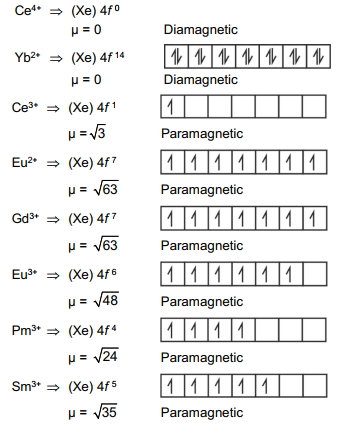
Magnetic moment $\mu=\sqrt{n(n+2)}$

$\mathrm{n} \rightarrow$ number of unpaired electron

$Image$

Hence $\mathrm{Ce}^{4+}$ and $\mathrm{Yb}^{2+}$ are only diamagnetic.

View full question & answer
MCQ 41 Mark
Given below are certain cations. Using inorganic qualitative analysis, arrange them in increasing group number from 0 to $\mathrm{VI}$.

$A$. $Al^{3+}$  $B$. $Cu^{2+}$  $C$. $Ba^{2+}$    $D$. $Co^{2+}$  $E$. $Mg^{2+}$

Choose the correct answer from the options given below.

  • A
     $B, C, A, D, E$
  • B
     $E, C, D, B, A$
  • C
    $E, A, B, C, D$
  •  $B, A, D, C, E$
Answer
Correct option: D.
 $B, A, D, C, E$
d
Group Cations
Group $-II$ $\mathrm{Cu}^{2+}$
Group $-III$ $\mathrm{Al}^{3+}$
Group $-IV$ $\mathrm{Co}^{2+}$
Group $-V$ $\mathrm{Ba}^{2+}$
Group $-VI$ $\mathrm{Mg}^{2+}$

The correct order of group number of ions is $\underset{\text { (B) }}{\mathrm{Cu}^{2+}} < \underset{\text { (A) }}{\mathrm{Al}^{3+}} < \underset{\text { (D) }}{\mathrm{Co}^{2+}} < \underset{\text { (C) }}{\mathrm{Ba}^{2+}} < \underset{\text { (E) }}{\mathrm{Mg}^{2+}}$

$\therefore$ The correct order is $\mathrm{B}, \mathrm{A}, \mathrm{D}, \mathrm{C}, \mathrm{E}$

View full question & answer
MCQ 51 Mark
The stability of $Cu ^{2+}$ is more than $Cu ^{+}$salts in aqueous solution due to -
  • A
    second ionisation enthalpy.
  • B
    first ionisation enthalpy.
  • C
    enthalpy of atomization.
  • hydration energy.
Answer
Correct option: D.
hydration energy.
d
The stability of $Cu ^{2 +}( aq )$ is more than $Cu ^+ ( aq )$ is due to the much more negative $\Delta_{\text {hyd }} H^{\circ}$ of $Cu ^{2+}( aq )$ than $Cu ^{+}( aq )$, which more than compensates for second ionisation enthalpy of $Cu$.

$\Delta \text { hyd } H ^{\circ} \text { of } Cu ^{2+}( aq )=-2121\,kJ\,mol ^{-1}$

$\Delta_{ i } H _1^0$ of $Cu =+745\,kJ\,mol ^{-1}$

$\Delta_{ i } H_2^{\circ} \text { of } Cu =+1960\,kJ\,mol ^{-1}$

View full question & answer
MCQ 61 Mark
Which of the following statements are INCORRECT?

$A$. All the transition metals except scandium form $MO$ oxides which are ionic.

$B$. The highest oxidation number corresponding to the group number in transition metal oxides is attained in $Sc _2 O _3$ to $Mn _2 O _7$.

$C$. Basic character increases from $V _2 O _3$ to $V _2 O _4$ to $V _2 O _5$.

$D$. $V _2 O _4$ dissolves in acids to give $VO _4^{3-}$ salts.

$E$. $CrO$ is basic but $Cr _2 O _3$ is amphoteric.

Choose the correct answer from the options given below:

  • A
    $B$ and $C$ only
  • B
    $A$ and $E$ only
  • C
    $B$ and $D$ only
  • $C$ and $D$ only
Answer
Correct option: D.
$C$ and $D$ only
d
All transitions metals except $Sc$ from MO oxides which are ionic.

- The highest oxidation number corresponding to the group number in transition metal oxides in attained in $Sc _2 O _3$ to $Mn _2 O _7$.

- Acidic character increases from $V _2 O _3$ to $V _2 O _4$ to $V _2 O _5$.

- $V _2 O _4$ dissolves in acids to give $VO ^{2+}$.

- $CrO$ is basic but $Cr _2 O _3$ is amphoteric.

View full question & answer
MCQ 71 Mark
In the neutral or faintly alkaline medium, $KMnO _{4}$ oxidises iodide into iodate. The change in oxidation state of manganese in this reaction is from?
  • A
    $+6$ to $+4$
  • B
    $+7$ to $+3$
  • C
    $+6$ to $+5$
  • $+7$ to $+4$
Answer
Correct option: D.
$+7$ to $+4$
d
Change $+7$ to $+4$
View full question & answer
MCQ 81 Mark
Gadolinium has a low value of third ionisation enthalpy because of $......$
  • high exchange enthalpy
  • B
    high electronegativity
  • C
    high basic character
  • D
    small size
Answer
Correct option: A.
high exchange enthalpy
a
${ }_{64} Gd =[ Xe ] 6 s ^{2} 4 f ^{7} 5 d ^{1}$

$Gd ^{+2}=[ Xe ] 4 f ^{7} 5 d ^{1}$

After losing $5 d$ electron $4 f$ has maximum exchange energy so Gd has low value of Third Ionisation energy

View full question & answer
MCQ 91 Mark
The incorrect statement among the following is :
  • A
    Actinoid contraction is greater for element to element than Lanthanoid contraction.
  • Most of the trivalent Lanthanoid ions are colorless in the solid state.
  • C
    Lanthanoids are good conductors of heat and electricity.
  • D
    Actinoids are highly reactive metals, especially when finely divided.
Answer
Correct option: B.
Most of the trivalent Lanthanoid ions are colorless in the solid state.
b
Fact
View full question & answer
MCQ 101 Mark
$\operatorname{Zr}\,(\mathrm{Z}=40)$ and $\mathrm{Hf}\,(\mathrm{Z}=72)$ have similar atomic and ionic radii because of :
  • A
    belonging to same group
  • B
    diagonal relationship
  • lanthanoid contraction
  • D
    having similar chemical properties
Answer
Correct option: C.
lanthanoid contraction
c
From $IV- A$ to $II- B$

Due to lanthanoid contration size of $4 \mathrm{~d}$ $\&$ $5 \mathrm{~d}$ series elements of same group are approx same.

View full question & answer
MCQ 111 Mark
Match the following aspects with the respective metal.

Aspects Metal
$(a)$ The metal which reveals a maximum number of oxidation states $(i)$ Scandium
$(b)$ The metal although placed in $3 d$ block is considered not as a transition element $(ii)$ Copper
$(c)$ The metal which does not exhibit variable oxidation states $(iii)$ Manganese
$(d)$ The metal which in $+1$ oxidation state in aqueous solution undergoes disproportionation $(iv)$ Zinc

Select the correct option

  • A
    $(a)-(ii) (b)-(iv) (c)-(i) (d)-(iii)$
  • B
    $(a)-(i) (b)-(iv) (c)-(ii) (d)-(iii)$
  • $(a)-(iii) (b)-(iv) (c)-(i) (d)-(ii)$
  • D
    $(a)-(iii) (b)-(i) (c)-(iv) (d)-(ii)$
Answer
Correct option: C.
$(a)-(iii) (b)-(iv) (c)-(i) (d)-(ii)$
c
In 3 d-series, Manganese reveals maximum number of oxidation states i.e.,
$(+2$ to +7$)$
Zinc atom has completely filled d-orbitals in its ground state as well as in its oxidised state, hence it is not regarded as a transition element.

Scandium shows only one oxidation state
i.e., +3 .
Cu $^{+}$ undergoes disproportionation reaction in aqueous solution
$2 Cu ^{*}( aq ) \longrightarrow Cu ^{2+}( aq )+ Cu ( s )$

View full question & answer
MCQ 121 Mark
Identify the incorrect statement.
  • The oxidation states of chromium in $CrO _{4}\,^{2-}$ and $Cr _{2} O _{7}\,^{2-}$ are not the same
  • B
    $Cr ^{2+}\left( d ^{4}\right)$ is a stronger reducing agent than $Fe ^{2+}\left( d ^{6}\right)$ in water.
  • C
    The transition metals and their compounds are known for their catalytic activity due to their ability to adopt multiple oxidation states and to form complexes.
  • D
    Interstitial compounds are those that are formed when small atoms like $H , C$ or $N$ are trapped inside the crystal lattices of metals.
Answer
Correct option: A.
The oxidation states of chromium in $CrO _{4}\,^{2-}$ and $Cr _{2} O _{7}\,^{2-}$ are not the same
a
Chromate $\left( CrO _{4}\,^{-2}\right) \Rightarrow$ oxidation state $=+6$

dichromate $\left( Cr _{2} O _{7}\,^{-2}\right) \Rightarrow$ oxidation state $=+6$

oxidation state are same.

View full question & answer
MCQ 131 Mark
Which of the following oxide is amphoteric in nature?
  • A
    $CO _{2}$
  • $SnO _{2}$
  • C
    $SiO _{2}$
  • D
    $GeO _{2}$
Answer
Correct option: B.
$SnO _{2}$
b
$CO _{2}:$ acidic

$SnO _{2}:$ amphoteric

$SiO _{2}:$ acidic

$GeO _{2}:$ acidic

View full question & answer
MCQ 141 Mark
Identify the Incorrect statement from the following 
  • A
    The overall decrease in atomic and ionic radii from lanthanum to lutetium is called lanthanoid contraction
  • B
    Zirconium and Hafnium have identical radii of $160 \;pm$ and $159 \;pm ,$ respectively as a consequence of lanthanoid contraction
  • Lanthanoids reveal only $+3$ oxidation state
  • D
    The lanthanoid ions other than the $f^{0}$ type and the $f^{14}$ type are all paramagnetic
Answer
Correct option: C.
Lanthanoids reveal only $+3$ oxidation state
c
Lanthanoids can show +2 or +4 oxidation states in solution or in solid compounds.

Most common oxidation state of Lanthanoids is +3 .

View full question & answer
MCQ 151 Mark
Match the element in column $I$ with that in column $II$.

Column - $I$ Column - $II$
$(a)$ Copper $(i)$ Non-metal
$(b)$ Fluorine $(ii)$ Transition Metal
$(c)$ Silicon $(iii)$ Lanthanoid
$(d)$ Cerium $(iv)$ Metalloid

Identify the correct match:

  • A
    $(a)-(i) (b)-(ii) (c)-(iii) (d)-(iv)$
  • B
    $(a)-(ii) (b)-(iv) (c)-(i) (d)-(iii)$
  • $(a)-(ii) (b)-(i) (c)-(iv) (d)-(iii)$
  • D
    $(a)-(iv) (b)-(iii) (c)-(i) (d)-(ii)$
Answer
Correct option: C.
$(a)-(ii) (b)-(i) (c)-(iv) (d)-(iii)$
c
Copper $\rightarrow$ Transition metal

Fluorine $\rightarrow$ Non-metal

Silicon $\rightarrow$ Metalloid

Cerium $\rightarrow$ Lanthanoid

View full question & answer
MCQ 161 Mark
The number of hydrogen bonded water molecule(s) associated with $CuSO_4\cdot 5H_2O$ is
  • A
    $3$
  • $1$
  • C
    $2$
  • D
    $5$
Answer
Correct option: B.
$1$
b
In $CuSO_4\cdot 5H_2O$, only one water molecule take part in hydrogen bonding.
View full question & answer
MCQ 171 Mark
Name the gas that can readily decolourise acidified $KMnO_4$ solution.
  • $SO_2$
  • B
    $NO_2$
  • C
    $P_2O_5$
  • D
    $CO_2$
Answer
Correct option: A.
$SO_2$
a
$\mathrm{KMnO}_{4}+\mathrm{SO}_{2} \rightarrow \mathrm{MnSO}_{4}+\mathrm{H}_{2} \mathrm{SO}_{4}+\mathrm{K}_{2} \mathrm{SO}_{4}$

Where $MnSO_4$ is colourless solution

View full question & answer
MCQ 181 Mark
The reason for greater range of oxidation states in actinoids is attributed to
  • A
    actinoid contraction
  • $5f, \,6d$ and $7s$ levels having comparable energies
  • C
    $4f$ and $5d$ levels being close in energies
  • D
    the radioactive nature of actinoids.
Answer
Correct option: B.
$5f, \,6d$ and $7s$ levels having comparable energies
b
Minimum energy gap between

$5 f, \,6 d$ and  $7s$ subshell. Thats why  exitation will be easier.

View full question & answer
MCQ 191 Mark
Which of the following lanthanoids shows $+4$ oxidation state to acquire noble gas configuration?

(At nos. : $L a=57, C e=58, E u=63$ and $Y b=70$ )

  • $Ce$
  • B
    $Yb$
  • C
    $La$
  • D
    $Eu$
Answer
Correct option: A.
$Ce$
a
$Ce$
View full question & answer
MCQ 201 Mark
Which one of the following statements is correct when $SO_2$ is passed through acidified $K_2Cr_2O_7$ solution?
  • A
    $SO_2$ is reduced.
  • Green $Cr_2(SO_4)_3$ is formed.
  • C
    The solution turns blue.
  • D
    The solution is decolourised.
Answer
Correct option: B.
Green $Cr_2(SO_4)_3$ is formed.
b
$\mathrm{K}_{2} \mathrm{Cr}_{2} \mathrm{O}_{7}+\mathrm{H}_{2} \mathrm{SO}_{4}+3 \mathrm{SO}_{2} \longrightarrow \mathrm{K}_{2} \mathrm{SO}_{4}+\mathrm{Cr}_{2}\left(\mathrm{SO}_{4}\right)_{3}+\mathrm{H}_{2} \mathrm{O}$

The appearance of green colour is due to the reduction of chromium metal.

View full question & answer
MCQ 211 Mark
Which one of the following statements related to lanthanons is incorrect ?
  • A
    Europium shows $+2$ oxidation state.
  • B
    The basicity decreases as the ionic radius decreases from $Pr$ to $Lu.$
  • All the lanthanons are much more reactive than aluminium.
  • D
    $Ce(+4)$ solutions are widely used as oxidizing agent in volumetric analysis.
Answer
Correct option: C.
All the lanthanons are much more reactive than aluminium.
c
The earlier number of lanthenoide series are quiet reactive similar to calcium but with increasing atomic number they behave more like aluminium
View full question & answer
MCQ 221 Mark
The electronic configurations of $Eu$ (Atomic No. $63$), $Gd$ (Atomic No. $64$) and $Tb$ (Atomic No. $65$) are
  • A
    $[Xe]4f^6\,5d^1\,6s^2,$  $[Xe]4f^7\,5d^1\,6s^2$  and   $[Xe]4f^8\,5d^1\,6s^2$
  • $[Xe]\,4f^7\,6s^2$,  $[Xe]\,4f^7\, 5d^1\, 6s^2$  and  $ [Xe]\,4f^9 \,6s^2$
  • C
    $[Xe]\,4f^7 \,6s^2$,  $[Xe]\,4f^8\, 6s^2$  and  $[Xe]\,4f^8 \,5d^1\, 6s^2$
  • D
    $[Xe]\,4f^6\, 5d^1 \,6s^2,$  $ [Xe]\,4f^7\, 5d^1 \,6s^2$  and  $[Xe]\,4f^9 \,6s^2$
Answer
Correct option: B.
$[Xe]\,4f^7\,6s^2$,  $[Xe]\,4f^7\, 5d^1\, 6s^2$  and  $ [Xe]\,4f^9 \,6s^2$
b
View full question & answer
MCQ 231 Mark
Magnetic moment $2.84\, B.M.$ is given by (At. nos. $Ni = 28, Ti = 22, $$Cr = 24, Co = 27$)
  • A
    $Cr^{2+}$
  • B
    $Co^{2+}$
  • $Ni^{2+}$
  • D
    $Ti^{3+}$
Answer
Correct option: C.
$Ni^{2+}$
c
$\sqrt{n(n+2)}=2.84$

$\Rightarrow n=2$

$N i^{+2}$

View full question & answer
MCQ 241 Mark
Gadolinium belongs to $4f$ series. Its atomic number is $64.$ Which of the following is the correct electronic configuration of gadolinium?
  • A
    $[Xe] 4f^9 5s^1$
  • $[X e] 4f^7 5d^1 6s^2$
  • C
    $[Xe] 4f^65d^26s^2$
  • D
    $[Xe] 4f^86d^2$
Answer
Correct option: B.
$[X e] 4f^7 5d^1 6s^2$
b
Electronic configuration of Gadolinium, with atomic number $64$ is [Xe] $4 f^7 5 d^1 6 s^2$ as half filled orbitals are more stable than incompletely filled orbitals.
View full question & answer
MCQ 251 Mark
Because of lanthanoid contraction, which of the following pairs of elements have nearly same atomic radii ? (Numbers in the parenthesis are atomic numbers)
  • $Zr(40)$ and $Hf(72)$
  • B
    $Zr(40)$ and $Ta(73)$
  • C
    $Ti(22)$ and $Zr(40)$
  • D
    $Zr(40)$ and $Nb(41)$
Answer
Correct option: A.
$Zr(40)$ and $Hf(72)$
a
$Zr$ and $Hf$ have nearly same radii due to lanthanoid contraction.
View full question & answer
MCQ 261 Mark
Magnetic moment $2.83\, BM$ is given by which of the following ions ?

(At. nos. $Ti = 22,\,Cr = 24,$ $ Mn = 25,\,Ni = 28$)

  • A
    $Ti^{3+}$
  • $Ni^{2+}$
  • C
    $Cr^{3+}$
  • D
    $Mn^{2+}$
Answer
Correct option: B.
$Ni^{2+}$
b
Magnetic moment is given by $\mu=\sqrt{n(n+2)}$

Here, $n=$ number of unpaired electrons

$\Rightarrow 2.83=\sqrt{n(n+2)}$

$\Rightarrow(2.83)^{2}=n(n+2)$

$0=8.00+n^{2}+2 n$

$n^{2}+ 2n-8=0$

$(n+4)(n-2)=0$

$n=2$      $n=-\,4$

$-\,4$ not be consider

Hence, $Ni^{2+}$ possesses a magnetic moment of $2.83\,\mathrm{B} . \mathrm{M}$

View full question & answer
MCQ 271 Mark
Reason of lanthanoid contraction is
  • negligible screening effect of $'f'-$orbitals
  • B
    increasing nuclear charge
  • C
    decreasing nuclear charge
  • D
    decreasing screening effect.
Answer
Correct option: A.
negligible screening effect of $'f'-$orbitals
a
Lanthanoid contraction is the regular decrease in atomic and ionic radii of lanthanides. This is due to the imperfect shielding [or poor screening effect ] of $l-$orbitals due to their diffused shape which unable to counterbalance the effect to the increased nuclear charge. Hence, the net result is a contraction in size of lanthanoids.
View full question & answer
MCQ 281 Mark
The reaction of aqueous $KMnO_4$ with $H_2O_2$ in acidic conditions gives
  • A
    $Mn^{4+}$ and $O_2$
  • $Mn^{2+}$ and $O_2$
  • C
    $Mn^{2+}$ and $O_3$
  • D
    $Mn^{4+}$ and $MnO_2.$
Answer
Correct option: B.
$Mn^{2+}$ and $O_2$
b
The reaction of aqueous $K M n O_{4}$ with $H_{2} O_{2}$ in acidic medium is $3 H_{2} S O_{4}+2 K M n O_{4}+5 H_{2} O_{2} \rightarrow$

$5 \mathrm{O}_{2}+2 \mathrm{Mn} \mathrm{SO}_{4}+8 \mathrm{H}_{2} \mathrm{O}+\mathrm{K}_{2} \mathrm{SO}_{4}$

In the above reaction, $K M n O_{4}$ oxidises $H_{2} O_{2}$ to $O_{2}$ and itself $\left[M n O_{4}^{-}\right]$ gets reduced to $M n^{2+}$ ion as $M n S O_{4}$

Hence, aqueous solution of $K M n O_{4} .$ with $H_{2} O_{2}$ yields $M n^{2+}$ and $O_{2}$ in acidic conditions.

View full question & answer
MCQ 291 Mark
$Sc\, (Z = 21)$ is a transition element but $Zn\, (Z = 30)$ is not because
  • A
    both $Sc^{3+}$ and $Zn^{2+}$ ions are colourless and form white compounds.
  • in case of $Sc, 3d$ orbitals are partially filled but in $Zn$ these are filled.
  • C
    last electron is assumed to be added to $4s$ level in case of $Zn.$
  • D
    both $Sc$ and $Zn$ do not exhibit variable oxidation states.
Answer
Correct option: B.
in case of $Sc, 3d$ orbitals are partially filled but in $Zn$ these are filled.
b
Transition element are those in which second last shell is in completely filled.

In $S{c}$, the $e^{-}$ configuration is $3 d^{1} 4 s^{2}$

wheareas in $Z{n}$ configuration is $3 d^{10} 4 s^{2}$

$\therefore \,\ln \,Z{n}$, the $3 d$ leaving completely filled, its not a transtion element.

View full question & answer
MCQ 301 Mark
Which of the following lanthanoid ions is diamagnetic ?

(At. nos. $Ce = 58, Sm = 62,$$ Eu = 63, Yb = 70$)

  • A
    $Eu^{2+}$
  • $Yb^{2+}$
  • C
    $Ce^{2+}$
  • D
    $Sm^{2+}$
Answer
Correct option: B.
$Yb^{2+}$
b
Lanthanoid ion with no unpaired electron is diamagnetic in nature.

$\mathrm{Ce}_{58}=[\mathrm{Xe}] 4 \mathrm{f}^{2} 5 \mathrm{d}^{0} 6 \mathrm{s}^{2}$

$\mathrm{Ce}^{2+}=[\mathrm{Xe}] 4 \mathrm{f}^{2}$ (two unpaired electrons)

$\mathrm{Sm}_{62}=[\mathrm{Xe}] 4 \mathrm{f}^{6} 5 \mathrm{d}^{0} 6 \mathrm{s}^{2}$

$\mathrm{Sm}^{2+}=[\mathrm{Xe}] 4 \mathrm{f}^{6}(\mathrm{six} \text { unpaired electron })$

$\mathrm{Eu}_{63}=[\mathrm{Xe}] 4 \mathrm{f}^{7} 5 \mathrm{d}^{0} 6 \mathrm{s}^{2}$

$\mathrm{Eu}^{2+}=[\mathrm{Xel}] 4 \mathrm{f}^{7}$ (seven unpaired electron)

$\mathrm{Yb}_{70}=[\mathrm{Xe}] 4 \mathrm{f}^{14} 5 \mathrm{d}^{0} 6 \mathrm{s}^{2}$

$\mathrm{Yb}^{2+}=[\mathrm{Xe}] 4 \mathrm{f}^{14}$ (No unpaired electron)

Because of the absence of unpaired electrons, $Yb ^{2+}$ is diamagnetic.

View full question & answer
MCQ 311 Mark
Which of the following pairs of species has same electronic configuration
  • A
    $Z{n^{2 + }}$ and $N{i^{2 + }}$
  • $C{o^{ + 3}}$ and $N{i^{4 + }}$
  • C
    $C{o^{2 + }}$ and $N{i^{2 + }}$
  • D
    $T{i^{4 + }}$ and ${V^{3 + }}$
Answer
Correct option: B.
$C{o^{ + 3}}$ and $N{i^{4 + }}$
b
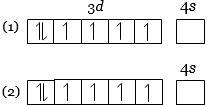
(b) $C{{o}^{3+}}=3{{d}^{6}}4{{s}^{0}}$  $(1)$

$N{{i}^{4+}}=3{{d}^{6}}4{{s}^{0}}$  $(2)$

View full question & answer
MCQ 321 Mark
Transitional elements exhibit variable valencies because they release electrons from the following orbits
  • A
    $ns$  orbit
  • B
    $ns $ and $ np$  orbits
  • $(n -1)d$  and $ns$  orbits
  • D
    $(n -1)d$  orbit
Answer
Correct option: C.
$(n -1)d$  and $ns$  orbits
c
(c)$(n - 1)\,d$ and  $ns$  orbits.
View full question & answer
MCQ 331 Mark
Maximum number of oxidation states of transition metal is derived from the following configuration
  • A
    $ns$  electron
  • B
    $(n - 1)d$ electron
  • C
    $(n + 1)d$ electron
  • $ns + (n - 1)d$ electron
Answer
Correct option: D.
$ns + (n - 1)d$ electron
d
Maximum number of oxidation states of transition metal is derived from the $ns +( n -1)$ d electron configuration.
View full question & answer
MCQ 341 Mark
Of the ions $Z{n^{2 + }},$ $N{i^{2 + }}$ and $C{r^{3 + }}$[atomic number of $Zn = 30,$ $Ni = 28,$ $Cr = 24$
  • Only $Z{n^{2 + }}$ is colourless and $N{i^{2 + }}$ and $C{r^{3 + }}$ are coloured
  • B
    All three are colourless
  • C
    All three are coloured
  • D
    Only $N{i^{2 + }}$ is coloured and $Z{n^{2 + }}$ and $C{r^{3 + }}$ are colourless
Answer
Correct option: A.
Only $Z{n^{2 + }}$ is colourless and $N{i^{2 + }}$ and $C{r^{3 + }}$ are coloured
a
(a) $N{i^{2 + }}$ and $C{r^{2 + }}$ are coloured. But $Z{n^{2 + }}$ is colourless because of absence of unpaired ${e^ - }$.
View full question & answer
MCQ 351 Mark
From $+6 $ to $+1 $ oxidation state is shown by the element of....... group
  • A
    $V-B$
  • $VI-B$
  • C
    $VII-B$
  • D
    $VIII$
Answer
Correct option: B.
$VI-B$
b
(b)Maximum oxidation state $= 6$

Maximum no. of ${e^ - }$ in last shell $= 6$

Group is $ VI-B.$

View full question & answer
MCQ 361 Mark
The number of unpaired electrons in $Z{n^{ + 2 }}$ is
  • A
    $2$
  • B
    $3$
  • C
    $4$
  • $0$
Answer
Correct option: D.
$0$
d
(d)$Z{n^{ + 2}} - 3{d^{10}}4{s^0}$ so there are no unpaired electrons.
View full question & answer
MCQ 371 Mark
$3{d^{10}}4{s^0}$ electronic configuration exhibits
  • $Z{n^{ + 2}}$
  • B
    $C{u^{ + 2 }}$
  • C
    $C{d^{ + 2 }}$
  • D
    $H{g^{ + 2 }}$
Answer
Correct option: A.
$Z{n^{ + 2}}$
a
(a)$Zn - 3{d^{10}}4{s^2}$

$Z{n^{ + 2 }} - 3{d^{10}}4{s^0}$

View full question & answer
MCQ 381 Mark
Which one of the following is an example of non - typical transition elements
  • A
    $Li, \,K, \,Na$
  • B
    $Be, \,Al,\, Pb$
  • $Zn, \,Cd, \,Hg$
  • D
    $Ba,\, Ca, \,Sr$
Answer
Correct option: C.
$Zn, \,Cd, \,Hg$
c
(c) $Zn,\,$ $ Cd $ and $Hg$  are non typical transition elements because they have complete $d-$ orbitals.
View full question & answer
MCQ 391 Mark
Which one is wrong in the following statements
  • A
    Gold is considered to be the king of metals
  • B
    Gold is soluble in mercury
  • C
    Copper is added to gold to make it hard
  • None of these
Answer
Correct option: D.
None of these
d
The king of metals is Gold.

Gold forms Amalgam with Mercury. Hence, it is soluble in Mercury.

Pure gold is very soft. So, impurities of Silver and Copper are added in order to make it harder.

View full question & answer
MCQ 401 Mark
In which of the following, tendency towards formation of coloured ions is maximum
  • A
    $s-$ block elements
  • $d-$ block elements
  • C
    $p-$ block elements
  • D
    $f-$ block elements
Answer
Correct option: B.
$d-$ block elements
b
Tendency towards formation of coloured ions is maximum is maximum in d-block elements.
View full question & answer
MCQ 411 Mark
The atomic number of an element is $22$. The highest oxidation state exhibited by it in its compounds is
  • A
    $1$
  • B
    $2$
  • C
    $3$
  • $4$
Answer
Correct option: D.
$4$
d
(d)Highest oxidation state $\to$ no. of $s$ $-$ $e^-$  $+$  no. of $d$ $-$ $e^-$

                                                                       $2$      $+$     $2$      $=4$

View full question & answer
MCQ 421 Mark
Which of the following is not an element
  • A
    Graphite
  • B
    Diamond
  • $22-$ carat gold
  • D
    Rhombic sulphur
Answer
Correct option: C.
$22-$ carat gold
c
(c) $22 $ carat gold is alloy of copper and gold.
View full question & answer
MCQ 431 Mark
An elements is in ${M^{3 + }}$ form. Its electronic configuration is $[Ar]3{d^1}$ the ion is
  • $T{i^{3 + }}$
  • B
    $T{i^{4 + }}$
  • C
    $C{a^{2 + }}$
  • D
    $S{c^ + }$
Answer
Correct option: A.
$T{i^{3 + }}$
a
(a)$(Ar)\,\,3{s^1} + 3 = Ti$, it means ${M^{3 + }}$ form $T{i^{3 + }}$ ion.
View full question & answer
MCQ 441 Mark
Which of the following metal does not show variable valency
  • A
    $Fe$
  • B
    $Hg$
  • $Zn$
  • D
    $Cu$
Answer
Correct option: C.
$Zn$
c
(c) $Zn$ shows only $+ 2$ valency.
View full question & answer
MCQ 451 Mark
Oxidation number of $Mn$ in ${K_2}Mn{O_4}$ and in $KMn{O_4}$ are respectively
  • $+ 6$ and $+ 7$
  • B
    $+ 6$ and $+ 6$
  • C
    $+ 7$ and $+ 7$
  • D
    $+ 7$ and $+ 6$
Answer
Correct option: A.
$+ 6$ and $+ 7$
a
(a) $O.N.$ of ${K_2}Mn{O_4}$

$2 + x - 8 = 0$

$x = 6$

$O.N.$ of $KMn{O_4}$

$1 + x - 8 = 0$

$x = 7$

View full question & answer
MCQ 461 Mark
The correct statement(s) about transition elements is/are
  • A
    the most stable oxidation state is $+3$ and its stability decreases across the period
  • B
    transition elements of $3d-$ series have almost same atomic sizes from $Cr$ to $Cu$
  • C
    the stability of $+2$ oxidation state increases across the period
  • All of the above
Answer
Correct option: D.
All of the above
d
View full question & answer
MCQ 471 Mark
The highest oxidation state shown by transition elements is
  • A
    $+ 7$ by $Mn$
  • B
    $+ 8$ by $Os$
  • C
    $+ 8$ by $Ru$
  • Both $(b)$ and $(c)$
Answer
Correct option: D.
Both $(b)$ and $(c)$
d
The highest oxidation state shown by any transition metal is eight which is shown by Ru and Os.

Hence Options $\mathrm{B} \& \mathrm{C}$ are correct.

View full question & answer
MCQ 481 Mark
Transition elements are usually characterised by variable oxidation states but $Zn$ does not show this property because of
  • A
    completion of $np-$ orbitals
  • completion of $(n-1)d$ orbitals
  • C
    completion of $ns-$ orbitals
  • D
    inert pair effect
Answer
Correct option: B.
completion of $(n-1)d$ orbitals
b
View full question & answer
MCQ 491 Mark
$Zn$ and $Cd$ metals do not show variable valency because
  • A
    They have only two electrons in the outermost subshells
  • Their $d-$ subshells are completely filled
  • C
    Their $d-$ subshells are partially filled
  • D
    They are relatively soft me
Answer
Correct option: B.
Their $d-$ subshells are completely filled
b
$d$-block elements show variable valency due to their incomplete $d$-orbitals but as $d$-orbitals of $Zn$ and $Cd$ are fully filled so they do not show variable valency.
View full question & answer
MCQ 501 Mark
Which of the following is the correct formula for a compound of scandium and oxygen?
  • A
    $Sc_2O$
  • B
    $ScO$
  • C
    $Sc_3O_2$
  • $Sc_2O_3$
Answer
Correct option: D.
$Sc_2O_3$
d
Sc oxidation state is $+3$ and oxygen is $-2$ so correct formula is $Sc 2 O _3$
View full question & answer
M.C.Q (1 Marks) - Chemistry STD 12 Science Questions - Vidyadip