MCQ
Identify the wrong description of the above figures
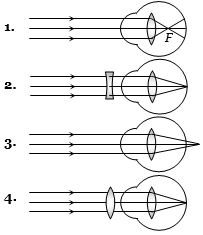
  • $1$ represents far-sightedness
  • B
    $2$ correction for short sightedness
  • C
    $3$ represents far sightedness
  • D
    $4$ correction for far-sightedness

Answer

Correct option: A.
$1$ represents far-sightedness
a
(a) In figure $1,$ parallel rays, that is, rays coming from infinity converge and focus before reaching the retina, hence the person is not able to see far objects, and is nearsighted.

Need a full question paper?

Generate a complete, print-ready paper with questions like this in minutes — across 16+ boards, with answer keys.
Start Generating Free

Similar questions

The concepts of holes is introduced based on:
Line spectrum was first of all theoretically explained by
A particle having a charge of $10.0\,\mu C$ and mass $1\,\mu g$ moves in a circle of radius $10\,cm$ under the influence of a magnetic field of induction $0.1\,T$. When the particle is at a point $P$, a uniform electric field is switched on so that the particle starts moving along the tangent with a uniform velocity. The electric field is......$V/m$
In a nuclear reaction, which of the following is conserved
A long cylindrical shell carries positive surface charge $\sigma$ in the upper half and negative surface charge $-\sigma$ in the lower half. The electric field lines around the cylinder will look like figure given in : (figures are schematic and not drawn to scale)
The current flowing through a lamp marked as $50\, W$ and $250\, V$ is ............. $amp$
A wire of length L metre carrying a current of I ampere is bent in the form of a circle. Its magnitude of magnetic moment will be
An object is placed $20\, cm$ in front of a $4\, cm$ thick plane mirror. The image of the object finally is formed at $45\, cm $ from the object itself . The refractive index of the material of the unpolished side of the mirror is (considering near normal incidence)
Two concave lenses $L_1$ and $L_2$ are kept in contact with each other. If the space between the two lenses is filled with a material of refractive index $\mu\approx1,$ the magnitude of the focal length of the combination:
When a ray of light is incident normally on one refracting surface of an equilateral prism (Refractive index of the material of the prism $= 1.5$)