Question
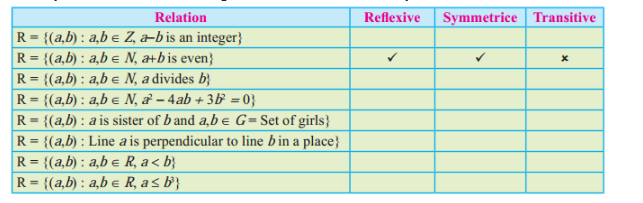
Identify which of the following relations are reflexive, symmetric, and transitive.
Image

Answer

Get the step-by-step solution for this question inside the Vidyadip app.

Get the answer in the app

Need a full question paper?

Generate a complete, print-ready paper with questions like this in minutes — across 16+ boards, with answer keys.

Start Generating Free

Similar questions

Solve the following systems of linear inequations graphically:
$2\text{x}+3\text{y}\leq6,3\text{x}+2\text{y}\leq6,\text{x}\geq0,\text{y}\geq0$
At What point the origin be shifted so that the equation $x^2+ xy - 3x - y + 2 = 0$ cantain any first degree term and constand term?
A box contains 100 bulbs, 20 of which are defective. 10 bulbs are selected for inspection. find the probability that:
  1. All 10 are defective
  2. All 10 are good
  3. At least one is defective
  4. None is defective
A person observes the angle of elevation of the peak of a hill from a station to be $\alpha.$ He walks c metres along a slope inclined at an angle $\beta$ and finds the angle of elevation of the peak of the hill to be $\gamma.$ Show that the height of the peak above the ground is $\frac{\text{c}\sin\alpha\sin(\gamma-\beta)}{(\sin\gamma-\alpha)}.$
Find the equation of the circle the end points of whose diameter are the centres of the circles $x^2 + y^2 + 6x - 14y - 1 = 0$ and $x^2 + y^2 - 4x + 10y - 2 = 0.$
Show that the circles touch each other internally. Find their point of contact and the equation of their common tangent.

$x^2+y^2+4 x-12 y+4=0$

$x^2+y^2-2 x-4 y+4=0$
Evaluate the following limits: $\lim _{x \rightarrow 0}\left[\frac{\cos (a x)-\cos (b x)}{\cos (c x)-1}\right]$
Find the equation to the ellipse in the standard form whose minor axis is equal to the distance between foci and whose latus-rectum is $10.$
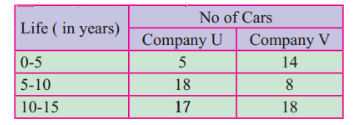
There are two companies U and V which manufacture cars. A sample of 40 cars each from these companies is taken and the average running life (in years) is recorded.

Image

Which company shows greater consistency?

Show that:$\sin(\text{B}-\text{C})\cos(\text{A}-\text{D})+\sin(\text{C}-\text{A})\\\cos(\text{B}-\text{D})+\sin(\text{A}-\text{B})\cos(\text{C}-\text{D})=0$