MCQ
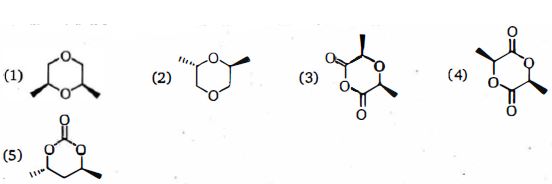
Identify which of the structures below are meso structures ?
  • $1$ and $3$
  • B
    $1,3$ and $5$
  • C
    $1,3$ and $4$
  • D
    $2$ and $5$

Answer

Correct option: A.
$1$ and $3$
a
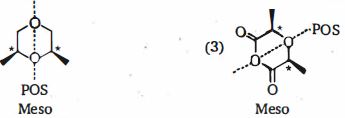
$(a)$ Mesa compounds are those having $2$ or more chiral centres along with symmetry.

Need a full question paper?

Generate a complete, print-ready paper with questions like this in minutes — across 16+ boards, with answer keys.

Start Generating Free

Similar questions

The rate of first order reaction is $0.04 \mathrm{~mol} \mathrm{~L}^{-1} \mathrm{~s}^{-1}$ at $10$ minutes and $0.03 \mathrm{~mol} \mathrm{~L}^{-1} \mathrm{~s}^{-1}$ at $20$ minutes after initiation. Half life of the reaction is ____________minutes. (Given $\log 2=0.3010, \log 3=0.4771)$
One mole of $1,2$ -dibromopropane on treatment with $X \,moles$ of $NaNH_2$  followed by treatment with ethyl bromide gave a pentyne. The value of $X$ is
For a reaction ${H_{2\left( g \right)}} + \frac{1}{2}{O_{2\left( g \right)}} \longrightarrow {H_2}{O_{\left( l \right)}}$ ; $\Delta {C_p} = 32\,J{K^{ - 1}}$, $\Delta H$ at $27\,^oC = -285.8\, kJ\, mol^{-1}$. What will be the value of $\Delta H$ at $127\,^oC$ ?.....$kJ/mol$
Which of the following species is not paramagnetic ?
If pure unhybridised orbitals are used in forming $CH_4$ then which statement is incorrect :-
Assuming that elements are formed to complete the seventh period, what would be the  atomic number of the alkaline earth metal of the eighth period?
The equivalent conductance of $NaCl $ at concentration $C$ and at infinite dilution are $\lambda _C$ and $\lambda _{\infty}$ respectively. The correct relationship between $\lambda _C$ and $\lambda _{\infty}$ is given as :

(Where the constant $B$ is positive)

The $IUPAC$ name of $[Cr(NH_3)_4Cl_2]NO_3$ is
Compound $‘A$’ reacts with $PC{l_5}$ to give ‘$B$ ’ which on treatment with $KCN$ followed by hydrolysis gave propanoic acid as the product. What is ‘$A$
At temperature $T$ a compound $AB_2(g)$ dissociates according to the reaction with a degree of dissociation $'x'$ which is very small compared to unity. The value of $x$ is 

$2A{B_2}(g) \rightleftharpoons 2AB(g) + {B_2}(g)$