MCQ
If $1000$ droplets of water of surface tension $0.07\,N / m$. having same radius $1\,mm$ each, combine to from a single drop. In the process the released surface energy is $\left(\text { Take } \pi=\frac{22}{7}\right)$
  • A
    $7.92 \times 10^{-6}\,J$
  • $7.92 \times 10^{-4}\,J$
  • C
    $9.68 \times 10^{-4}\,J$
  • D
    $8.8 \times 10^{-5}\,J$

Answer

Correct option: B.
$7.92 \times 10^{-4}\,J$
b
$1000 \times \frac{4 \pi}{3}(1)^3=\frac{4 \pi}{3} R ^3$

$R =10\,mm$

$T \times 1000 \times 4 \pi\left(10^{-3}\right)^2- T \times 4 \pi\left(10 \times 10^{-3}\right)^2=\Delta E$

$\Delta E =4 \times \pi \times 7 \times 10^{-2}[1000-100] \times 10^{-6}$

$\Delta E =7.92 \times 10^{-4}\,J$

Need a full question paper?

Generate a complete, print-ready paper with questions like this in minutes — across 16+ boards, with answer keys.

Start Generating Free

Similar questions

Two seconds after projection a projectile is travelling in a direction inclined at $30^o$ to  horizontal, after one more second it is travelling horizontally. What is the magnitude and  direction of its velocity at initial point
The $K.E.$ of a body can be increased maximum by doubling its:
$Assertion$ : An astronaut experience weightlessness in a space satellite.

$Reason$ : When a body falls freely it does not experience gravity

A binary star consists of two stars $\mathrm{A}$ (mass $2.2 \mathrm{M}_5$ ) and $\mathrm{B}$ (mass $11 \mathrm{M}_5$ ), where $\mathrm{M}_5$ is the mass of the sun. They are separated by distance $\mathrm{d}$ and are rotating about their centre of mass, which is stationary. The ratio of the total angular momentum of the binary star $\mathrm{A}$ to the angular momentum of star $\mathrm{B}$ about the centre of mass is
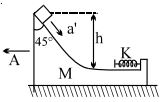
$A$ small block of mass $m$ is placed on $a$ wedge of mass $M$ as shown, which is initially at rest. All the surfaces are frictionless . The spring attached to the other end of wedge has force constant $k$. If $a'$ is the acceleration of $m$ relative to the wedge as it starts coming down and $A$ is the acceleration acquired by the wedge as the block starts coming down, then 
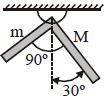
Two uniform rods of equal length but different masses are rigidly joined to form an $L-$ shaped body, which is then pivoted as shown in figure. If in equilibrium the body is in the shown configuration, ratio $M/m$ will be
A spring of force constant $k$ is cut into two pieces such that one piece is double the length of the other. Then the long piece will have a force constant of
A glass flask of volume one litre at $0^oC$ is filled, level full of mercury at this temperature. The flask and mercury are now heated to $100°C$ ........... $cc$ mercury will spill out, if coefficient of volume expansion of mercury is $1.82 \times {10^{ - 4}}°C^{-1}$ and linear expansion of glass is $0.1 \times {10^{ - 4}}°C^{-1}$ respectively
A thin and uniform rod of mass $M$ and length $L$ is held vertical on a floor with large friction. The rod is released from rest so that it falls by rotating about its contact-point with the floor without slipping. Which of the following statement($s$) is/are correct, when the rod makes an angle $60^{\circ}$ with vertical ? [ $g$ is the acceleration due to gravity]

$(1)$ The radial acceleration of the rod's center of mass will be $\frac{3 g }{4}$

$(2)$ The angular acceleration of the rod will be $\frac{2 g }{ L }$

$(3)$ The angular speed of the rod will be $\sqrt{\frac{3 g}{2 L}}$

$(4)$ The normal reaction force from the floor on the rod will be $\frac{ Mg }{16}$

A long stiff uniform wire is suspended from one end. The time period of oscillations of the wire is $T$. If the wire is now bent into a circle and suspended from a knife edge so that it can oscillate freely in the plane of the ring, its time period will be