Question
If $1+\sin^2\theta=3\sin\theta\cos\theta,$ then prove that $\tan\theta=1,\text{ or }\frac{1}{2}.$

Answer

To solve an equation in we have to change it into one trigonometric ratio.
Given trigonometric equation is.
$1+\sin^2\theta=3\sin\theta\cos\theta$
$\Rightarrow\ \frac{1}{\sin^2\theta}+\frac{\sin^2\theta}{\sin^2\theta}=\frac{3\sin\theta\cos\theta}{\sin^2\theta}$ $[\text{Dividing by}\sin^2\theta\text{ both sides}]$
$\Rightarrow\ \text{cosec}^2\theta+1=3\cot\theta$
$\Rightarrow\ 1+\cot^2\theta+1-3\cot\theta=0$
$\Rightarrow\ \cot^2\theta-3\cot\theta+2=0$
$\Rightarrow\ \cot^2\theta-2\cot\theta-1\cot\theta+2=0$
$\Rightarrow\ \cot\theta(\cot\theta-2)-1(\cot\theta-2)=0$
$\Rightarrow\ (\cot\theta-2)(\cot\theta-1)=0$
$\Rightarrow\ \cot\theta-2=0\text{ or }(\cot\theta-1)=0$
$\Rightarrow\ \cot\theta=2\text{ or }\cot\theta=1$
$\Rightarrow\ \tan\theta=\frac{1}{2}\text{ or }\tan\theta=1$
Hence, $\tan\theta=\frac{1}{2},\text{ or }1.$

Need a full question paper?

Generate a complete, print-ready paper with questions like this in minutes — across 16+ boards, with answer keys.

Start Generating Free

Similar questions

Two dice, one blue and one grey, are thrown at the same time. Complete the following table:
Event 'Sum on two dice' 2 3 4 5 6 7 8 9 10 11 12
Probability                      
From the above table a student argues that there are 11 possible outcomes 2, 3, 4, 5, 6, 7, 8, 9, 10, 11 and 12. Therefore, each of them has a probability $\frac{1}{11}$. Do you agree with this argument?
A dealer sells an article for Rs. 75 and gains as much percent as the cost price of the article. Find the cost price of the article.
Solve the following system of equations graphically:
Shade the region between the lines and the y-axis.
3x - 4y = 7,
5x + 2y = 3.
If Zeba were younger by 5 years than what she really is, then the square of her age (in years) would have been 11 more than five times her actual age. What is her age now?
If three times the larger of two numbers is divided by the smaller, we get 4 as the quotient and 8 as the remainder. If five times the smaller is divided by the larger, we get 3 as the quotient and 5 as the remainder. Find the numbers.
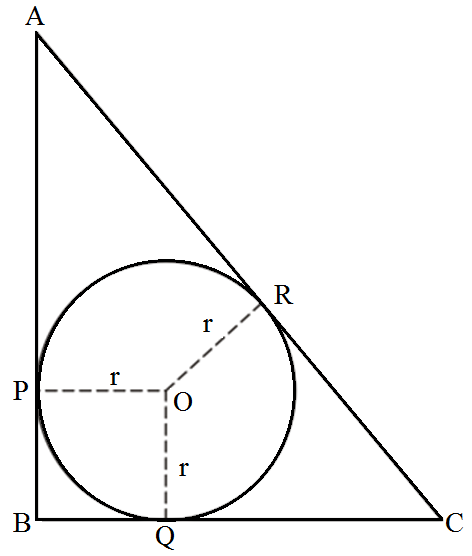
In the given figure, ABC is a right triangle right-angled at B such that BC = 6cm and AB = 8cm. Find the radius of its in circle.
If the points $A(k+1,2 k), B(3 k, 2 k+3)$ and $C(5 k-1,5 k)$ are collinear, then find the value of $k$.
Solve each of the following given systems of equations graphically and find the vertices and area of the triangle formed by these lines and the x-axis:
2x - 3y + 4 = 0, x + 2y - 5 = 0
Solve the following quadratic equation:
$\frac{3}{\text{x}+1}-\frac{1}{2}=\frac{2}{\text{3x}-1},$ $\text{x}\neq-1,\ \frac{1}{3}$
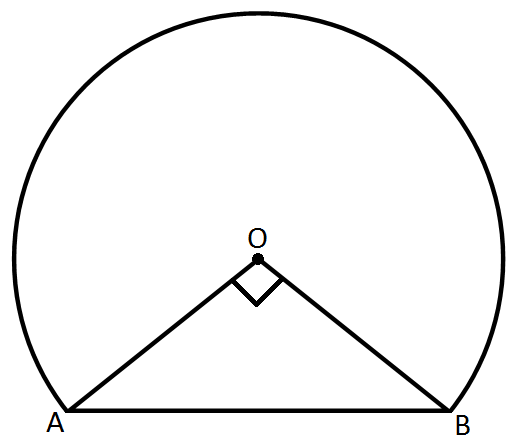
In the following figure, shows the cross-section of railway tunnel. The radius OA of the circular part is 2m. If $\angle\text{AOB}=90^\circ,$ calculate
  1. The height of the tunnel
  2. The perimeter of the cross-section
  3. The area of the cross-section.