Questions

5 Marks Questions

🎯

Test yourself on this topic

18 questions · timed · auto-graded

Question 15 Marks
The angle of elevation of the top of a vertical tower from a point on the ground is 60º. From another point 10m vertically above the first, its angle of elevation is 45º. Find the height of the tower.
Answer
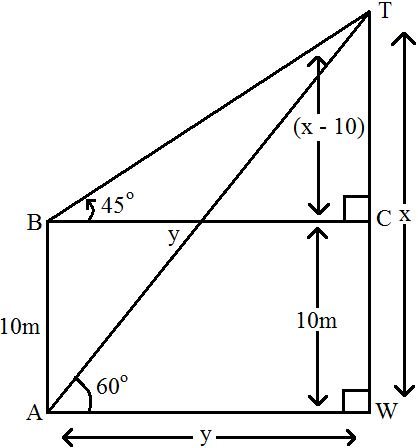
Let the height of the vertical tower TW = x m.
It stands on a horizontal plane AW = y.
Also BC.
Observation point B is 10m above the first observation point A.
The angles of elevation from point of observation A and B are 60º and 45º respectively.
TC = x - 10
In right angled triangle TBC, we have
$\tan45^\circ=\frac{\text{x}-10}{\text{y}}$
$\Rightarrow\ 1=\frac{\text{x}-10}{\text{y}}$
$\Rightarrow\ \text{y}=\text{x}-10\ \ ...(\text{I})$
Now, in $\triangle\text{TAW},$
$\tan60^\circ=\frac{\text{x}}{\text{y}}$
$\Rightarrow\ \sqrt{3}=\frac{\text{x}}{\text{x}-10}\ \ [\text{From (I)}]$
$\Rightarrow\ \sqrt{3}\text{x}-10\sqrt{3}=\text{x}$
$\Rightarrow\ \sqrt{3}\text{x}-\text{x}=10\sqrt{3}$
$\Rightarrow\ \text{x}(\sqrt{3}-1)=10\sqrt{3}$
$\Rightarrow\ \text{x}=\frac{10\sqrt{3}}{(\sqrt{3}-1)}\times\frac{(\sqrt{3}+1)}{\sqrt{3}+1}$
$\Rightarrow\ \text{x}=\frac{10(3+\sqrt{3})}{(\sqrt{3})^2-1}$
$=\frac{10\times(3+1.732)}{3-1}=\frac{10\times4.732}{2}=10\times2.366$
$\Rightarrow\ \text{x}=23.66\text{m}$
Hence, the height of the tower = 23.66m.
View full question & answer
Question 25 Marks
If $\text{a}\sin\theta+\text{b}\cos\theta=\text{c},$ then prove that $\text{a}\cos\theta-\text{b}\sin\theta=\sqrt{\text{a}^2+\text{b}^2-\text{c}^2}.$
Answer
$\text{a}\sin\theta+\text{b}\cos\theta=\text{c}\ \ [\text{Given}]$
On squaring both sides, we get
$(\text{a}\sin\theta)^2+(\text{b}\cos\theta)^2+2(\text{a}\sin\theta)(\text{b}\cos\theta)=\text{c}^2$
$\Rightarrow\ \text{a}^2\sin^2\theta+\text{b}^2\cos^2\theta+2\text{ab}\sin\theta\cos\theta=\text{c}^2$
$\Rightarrow\ \text{a}^2(1-\cos^2\theta)+\text{b}^2(1-\sin^2\theta)+2\text{ab}\sin\theta\cos\theta=\text{c}^2$
$\Rightarrow\ \text{a}^2-\text{a}^2\cos^2\theta+\text{b}^2-\text{b}^2\sin^2\theta+2\text{ab}\sin\theta\cos\theta=\text{c}^2$
$\Rightarrow\ -\text{a}^2\cos^2\theta-\text{b}^2\sin^2\theta+2\text{ab}\sin\theta\cos\theta=\text{c}^2-\text{a}^2-\text{b}^2$
$\Rightarrow\ \text{a}^2\cos^2\theta+\text{b}^2\sin^2\theta-2\text{ab}\sin\theta\cos\theta=\text{a}^2+\text{b}^2-\text{c}^2$
$\Rightarrow\ (\text{a}\cos\theta)^2+(\text{b}\sin\theta)^2-2(\text{a}\cos\theta)(\text{b}\sin\theta)=\text{a}^2+\text{b}^2-\text{c}^2$
$\Rightarrow\ (\text{a}\cos\theta-\text{b}\sin\theta)^2=\text{a}^2+\text{b}^2-\text{c}^2$
$\Rightarrow\ \text{a}\cos\theta-\text{b}\sin\theta=\pm\sqrt{\text{a}^2+\text{b}^2+\text{c}^2}$
(Taking square root both sides)
Hence, $\text{a}\cos\theta-\text{b}\sin\theta=\sqrt{\text{a}^2+\text{b}^2-\text{c}^2}$
Hence, proved.
View full question & answer
Question 35 Marks
If $\sin\theta+\cos\theta=\text{p and }\sec\theta+\text{cosec}\theta=\text{q},$ then prove that $\text{q}(\text{p}^2-1)=2\text{p}.$
Answer
$\sin\theta+\cos\theta=\text{p}\ \ ...(\text{I})$
$\sec\theta+\text{cosec}\theta=\text{q}\ \ ...(\text{II})$
[(II)nd expretion can be changed into $\sin\theta,\ \cos\theta$ and eliminate trigonometric ratio from (I) and (II)]
$\sec\theta+\text{cosec}\theta=\text{q}$
$\Rightarrow\ \frac{1}{\cos\theta}+\frac{1}{\sin\theta}=\text{q}$
$\Rightarrow\ \frac{\sin\theta+\cos\theta}{\sin\theta\cos\theta}=\frac{\text{q}}{1}$
$\Rightarrow\ \frac{\text{p}}{\sin\theta\cos\theta}=\text{q}\ \ [\text{Using(I)}]$
$\Rightarrow\ \sin\theta\cos\theta=\frac{\text{p}}{\text{q}}\ \ (\text{III})$
$\sin\theta+\cos\theta=\text{p}\ \ [\text{From(I)}]$
$\Rightarrow(\sin\theta+\cos\theta)^2=\text{p}^2\ \ [\text{squaring both sides}]$
$\Rightarrow\ \sin^2\theta+\cos^2\theta+2\sin\theta\cos\theta=\text{p}^2$
$\Rightarrow\ 1+2\cdot\frac{\text{p}}{\text{q}}=\text{p}^2\ \ [\because\sin^2\theta+\cos^2\theta=1\text{ and using (III)}]$
$\Rightarrow\ \text{q}+2\text{p}=\text{p}^2\text{q}$
$\Rightarrow\ 2\text{p}=\text{p}^2\text{q}-\text{q}$
$\Rightarrow\ 2\text{p}=\text{q}(\text{p}^2-1)$
Hence, proved.
View full question & answer
Question 45 Marks
The lower window of a house is at a height of 2m above the ground and its upper window is 4m vertically above the lower window. At certain instant the angles of elevation of a balloon from these windows are observed to be $60^\circ$ and $30^\circ$, respectively. Find the height of the balloon above the ground.
Answer

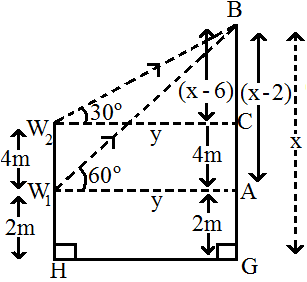
Let $B$ be a balloon at a height $G B=x m$.
Let $W _1$ be the window, which is 2 m above the ground H .
$\therefore W_1 H=2 m$
$\Rightarrow A G=2 m$
Let $W_2$ be the second window, which is the 4 m above the window $W_1$.
$\therefore W_2 W_1=AC=4 m$
The angles of elevation of balloon $B$ from $W_1, W_2$ are $60^{\circ}$ and $30^{\circ}$ respectively.
$BA = (x - 2)m$
$BC = x - 2 - 4 = (x - 6)m$
In right angled $\triangle\text{W}_2\text{CB},$ we have
$\tan30^\circ=\frac{\text{x}-6}{\text{y}}$
$\Rightarrow\ \frac{1}{\sqrt{3}}=\frac{\text{x}-6}{\text{y}}$
$\Rightarrow\ \text{y}=\sqrt{3}(\text{x}-6)\ \ ...(\text{I})$
Now, in right angled $\triangle\text{W}_1\text{AB},$
$\tan60^\circ=\frac{\text{x}-2}{\text{y}}$
$\Rightarrow\ \sqrt{3}=\frac{\text{x}-2}{\text{y}}$
$\Rightarrow\ \sqrt{3}\text{y}=(\text{x}-2)\ \ ...(\text{II})$
$\Rightarrow\ \sqrt{3}\cdot\sqrt{3}(\text{x}-6)=\text{x}-2\ \ [\text{From (I)}]$
$\Rightarrow\ 3\text{x}-18=\text{x}-2$
$\Rightarrow\ 3\text{x}-\text{x}=18-2$
$\Rightarrow\ 2\text{x}=16$
$\Rightarrow\ \text{x}=8\text{m}.$
Hence, the height of the balloon above the ground is 8m.
View full question & answer
Question 55 Marks
Prove that $\sqrt{\sec^2\theta+\text{cosec}^2\theta}=\tan\theta+\cot\theta.$
Answer
LHS $=\sqrt{\sec^2\theta+\text{cosec}^2\theta}$
$=\sqrt{\frac{1}{\cos^2\theta}+\frac{1}{\sin^2\theta}}=\sqrt{\frac{\sin^2\theta+\cos^2\theta}{\cos^2\theta\sin^2\theta}}$
$=\sqrt{\frac{1}{\sin^2\theta\cdot\cos^2\theta}}=\frac{1}{\sin\theta\cos\theta}$
$=\text{cosec}\theta\sec\theta$
RHS $=\tan\theta+\cot\theta $
$=\frac{\sin\theta}{\cos\theta}+\frac{\cos\theta}{\sin\theta}=\frac{\sin^2\theta+\cos^2\theta}{\sin\theta\cos\theta}$
$=\frac{1}{\sin\theta\cdot\cos\theta}$
$=\text{cosec}\theta\cdot\sec\theta=$ LHS
Hence,proved.
View full question & answer
Question 65 Marks
If $\text{cosec}\theta+\cot\theta=\text{p},$ then prove that $\cos\theta=\frac{\text{p}^2-1}{\text{p}^2+1}.$
Answer
$\text{cosec}\theta+\cot\theta=\text{p}\ [\text{Given}]$
$\Rightarrow\ \frac{1}{\sin\theta}+\frac{\cos\theta}{\sin\theta}=\text{p}$
$\Rightarrow\ \frac{1+\cos\theta}{\sin\theta}=\text{p}$
$\Rightarrow\ \frac{(1+\cos\theta)^2}{\sin^2\theta}=\text{p}^2$
$\Rightarrow\ \frac{(1+\cos\theta)^2}{(1-\cos^2\theta)}=\text{p}^2$
$\Rightarrow\ \frac{(1+\cos\theta)^2}{(1-\cos\theta)(1+\cos\theta)}=\text{p}^2$
$\Rightarrow\ \frac{(1+\cos\theta)}{(1-\cos\theta)}=\frac{\text{p}^2}{1}$
$\begin{bmatrix}\text{By using the rule of componendo and dividendo}\frac{\text{a}}{\text{b}}=\frac{\text{c}}{\text{d}}\\\text{can be written as }\frac{\text{a}+\text{b}}{\text{a}-\text{b}}=\frac{\text{c}+\text{d}}{\text{c}-\text{d}} \end{bmatrix}$
So,by using componendo and dividendo, we have
$\frac{(1+\cos\theta)+(1-\cos\theta)}{(1+\cos\theta)-(1-\cos\theta)}=\frac{\text{p}^2+1}{\text{p}^2-1}$
$\Rightarrow\ \frac{2}{2\cos\theta}=\frac{\text{p}^2+1}{\text{p}^2-1}\ \Big(\text{By invertendo }\frac{\text{a}}{\text{b}}=\frac{\text{c}}{\text{d}};\ \frac{\text{b}}{\text{a}}=\frac{\text{d}}{\text{c}}\Big)$
$\Rightarrow\ \cos\theta=\frac{\text{p}^2-1}{\text{p}^2+1}$
Hence, proved.
View full question & answer
Question 75 Marks
The shadow of a tower standing on a level plane is found to be 50m longer when Sun’s elevation is 30° than when it is 60°. Find the height of the tower.
Answer
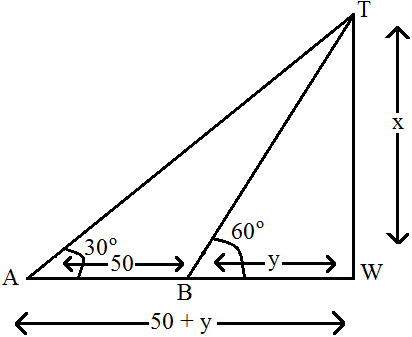
Let a tower TW of light x (let) is standing vertically upright on a level plane ABW. A and B are two positions of observation when angle of elevation changes from 30° to 60° respectively.
Let BW = y AB = 50m [Given] In $\triangle\text{TWB},$ we have $\tan60^\circ=\frac{\text{x}}{\text{y}}$ $\Rightarrow\ \sqrt{3}=\frac{\text{x}}{\text{y}}$ $\Rightarrow\ \text{x}=\sqrt{3}\text{y}\ \ ...(\text{I})$ Now, in $\triangle\text{TWA},$ we have $\tan30^\circ=\frac{\text{x}}{\text{y}+50}\ \ ...(\text{II})$ $\Rightarrow\ \frac{1}{\sqrt{3}}=\frac{\sqrt{3}\text{y}}{\text{y}+50}\ \ [\text{From (I)}]$ $\Rightarrow\ 3\text{y}=\text{y}+50$ $\Rightarrow\ 3\text{y}-\text{y}=50$ $\Rightarrow\ 2\text{y}=50$ $\Rightarrow\ \text{y}=25\ \ (\text{I})$ Now, $\text{x}=\sqrt{3}\text{y}$ $\Rightarrow\ \text{x}=\sqrt{3}\times25$ $\Rightarrow\ \text{x}=25\sqrt{3}\text{m}.$
View full question & answer
Question 85 Marks
Prove the following.
$\tan\theta+\tan(90^\circ-\theta)=\sec\theta\sec(90^\circ-\theta)$
Answer
LHS $=\tan\theta+\tan(90^\circ-\theta)\ [\because\tan(90^\circ-\theta)=\cot\theta]$
$=\tan\theta+\cot\theta=\frac{\sin\theta}{\cos\theta}+\frac{\cos\theta}{\sin\theta}$
$=\frac{\sin^2\theta+\cos^2\theta}{\sin\theta\cos\theta}\ \Big[\because\tan\theta=\frac{\sin\theta}{\cos\theta}\text{ and }\cot\theta=\frac{\cos\theta}{\sin\theta}\Big]$
$=\frac{1}{\sin\theta\cos\theta}\ [\because\sin^2\theta+\cos^2\theta=1]$
$=\sec\theta\text{cosec}\theta\ \Big[\because\sec\theta=\frac{1}{\cos\theta}\text{ and }\cos\theta=\frac{1}{\sin\theta}\Big]$
$=\sec\theta\sec\theta(90^\circ-\theta)=$ RHS $[\because\sec(90^\circ-\theta)=\text{cosec}\theta]$
View full question & answer
Question 95 Marks
If $1+\sin^2\theta=3\sin\theta\cos\theta,$ then prove that $\tan\theta=1,\text{ or }\frac{1}{2}.$
Answer
To solve an equation in we have to change it into one trigonometric ratio.
Given trigonometric equation is.
$1+\sin^2\theta=3\sin\theta\cos\theta$
$\Rightarrow\ \frac{1}{\sin^2\theta}+\frac{\sin^2\theta}{\sin^2\theta}=\frac{3\sin\theta\cos\theta}{\sin^2\theta}$ $[\text{Dividing by}\sin^2\theta\text{ both sides}]$
$\Rightarrow\ \text{cosec}^2\theta+1=3\cot\theta$
$\Rightarrow\ 1+\cot^2\theta+1-3\cot\theta=0$
$\Rightarrow\ \cot^2\theta-3\cot\theta+2=0$
$\Rightarrow\ \cot^2\theta-2\cot\theta-1\cot\theta+2=0$
$\Rightarrow\ \cot\theta(\cot\theta-2)-1(\cot\theta-2)=0$
$\Rightarrow\ (\cot\theta-2)(\cot\theta-1)=0$
$\Rightarrow\ \cot\theta-2=0\text{ or }(\cot\theta-1)=0$
$\Rightarrow\ \cot\theta=2\text{ or }\cot\theta=1$
$\Rightarrow\ \tan\theta=\frac{1}{2}\text{ or }\tan\theta=1$
Hence, $\tan\theta=\frac{1}{2},\text{ or }1.$
View full question & answer
Question 105 Marks
The angle of elevation of the top of a tower 30m high from the foot of another tower in the same plane is 60° and the angle of elevation of the top of the second tower from the foot of the first tower is 30°. Find the distance between the two towers and also the height of the other tower.
Answer

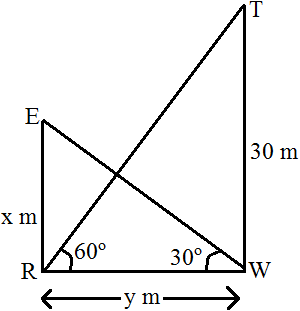
Two vertical towers TW = 30m and ER = x m (let) are standing on a horizontal plane RW = y(let). The angle of elevation from R to top of 30m high tower is 60º and the angle of elevation of second tower from W is 30º.
In $\triangle\text{ERW},$
$\tan30^\circ=\frac{\text{x}}{\text{y}}$
$\Rightarrow\ \frac{1}{\sqrt{3}}=\frac{\text{x}}{\text{y}}$
$\Rightarrow\ \text{y}=\sqrt{3}\text{x}\ \ ...(\text{I})$
Now, In $\triangle\text{TWR},$
$\tan60^\circ=\frac{30^\circ}{\text{y}}\ \ (\text{I})$
$\Rightarrow\ \sqrt{3}=\frac{30}{\sqrt{3}\text{x}}\ \ [\text{From (I)}]$
$\Rightarrow\ 3\text{x}=30$
$\Rightarrow\ \text{x}=10\text{m}$
Now, $\text{y}=\sqrt{3}\text{x}$
$\Rightarrow\ \text{y}=\sqrt{3}(10)$
$\Rightarrow\ \text{y}=1.732\times10$
$\Rightarrow\ \text{y}=17.32\text{m}$
Hence, the distance between the two towers is 17.32m and the height of the second tower is 10m.
View full question & answer
Question 115 Marks
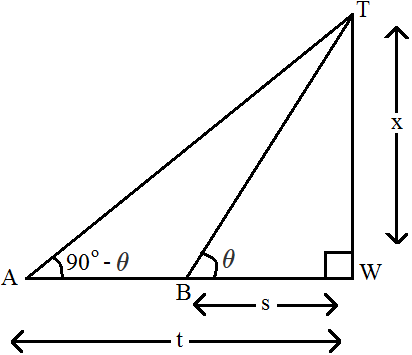
The angle of elevation of the top of a tower from two points distant s and t from its foot are complementary. Prove that the height of the tower is $\sqrt{\text{st}}.$
Answer

Let the height of the vertical tower (TW) = x m.
Points of observation A and B are at distances 'P and 's' from the foot of tower.
The angles of elevation of top of the tower from observation points A and B are $(90^\circ-\theta)$ and $\theta$ which are complementary.
In $\triangle\text{TWB},$ we have
$\tan\theta=\frac{\text{x}}{\text{s}}\ ...(\text{I})$
Now, in $\triangle\text{TWA},$ we have
$\tan(90^\circ-\theta)=\frac{\text{x}}{\text{t}}$
$\Rightarrow\ \cot\theta=\frac{\text{x}}{\text{t}}$
$\Rightarrow\ \cot\theta\cdot\tan\theta=\frac{\text{x}}{\text{t}}\cdot\frac{\text{x}}{\text{s}}$ [Multiply by (I)]
$\Rightarrow\ \frac{1}{\tan\theta}\cdot\tan\theta=\frac{\text{x}^2}{\text{st}}$
$\Rightarrow\ \frac{\text{x}^2}{\text{st}}=1$
$\Rightarrow\ \text{x}^2=\text{st}$
$\Rightarrow\ \text{x}=\sqrt{\text{st}}$
Hence, proved.
View full question & answer
Question 125 Marks
Prove the following.
$\frac{\sin\theta}{1+\cos\theta}+\frac{1+\cos\theta}{\sin\theta}=2\text{cosec}\theta$
Answer

LHS $\frac{\sin\theta}{1+\cos\theta}+\frac{1+\cos\theta}{\sin\theta}=\frac{\sin^2\theta+(1+\cos\theta)^2}{\sin\theta(1+\cos\theta)}$
$=\frac{\sin^2\theta+1+\cos^2\theta+2\cos\theta}{\sin\theta(1+\cos\theta)}\ [\because(\text{a}+\text{b})^2=\text{a}^2+\text{b}^2+2\text{ab}]$
$=\frac{1+1+2\cos\theta}{\sin\theta(1+\cos\theta)}\ [\because\sin^2\theta+\cos^2\theta=1]$
$=\frac{2(1+\cos\theta)}{\sin\theta(1+\cos\theta)}=\frac{2}{\sin\theta}$
$=2\text{cosec}\theta=$ RHS $\Big[\because\ \text{cosec}\theta=\frac{1}{\sin\theta}\Big]$
View full question & answer
Question 135 Marks
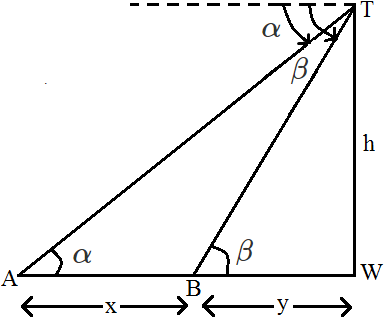
From the top of a tower h m high, the angles of depression of two objects, which are in line with the foot of the tower are α and $\beta(\beta>\alpha).$ Find the distance between the two objects.
Answer

Consider a vertical tower TW = h m. Two objects A and B are x m apart in the line joining A,B, and W and BW = y (let).
The angle of depression from the top a tower to objects A and B are $\alpha\text{ and }\beta$ respectively.
In $\triangle\text{TWB},$ we have
$\tan\beta=\frac{\text{h}}{\text{y}}$
$\Rightarrow\ \text{y}=\frac{\text{h}}{\tan\beta}\ \ ...(\text{I})$
Now, in $\triangle\text{TWA},$
$\tan\alpha=\frac{\text{h}}{\text{x + y}}$
$\Rightarrow\ \tan\alpha(\text{x + y})=\text{h}$
$\Rightarrow\ \Big(\text{x}+\frac{\text{h}}{\tan\beta}\Big)\tan\alpha=\text{h}\ \ [\text{From (I)}]$
$\Rightarrow\ \text{x}\tan\alpha+\frac{\text{h}\tan\alpha}{\tan\beta}=\text{h}$
$\Rightarrow\ \text{x}\tan\alpha=\text{h}-\frac{\text{h}\tan\alpha}{\tan\beta}$
$\Rightarrow\ \text{x}\tan\alpha=\frac{\text{h}\tan\beta-\text{h}\tan\alpha}{\tan\beta}$
$\Rightarrow\ \text{x}=\frac{\text{h}[\tan\beta-\tan\alpha]}{\tan\alpha\cdot\tan\beta}$
$\Rightarrow\ \text{x}=\text{h}\Big[\frac{\tan\beta}{\tan\alpha\cdot\tan\beta}-\frac{\tan\alpha}{\tan\alpha\cdot\tan\beta}\Big]$
$\Rightarrow\ \text{x}=\text{h}\Big[\frac{1}{\tan\alpha}-\frac{1}{\tan\beta}\Big]$
$\Rightarrow\ \text{x}=\text{h}[\cot\alpha-\cot\beta]$
Hence, the distance between the two objects is $\text{h}(\cot\alpha-\cot\beta)\text{m}.$
View full question & answer
Question 145 Marks
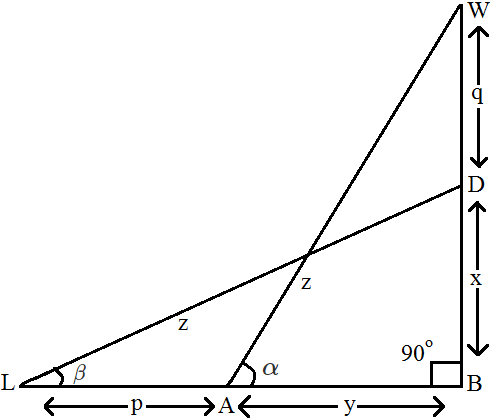
A ladder rests against a vertical wall at an inclination $\alpha$ to the horizontal. Its foot is pulled away from the wall through a distance p so that its upper end slides a distance q down the wall and then the ladder makes an angle $\beta$ to the horizontal.
Show that $\frac{\text{p}}{\text{q}}=\frac{\cos\beta-\cos\alpha}{\sin\alpha-\sin\beta}.$
Answer

Consider a vertical wall WB. Two positions AW and LD of a ladder as shown in figure such that LA = p, WD = q and LD = AW = z. Angle of inclination of ladder at two positions A and L are $\alpha\text{ and }\beta$ respectively.
Let AB = y and DB = x.
In $\triangle\text{ABW},$ we have
$\sin\alpha=\frac{\text{x + q}}{\text{z}}$
and $\cos\alpha=\frac{\text{y}}{\text{z}}$
In $\triangle\text{LBD}, $ we have
$\sin\beta=\frac{\text{x}}{\text{z}}$
$\cos\beta=\frac{\text{y + p}}{\text{z}}$
Taking RHS $=\frac{\cos\beta-\cos\alpha}{\sin\alpha-\sin\beta}$
$=\frac{\frac{\text{y + p}}{\text{z}}-\frac{\text{y}}{\text{z}}}{\frac{\text{x + q}}{\text{z}}-\frac{\text{x}}{\text{z}}}=\frac{\frac{\text{y + p}-\text{y}}{\text{z}}}{\frac{\text{x + q}-\text{x}}{\text{z}}}$
$=\frac{\text{p}}{\text{z}}+\frac{\text{q}}{\text{z}}=\frac{\text{p}}{\text{z}}\times\frac{\text{z}}{\text{q}}$
$=\frac{\text{p}}{\text{q}}=$ LHS
Hence, proved.
View full question & answer
Question 155 Marks
A vertical tower stands on a horizontal plane and is surmounted by a vertical flag staff of height 'h'. At a point on the plane, the angles of elevation of the bottom and the top of the flag staff are $\alpha\text{ and }\beta$ respectively. Prove that the height of the tower is $\Big(\frac{\text{h}\tan\alpha}{\tan\beta-\tan\alpha}\Big).$
Answer

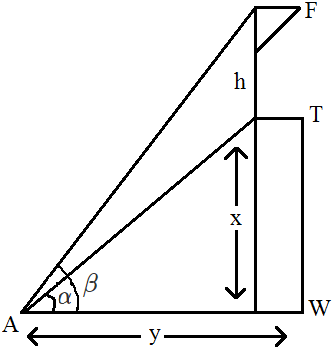
Let the height of vertical tower (TW) = x. And, the height of flag staff (TF) = h (Given).
The angle of elevation at A on ground from the base and top of flag staff are $\alpha,\beta$ respectively.
Let AW = y
in $\triangle\text{TWA},$ we have
$\tan\alpha=\frac{\text{x}}{\text{y}}$
$\Rightarrow\ \text{y}=\frac{\text{x}}{\tan\alpha}\ \ ...(\text{I})$
Now, in $\triangle\text{FWA},$ we have
$\tan\beta=\frac{\text{x}+\text{h}}{\text{y}}$
$\Rightarrow\ \text{y}\tan\beta=\text{x}+\text{h}$
$\Rightarrow\ \frac{\text{x}\tan\beta}{\tan\alpha}=\text{x}+\text{h}\ [\text{From}\text{(I)}]$
$\Rightarrow\ \text{x}\tan\beta=\text{x}\tan\alpha+\text{h}\tan\alpha$
$\Rightarrow\ \text{x}(\tan\beta-\tan\alpha)=\text{h}\tan\alpha$
$\Rightarrow\ \text{x}=\frac{\text{h}\tan\alpha}{\tan\beta-\tan\alpha}$
Hence, proved.
View full question & answer
Question 165 Marks
Prove the following.
An observer 1.5 metres tall is 20.5 metres away from a tower 22 metres high. Determine the angle of elevation of the top of the tower from the eye of the observer.
Answer
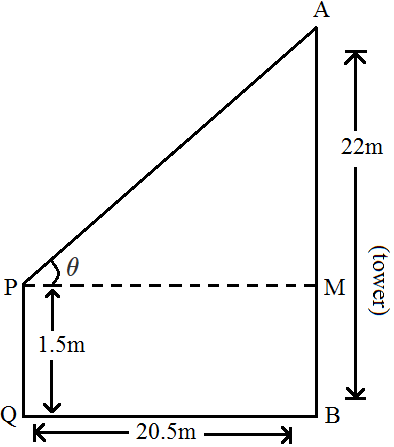
Let the angle of elevation of the top of the tower from the eye of the observe is $\theta.$
Given that, AB = 22m, PQ = 1.5m = MB and QB = PM = 20.5m ⇒ AM = AB - MB = 22 - 1.5 = 20.5m Now, in $\triangle\text{APM},\ \tan\theta=\frac{\text{AM}}{\text{PM}}=\frac{20.5}{20.5}=1$ $\Rightarrow\ \tan\theta=\tan45^\circ$ $\therefore\ \theta=45^\circ$ Which may be either positive or negative. Hence, required angle of elevation of the top of the tower from the eye of the observer is 45º.
View full question & answer
Question 175 Marks
Prove that $\frac{1+\sec\theta-\tan\theta}{1+\sec\theta+\tan\theta}=\frac{1-\sin\theta}{\cos\theta}.$
Answer
Recall identity $\sec^2\theta-\tan^2\theta=1$
LHS $=\frac{1+\sec\theta-\tan\theta}{1+\sec\theta+\tan\theta}$
$=\frac{\sec^2\theta-\tan^2\theta+\sec\theta-\tan\theta}{1+\sec\theta+\tan\theta}$
$=\frac{(\sec\theta-\tan\theta)(\sec\theta+\tan\theta)+(\sec\theta-\tan\theta)}{1+\sec\theta+\tan\theta}$
$[\because\text{a}^2-\text{b}^2=(\text{a}-\text{b})(\text{a}+\text{b})]$
$=\frac{(\sec\theta-\tan\theta)[\sec\theta+\tan\theta+1]}{(\sec\theta+\tan\theta+1)}$
$=\sec\theta-\tan\theta$
$=\frac{1}{\cos\theta}-\frac{\sin\theta}{\cos\theta}$
$=\frac{1-\sin\theta}{\cos\theta}=$ RHS
Hence, proved.
View full question & answer
Question 185 Marks
A window of a house is h metres above the ground. From the window, the angles of elevation and depression of the top and the bottom of another house situated on the opposite side of the lane are found to be $\alpha\text{ and }\beta,$ respectively. Prove that the height of the other house is h $(1+\tan\alpha\cot\beta)$ metres.
Answer

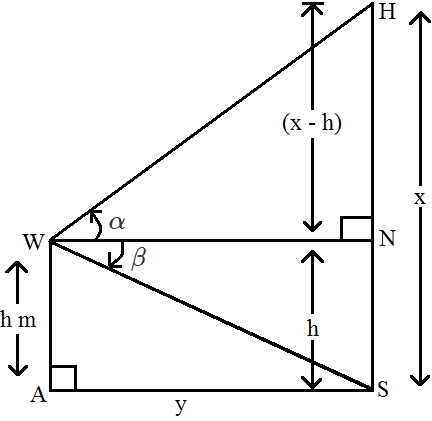
Window W, h m above the ground point A, another house HS = x(m), AS = y m away from observation window, AS = WN = y(let), NS = h, HN = (x - h).
Angle of elevation and depression of top and bottom of house HS from window W are $\alpha,\beta$ respectively.
In right angled $\triangle\text{WNS},$
$\tan\beta=\frac{\text{h}}{\text{y}}$
$\Rightarrow\ \text{y}=\frac{\text{h}}{\tan\beta}\ \ ...(\text{I})$
Now, in right angled $\triangle\text{HNW},$
$\Rightarrow\ \tan\alpha=\frac{\text{x}-\text{h}}{\text{y}}$
$\Rightarrow\ \text{y}\tan\alpha=\text{x}-\text{mh}$
$\Rightarrow\ \frac{\text{h}\tan\alpha}{\tan\beta}=\text{x}-\text{h}\ \ [\text{From (I})]$
$\Rightarrow\ \text{h}\tan\alpha=\text{x}\tan\beta-\text{h}\tan\beta$
$\Rightarrow\ \text{x}\tan\beta=\text{h}\tan\alpha+\text{h}\tan\beta$
$\Rightarrow\ \text{x}=\frac{\text{h}(\tan\alpha+\tan\beta)}{\tan\beta}$
$\Rightarrow\ \text{x}=\text{h}\Big[\frac{\tan\alpha}{\tan\beta}+\frac{\tan\beta}{\tan\beta}\Big]$
$\Rightarrow\ \text{x}=\text{h}[\tan\alpha\cdot\cot\beta+1]$
Hence, the height of the house on the other side of the observer is $\text{h}[1+\tan\alpha\cdot\cot\beta]\text{m}.$
View full question & answer
5 Marks Questions - Maths STD 10 Questions - Vidyadip