Question
If $2 \log x + 1 = \log$ $360$, find: $\log (3 x^2 - 8)$

Answer

$\log \left(3 x^2-8\right) $
$2 \log x+1=\log 360 $
$\Rightarrow \log x^2+\log 10=\log 360 $
$\Rightarrow \log \left(10 x^2\right)=\log 360 $
$\Rightarrow 10 x^2=360 $
$\Rightarrow x^2=\frac{360}{10}=36 $
$\Rightarrow x=\sqrt{36}= \pm 6$
As negative value is rejected,
$\therefore x =6 $
$\therefore \log \left(3 x ^2-8\right) $
$=\log \left\{3(6)^2-8\right\} $
$=\log (108-8) $
$=\log 100 $
$=\log 10^2 $
$=2 \log 10 $
$=2 \times 1$
$= 2.$

Need a full question paper?

Generate a complete, print-ready paper with questions like this in minutes — across 16+ boards, with answer keys.

Start Generating Free

Similar questions

In a two$-$digit number, the sum of the digits is 7$$. The difference of the number obtained by reversing the digits and the number itself is $9$. Find the number.
Calculate man of the following: $4, 6, 6, 6, 7, 7, 7, 7, 8, 8, 9, 9, 11, 3$
Case Study III: Tanusha went to a bank to withdraw money. She asked the cashier to give her ₹100 and ₹ 500 notes only. The cashier agreed. Tanusha got x, 100-rupee notes and y, 500-rupee notes. Based on the above information, answer the following questions.
1. If Tanusha withdrew ₹ 15,000, then the above information can be represented by the linear equation:
(a) x + 5y = 150
(b) 5x + y = 150
(c) x + 5y + 150 = 0
(d) x + y = 150
2. If she got 54 notes in all, then the above information can be represented by the linear equation:
(a) 100x + 500y = 54
(b) x + y = 54
(c) 500x + 100y = 54
(d) 100x + y = 54
3. If Tanusha withdraws ₹ 16,000, then which of the following combination of notes she may get?
(a) ₹ 500 notes - 30, ₹ 100 notes - 20
(b) ₹ 500 notes - 25, ₹ 100 notes - 25
(c) ₹ 500 notes - 20, ₹ 100 notes - 30
(d) ₹ 500 notes - 30, ₹ 100 notes - 10
4. If she gets twenty 500-rupee notes and twenty five 100-rupee notes, then the amount she withdraws is:
(a) ₹ 10000 (b) ₹ 11000 (c) ₹ 12000 (d) ₹ 12500
5. Can Tanusha withdraw ₹ 10050, under the given conditions?
(a) yes
(b) no
(c) can't say anything
(d) none of these
Find the lateral surface area, total surface area and the volume of the following cylinders: Radius $= 4.2\ cm,$ Height $= 12\ cm$
Simplify the following and express with positive index :$\left[1-\left\{1-(1-n)^{-1}\right\}^{-1}\right]^{-1}$
In a two digit number, the ratio of the digits at the unit's place and the ten's place is $3:2.$ If the digits are reversed, the resulting number is $27$ more than the original number. Find the two digit number.
Calculate the rate percent when $Rs. 28000$ amount to $Rs. 30870$ in $2$ years at compounded annually.
Solve the following equations graphically $:\ 2+\frac{3 y}{x}=\frac{6}{x} , \frac{6 x}{y}-5=\frac{4}{y}$
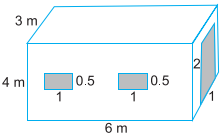
The length, breadth and height of Kavita's bedroom are 6 m, 4 m and 3 m respectively. It has two equal windows, each of dimensions 1 m 0.5 m. It also has a door of dimensions 2 m 1 m.
Image
Based on the above information, answer the following questions:
Q.1. Area occupied by the door and the two windows is:
(a) $1 m^2$ (b) $2 m^2$ (c) $2.5 m^2$ (d) $3 m^2$
Q.2. Kavita wants to whitewash the four walls of the room. Area to be whitewashed is:
(a) $60 m^2$ (b) $57 m^2$ (c) $55 m^2$ (d) $50 m^2$
Q.3. Square tiles each of side 50 cm are laid on the floor of the room. The number of such tiles laid is:
(a) 100 (b) 98 (c) 96 (d) 72
Q.4. Volume of air contained in the room is:
(a) $72 m^3$ (b) $70 m^3$ (c) $60 m^3$ (d) $52 m^3$
Q.5. The length of the longest rod (to the nearest m) that can be placed in the room is:
(a) 4 m (b) 5 m (c) 8 m (d) 7 m
Find the value of $' y\ '$ if $\sqrt{3}=1.723$.Given your answer correct to $2$ decimal places.
https://pg-data.sgp1.digitaloceanspaces.com/chapter_wise/20822/F50.png" alt="Image" width="250" height="">